

Audio By Carbonatix
As Ghana continues to struggle with the devastating effects of perennial flooding, a Canadian-based data scientist is calling for a radical shift in how the nation manages its environment.
Prof. Andy Ohemeng Asare, an assistant professor in data science analytics at the University of Calgary, Canada, is proposing the integration and use of data science and artificial intelligence (AI) as the blueprint to solving the country’s perennial flooding crisis.
Speaking in an exclusive interview with JoyNews from his Canadian base, Prof. Asare observed that traditional methods of managing floods may no longer be sufficient in an era driven by rapid technological advancement and climate unpredictability.
“It is a multi-disciplinary field. It means that it can be applied in all areas. Now our security agencies-in our say disaster management agencies like NADMO, Fire Service- there is a need for extensive training on how they can be more proactive on such situations. You cannot be proactive without using data science.”
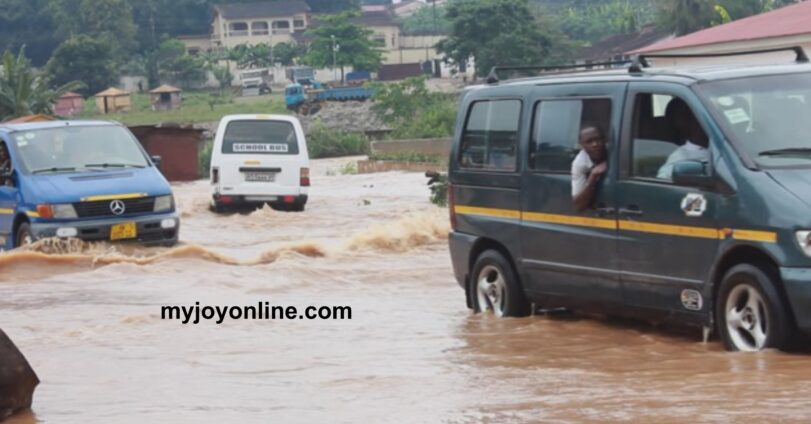
Ghana, over the years, has faced perennial flooding that has led to loss of lives and property.
Understanding the Causes of Flooding
Promises and attempts to solve this have not yielded positive results as human development and climate change continue to drive flooding in major cities.
According to Professor Andy Asare, the world currently generates between 400 and 500 million terabytes of data daily through mobile phones, social media, banking, and business transactions.
He observed the government can harness data and move away from reactive measures by precisely predicting rainfall patterns to know when and how floods occur.
The former student of Agogo State SHS and Tamale Technical University student believes the antidote to solving what appear to be complex national challenges, such as floods, lies in a data-based approach and how data can be used to make informed decisions.
“When I travelled to University of Cape Coast 2-years ago, as part of the proposal was for us to come up with a new program that is Environmental Analytics. So the Environmental Analytics is whereby students now get opportunity to collect data sets, right, pertaining to let's say natural disasters, areas of disaster, all of that, and then sit down, analyze, and say, okay, which areas in Ghana, which areas in Accra, okay, are prone to flooding?
And what contributes to this whole flooding issues? Is it about the population in these areas? Like pressure on that area? Is it about housing issues? Is it about sanitation issues? Now, without data sets, if you're not able to analyze the, the, the true cause, or the underlying issue of this whole natural disasters happening in Ghana, there's nothing that we can do to fix. And I stand to be corrected, because we need to address the issue from the grassroots,” he said.
“So, and that's where data comes in because whatever decision that you make, whether you want to expand our bridges, or you want to expand our gutters, you want to demolish houses, you know, all of that, you need to base your decision on facts, and the facts will be the numbers that you have.
So, I would say, um, what, what happened few days ago in terms of the flooding in Ghana, to me, we, we can find something good from the bad”. Professor Asare added.
Highlighting the link between data science and artificial intelligence, he said that AI serves as the engine that processes massive amounts of environmental and meteorological data.

Prof Andy Asare is a Assistant Professor in Data Science Analytics, University of Calgary, Canada
With this technology, he noted that Ghana can use AI algorithms to predict things by looking at past rainfall patterns, soil moisture levels, drainage systems, and city layouts.
“On the media, I've seen people complaining that the issue has nothing to do with, um, where structures have been built. Some are complaining that the issue has to do with blockage of drainages in the country.
So if you don't engage stakeholders, if you don't collect data set from stakeholders, you will not be able to understand the root cause of the problem. The flooding issue in Ghana right now has to do with multiple factors. It's not only one problem. People building structures in waterlogged areas, right, where they are not supposed to build, like the Ramsar sites, all of that, it's a factor. Individuals or citizens not being responsible—they throw garbage all over the place. I can only conclude when we'll be able to collect data sets.”
Prof. Asare has over 15-years of experience in teaching data science and analytics in tertiary institutions in Canada, China and Ghana.
He has an upcoming free virtual data science and analytics conference in Ghana on June 27, 2026.
The student-focused conference is driven by Prof. Asare's resolve to help students and professionals globally develop their data science potentials.
This initiative aims to bridge the gap in knowledge and skills, fostering a new generation of data scientists who can tackle local challenges.
Latest Stories
-
Ariana Grande leaves problems at home as her tour hits the UK
7 minutes -
Multiple suspects at large after five shot at Virginia State University, police say
7 minutes -
Three killed as Russia launches fresh aerial attacks across Ukraine
19 minutes -
Boxing: John Laryea disqualified in WBA Featherweight title eliminator
29 minutes -
Hawaii battles strong winds and rain as Hurricane Lala threat looms
53 minutes -
Twelve killed as Polish bus veers off Hungarian motorway
2 hours -
Building Ghana better: Why architects must be at the heart of national development
4 hours -
GMet warns of severe rainstorm across northern Ghana
5 hours -
Semenyo eyes bigger targets after breaking Yeboah’s Ghanaian Premier League record
5 hours -
Health Ministry reviews NDC manifesto commitments
6 hours -
Mfantsipim School @ 150 and Creech’s Mfantsipim Diaries: My First Shock
7 hours -
Labour backs proposed IPEC but demands full involvement in pay reforms
7 hours -
Ashaiman, parts of Accra to face a 15-hour power outage today
8 hours -
Mohammed Baantima Samba retains NPP Northern Regional chairmanship
9 hours -
Qatar denies capturing three Iranian pilots after downing fighter jets
9 hours