

Audio By Carbonatix
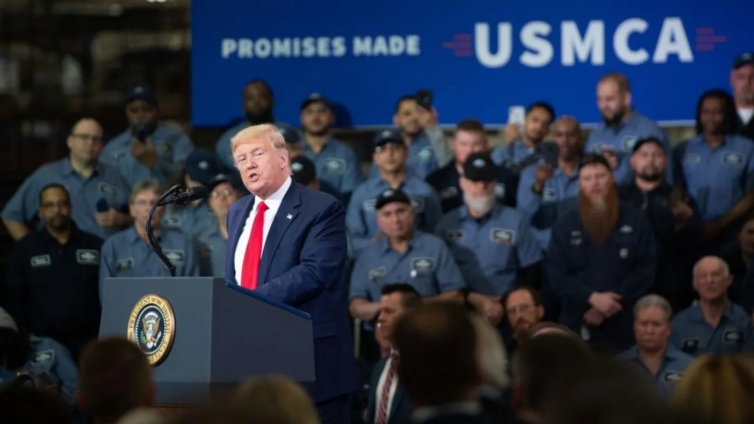
The US has declined to renew the landmark US-Mexico-Canada Agreement (USMCA) in its current form, according to a senior US official.
This decision means the trilateral trade pact will miss out on an automatic 16-year extension.
The official said the administration "chose not to rubber stamp a USMCA renewal without addressing existing issues," and "the United States did not agree to renew the USMCA in its current form".
If the countries fail to unanimously agree to renew the agreement, "it essentially sets a ten-year shot clock to termination," per the official.
Under the pact guidelines, each country must decide whether to renew the agreement for another 16-year term.
While the free trade deal remains in place for now, the lack of a long-term commitment creates fresh economic uncertainty across North America.
The agreement, which underpins around $2tn (£1.5tn ) in trade each year, is facing pressure over unresolved disputes. US trade officials are pushing for major changes before committing to a long-term extension.
Washington has consistently raised concerns over automotive rules of origin, dairy market access, and stopping third-party countries like China from exploiting the regional agreement.
Under the USMCA's original terms, unanimous agreement on an extension would have seen the trade deal kept in place until 2042.
The US opting out will force the nations to meet every year to negotiate changes. Business groups across the continent had called for the pact to be extended. The decision also kicks off a ten-year countdown towards the deal expiring as early as 2036.
The US Chamber of Commerce had warned that sectors such as manufacturing and agriculture rely heavily on cross-border certainty.
However, US domestic trade groups such as the American Iron and Steel Institute and the Steel Manufacturers Association have welcomed the shift, arguing annual reviews give American negotiators leverage to fix parts of the deal.
The friction comes six years after the USMCA entered into force, replacing the 1994 North American Free Trade Agreement (NAFTA).
It updated rules around digital trade, workers' rights, and regional manufacturing, specifically requiring more vehicle parts to be made within North America.
Latest Stories
-
Mr President, Ghana was mentioned at the UN; why aren’t we talking about it?
2 hours -
Accra to convene Africa’s regulators and markets on tokenisation at AVAS 2026
3 hours -
The Paradox of Plenty — When every smartphone becomes a newsroom
3 hours -
GTA sensitises taxi drivers in ‘Know Ghana’ tourism campaign
4 hours -
Archbishop Agyinasare calls for responsible speech amid growing social media abuse
4 hours -
‘It will be inexcusable for gov’t not to honour payment of teachers’ arrears by 30th October’ – Haruna Iddrisu
5 hours -
Forbes’ World’s Best Employers 2026: No Ghanaian firm ranked among 900 companies
5 hours -
Electronic processing of teachers’ data: ‘The decision is the Controller’s’ – GES boss
5 hours -
Teachers’ Strike: Haruna Iddrisu questions paper-based processing of promoted teachers’ data
5 hours -
Savannah Region: Kunfusi bridge collapses again, leaving nearly 4,000 residents cut off
5 hours -
Teachers’ strike: GES targets Monday deadline to submit promotion data to Controller
5 hours -
Inflation to average 11.3% in 2027 – Fitch Solutions
5 hours -
‘I didn’t campaign for NDC to come and do this nonsense’ – Kpebu on EOCO’s conduct
6 hours -
Fitch Solutions maintains policy rate forecast of 14% by December 2026
6 hours -
Diaspora Nasara Caucus congratulates Mohammed Ali Suraj, new NPP executives
7 hours