

Audio By Carbonatix
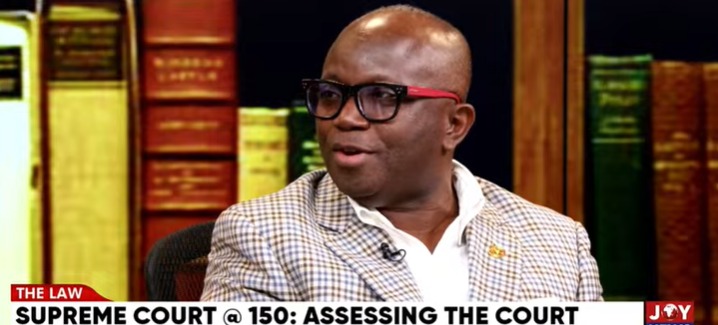
Justice of the Supreme Court, Justice Kweku Tawiah Ackah-Boafo, has said the time has come for Ghana to consider live-streaming some Supreme Court proceedings to improve public access and confidence in the judiciary.
Speaking on The Law on JoyNews on Sunday, July 12, as part of discussions marking the Supreme Court's 150th anniversary, Justice Ackah-Boafo said greater transparency through technology should be explored, although financial and operational challenges must first be addressed.
Responding to a question on whether live streaming should become the standard for major constitutional and appellate cases, he stressed that Ghana's courts are already open to the public.
"I think that in the first place, we have that transparency of the court being a public forum, so that anybody at all can go to the court to view the work of the court," he said.
The programme host noted that many Ghanaians continue to refer to the live broadcast of the 2012 presidential election petition as an example of judicial openness.
He asked whether regular live broadcasts could deepen public confidence or whether they risked turning court proceedings into "theatre".
South Africa's Constitutional Court, which broadcasts all its proceedings live, was also cited as an example.
Justice Ackah-Boafo said different countries have adopted different approaches to balancing transparency with the dignity of the courts.
He explained that the United States Supreme Court does not provide live video coverage but instead offers live audio and later publishes transcripts of proceedings.
"In the United States Supreme Court, they don't show live. They give you audio recording or audio live streaming, so you can listen to the argument by audio. And when they are done, you'll see the transcript online," he said.
He added that Canada and the United Kingdom stream proceedings through their court websites rather than on free-to-air national television.
"The Canadians have live streaming, but it's not on national television. It's on a system they call CPAC… and the UK has something similar, also not on terrestrial television, but on the court's website."
Drawing from those examples, Justice Ackah-Boafo said Ghana should also move in that direction.
"I think that yes, the time has come for us to have maybe live broadcasts of some of these oral arguments," he stated.
However, he said such a move would require investment in the necessary technology and infrastructure.
"If we are to have a website, a webcam that can stream live, that will bring in the money and financial issue," he noted.
Justice Ackah-Boafo also cautioned that live broadcasts should not be introduced without considering how the Supreme Court currently operates.
He observed that, unlike some foreign courts where lawyers are given lengthy periods to present oral arguments, Ghana's Supreme Court handles a heavy caseload, leaving little room for extended courtroom advocacy.
"The workload has also prevented the opportunity for counsel to be on their feet," he said.
He explained that while courts such as Canada's Supreme Court may hear only three cases in a day, with lawyers allocated up to 45 minutes each for oral arguments, Ghana's Supreme Court often hears far more matters.
"If the Supreme Court is assessing 18 dockets a day… what time do you have to do the real work in chambers?" he asked.
Justice Ackah-Boafo also acknowledged concerns that live broadcasts could encourage lawyers to perform for public attention rather than focus on legal arguments.
"In our jurisdiction, people play to the gallery," he said, recalling instances where lawyers appeared more interested in impressing clients than addressing the court.
Despite those concerns, he maintained that live-streaming selected proceedings would be beneficial if the necessary resources became available.
"If we have the financial means, which we don't, we should have the opportunity of live streaming some of these," Justice Ackah-Boafo said.
Latest Stories
-
Outstanding challenges in school placement will be addressed before schools reopen – Education Minister
50 minutes -
Akufo-Addo to attend NPP National Delegates Conference as party begins rebuilding process
55 minutes -
GRA questions GH¢79.65m Servestar Minwax claim, seeks independent audit
1 hour -
PROTOA sets September 21 for indefinite strike over rising transport costs
1 hour -
NPP must unite and rebuild for 2028 – Akufo-Addo
1 hour -
Ex-convict arrested for allegedly posing as soldier and extorting residents in Ashaiman
1 hour -
Diesel could hit GH¢28 without government support – NPA CEO
1 hour -
Four-year water crisis deepens hardship in Agbozume
1 hour -
Denmark, Ghana must deepen green industrial partnership
2 hours -
LEAP new grant rates take effect this month, says Gender Minister
2 hours -
Ghana shifts from advocacy to enforcement on gender equity, disability inclusion
2 hours -
Ho West communities benefit from 2026 big push rural electrification
2 hours -
Dorcas Afo-Toffey pledges to sustain SHS scholarship support in Jomoro
2 hours -
Afo-Toffey Supports 1,000 Jomoro SHS freshers with educational materials
2 hours -
Gender Minister hails Ghana School Feeding Programme
2 hours