

Audio By Carbonatix
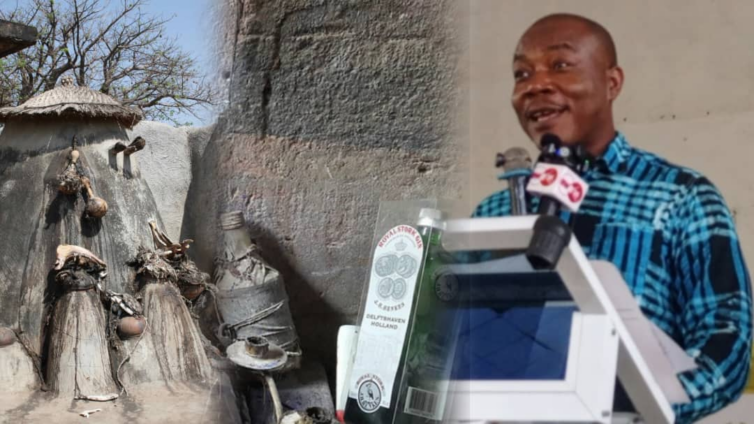
The Ministry of Local Government, Chieftaincy and Religious Affairs has begun efforts to build a national database of shrines, religious sites and their operators as part of measures to improve regulation, planning and recognition of traditional and faith-based institutions.
The Ministry is therefore urging traditional authorities and practitioners to cooperate with the exercise to ensure accurate documentation of Ghana’s spiritual and cultural heritage.
Chief Registrar at the Ministry, Baafi Nsiah, made the appeal at a mass registration, licensing and sensitisation programme for traditional, indigenous and faith-based healing practitioners in the Ashanti Region.
He said the exercise was necessary to help the government understand the scope and nature of traditional and faith-based practice across the country.
“There is no cause for alarm. The aim is simply to determine the number of shrines and other religious sites nationwide. We will therefore need the cooperation of traditional authorities and practitioners to ensure accurate data collection,” he said.
Mr Nsiah acknowledged that identifying and documenting shrines could be complex because some are housed in permanent structures while others are located at natural sites.
He said the database would also help identify shrines and religious sites with historical and cultural significance that could be developed as tourist attractions.
According to him, this would help preserve Ghana’s spiritual heritage while creating opportunities for education and tourism.
“Beyond documentation, we want to protect these spaces and use them as avenues to promote our culture and heritage to the next generation,” he said.
Mr Nsiah added that the Ministry would work with traditional authorities, tourism stakeholders and local assemblies to ensure that selected sites are properly conserved and presented in a manner that respects their sanctity.
Traditional healers undergo registration and licensing
The event was organised by the Trado-Afrikan Faith Healers Association in collaboration with the Ministry of Local Government, Chieftaincy and Religious Affairs and the Traditional Medicine Practice Council.
Held at the Kumasi Centre for National Culture, the programme was on the theme: “Building a Recognised and Regulated Traditional Healing Sector in Ghana.”
Hundreds of practitioners attended to register, receive licences and be sensitised on regulatory requirements and best practices.
Participants welcomed the initiative, describing it as an important step towards greater recognition, regulation and legitimacy for practitioners who have historically operated outside formal structures.
Registrar and Chief Executive Officer of the Traditional Medicine Practice Council, Dr Yakubu T. Yusuf, said the registration and licensing exercise formed part of the government’s broader efforts to formalise and regulate the traditional healing sector.
He said the process was intended to protect public health, eliminate unqualified practitioners and support the proper integration of traditional medicine into the national healthcare system.
Dr Yusuf cautioned that practising without a valid licence is an offence under the Traditional Medicine Practice Act.
He said offenders could face a fine of up to 500 penalty units, a prison term of up to two years, or both.
“We are not here to witch-hunt anyone. Our goal is to recognise legitimate practitioners, give them legal backing, and ensure that the services they provide are safe for the public,” he said.
He urged traditional and faith-based healers who are yet to register to take advantage of the ongoing exercise to regularise their practice.
Latest Stories
-
Useless Column: Kasoa V8
7 minutes -
SUNU Assurances Ghana LTD extends support to Paediatric Ward of Holy Family Hospital, Techiman
15 minutes -
Newspring Assemblies of God founder to host 2026 HigherLife Breakfast Meeting in Kumasi
16 minutes -
Government targets 100,000 jobs through new care economy programme – Opare-Addo
21 minutes -
Religious Affairs Ministry begins national database of shrines, religious sites
33 minutes -
GMA pushes for implementation of port optimisation measures at Tema Port
38 minutes -
Public sector reform must prioritise staff welfare – Civil Service head
42 minutes -
LEAP expansion brings relief to 4,372 more vulnerable residents in Jirapa
49 minutes -
President Ruto’s State backing fuels Nairobi’s historic 2029 World Athletics Championships bid
54 minutes -
Veep commissions five envoys, charges them to advance Ghana’s interests abroad
54 minutes -
19-year-old man jailed 15 years for robbery at Asokore Mampong
57 minutes -
Woman killed, 14 injured after vehicles collide on Accra–Kumasi highway
1 hour -
Regulatory burden threatens SME growth, job creation – ILAPI study
1 hour -
22-year-old man sentenced to 10 years for robbery in Kumasi
1 hour -
EOCO inaugurates new audit committee to strengthen financial oversight
1 hour