


Audio By Carbonatix
The August price floor increase didn't just raise prices at the pump — it exposed which OMCs can absorb margin shocks, and which can't.
THE TRIGGER: AUGUST'S PRICE SHOCK
On 29 July, the National Petroleum Authority published sharply higher indicative price floors for the first pricing window of August 2026. Petrol rose 9.4 percent, from GH¢13.28 to GH¢14.53 per litre. Diesel rose more steeply still — 18.3 per cent, from GH¢14.35 to GH¢16.97. LPG followed with an 8.5 per cent increase. The NPA attributed the move to two converging pressures: Brent crude climbing on renewed U.S.–Iran tensions, and the cedi's continued slide against the dollar.
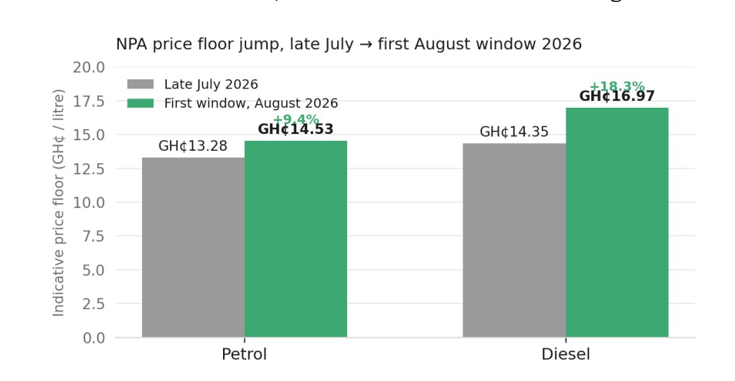
Numbers this size are easy to read as a one-off. We think that is the wrong frame. The more useful question for a Board this quarter isn't "how much more expensive is fuel" — it's "whose cost structure absorbed this shock cleanly, and whose didn't." That is a solvable, company-specific question, and the answer varies enormously across operators of similar size.
THE MACRO SQUEEZE: TWO BLADES OF THE SAME SCISSORS
The August adjustment is not an isolated event — it is the visible edge of a structural currency problem. Ghana's fuel import bill is priced in dollars. In 2025, the cedi appreciated more than 40 percent against the dollar, its first annual gain in nearly 33 years. The performance of the cedi this year has not been anywhere as impressive as it was in 2025 — well behind the strong performance we witnessed last year.
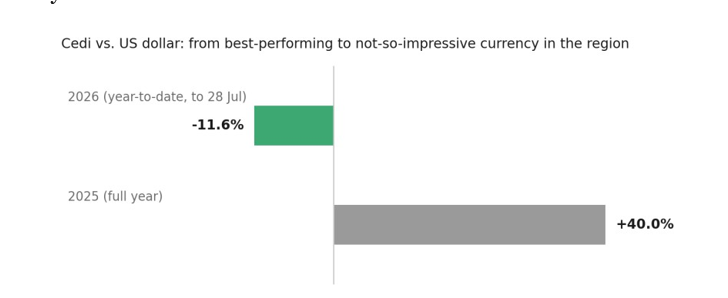
For an operator, this is not an abstract macro story — it is a working-capital story. Every point the cedi moves widens the gap between what a BDC or OMC pays to import product in dollars and what it can recover in cedis before the next pricing window opens. Firms whose forex hedging posture, credit facilities, or supply contracts were built for a stable-cedi environment are now finding that assumption tested in real time.
MARGIN REALITY: WHAT DEREGULATION PROMISED VS. WHAT OMCs ARE LIVING
Deregulation was meant to let efficient, well-run OMCs compete and thrive on service and cost discipline. What is actually happening in parts of the market looks different. Industry voices have been unusually direct about it this year.
"[Many OMCs] significantly reduce their profit margins — or, in some cases, sell at zero or even negative margins — to compete for market share," Michael Bozumbil, CEO, PETROSOL Platinum Energy PLC, June 2026.
Bozumbil went further, warning that some operators sustain artificially low pump prices through practices that themselves threaten the sector's stability — from tax evasion to fuel adulteration.
Whatever the precise scale of that behaviour, the underlying signal is one Boards of OMCs should take seriously: in a market this thin on margin, undisciplined price competition is not a sign of a healthy market working — it is frequently a sign of distress being pushed downstream onto whoever can least afford it.
This is the tension every OMC Board should be sitting with. Deregulation rewards efficient operators. It does not automatically protect against a race to the bottom among operators competing on price alone, with no visibility into who is genuinely cost-competitive and who is simply burning working capital to hold volume.
THE REGULATOR'S HAND: COMPLIANCE AND THE CONSOLIDATION SIGNAL
The NPA has not been a passive observer of these dynamics. Enforcement has come in periodic, sizeable waves — including revocations tied to unapproved station locations and unpaid licence fees - and the pattern recurs often enough that compliance is better understood as an active, ongoing enforcement environment than a one-time hurdle cleared at licensing.
At July's Ghana International Petroleum Conference (GhIPCon 2026) in Accra, NPA Chief Executive Godwin Edudzi Tamakloe was explicit about where the regulator wants the sector to go:
"Resilience is not built overnight. It requires continuous investment in infrastructure, technology, human capital and systems that allow us to respond effectively to changing global dynamics... Our goal is to create a downstream sector that is competitive, sustainable and attractive to investment while ensuring that consumers are protected," Godwin Edudzi Tamakloe, Chief Executive, National Petroleum Authority, GhIPCon 2026
Read plainly, this is consolidation-readiness language from the regulator itself. A sector contributing roughly a tenth of Ghana's GDP, under active enforcement, and being pushed publicly toward "resilience" and "investment attractiveness" is a sector where scale, compliance infrastructure, and balance-sheet strength are becoming competitive advantages in their own right not just operational hygiene.
WHAT THIS MEANS FOR THE NEXT TWELVE MONTHS — OUR HOUSE VIEW
Margin volatility of this severity will accelerate consolidation among sub-scale OMCs. The operators most exposed are not necessarily the smallest by volume, but those with the thinnest working-capital buffers relative to their import exposure.
Working-capital discipline — forex hedging posture, supplier credit terms, inventory financing — will separate resilient operators from distressed ones faster than retail volume will over the next few pricing cycles.
Regulatory compliance is shifting from a cost centre to a competitive moat. Operators who treat NPA requirements as a floor to clear will increasingly lose ground to those who treat them as infrastructure to invest in.
Boards that cannot currently model, in real time, what a further price-floor revision does to their cash position are flying blind into a period where that revision is more likely than not.
THE QUESTION EVERY BOARD SHOULD BE ASKING
If the NPA revises price floors again next quarter, do you know today what that does to your cash position — or will you find out when it happens?
Latest Stories
-
Know when to wait, verify and publish – GJA President tells journalist
16 minutes -
“If you think I’m a nobody, so be it” – Presidential aide responds after Disability Graduates reject petition handover
42 minutes -
Rotary Club of Accra Ridge gets new president, vows to create lasting impact
46 minutes -
GJA@77: Free press necessity for nation-building, not luxury – UNESCO Representative
46 minutes -
‘No disrespect to Dr Ayeh but we demand engagement with senior government official’ – Graduates with disabilities
48 minutes -
We can’t defend journalism’s credibility if journalists don’t uphold professional standards – GJA
54 minutes -
Ghana’s Roads of Sorrow: Tankers, dump trucks, and trailers on the country’s deadliest corridors
1 hour -
Beyond the Concert: What BHIM festival London reveals about Ghana’s cultural diplomacy and soft power
1 hour -
Technology must serve journalism, not destroy public trust – GJA President
1 hour -
From Ghana to Wembley: The production story behind Stonebwoy’s BHIM festival London
1 hour -
GJA @77: A nation without credible journalism is walking in the dark – GJA Vice President
1 hour -
Over 500 attend National Mining Dialogue 2026 organised by Asempa FM
2 hours -
State of the downstream: A quarterly briefing on Ghana’s downstream petroleum sector
2 hours -
Hijab-wearing Muslim woman reportedly attacked in north London
2 hours -
Daily Insight for CEOs: Leading Organisational Transformation
2 hours