


Audio By Carbonatix
A Minority Caucus press conference accused the Ghana Gold Board (GoldBod) of GH₵22 billion in losses in 2025.
GoldBod's CEO, Sammy Gyamfi, called it a "barefaced lie," pointing to an audited surplus and no mention of GoldBod losses in the International Monetary Fund (IMF) document.
JoyNews Research examined both IMF reports cited and GoldBod's audited accounts, line by line.
VERDICT:
MINORITY’S CLAIM
MISLEADING: GoldBod did not make a trading loss in 2025; its own audited accounts show a surplus. But the GH₵22 billion figure the Minority cited is real and correctly quoted from the IMF. It is the Bank of Ghana's loss under a gold-purchase programme; GoldBod served only as a paid buying agent, not a loss on GoldBod's own books.
CLAIM BY GOLDBOD CEO
TRUE: Nowhere in either IMF document, not in 47 separate mentions of "GoldBod" across the 182-page Staff Report, and not in paragraph 13 itself, does the IMF say GoldBod caused the loss, or that the loss sits on GoldBod's books.
Ghana's Minority Caucus in Parliament, led by Minority Leader Alexander Afenyo-Markin, publicly held a press conference on 18 August accusing the Ghana Gold Board (GoldBod) of "losing 22 billion Ghana cedis plus in one year," a figure it said came directly from the International Monetary Fund.
A day later, GoldBod's Chief Executive Officer, Sammy Gyamfi, appeared at the Government Accountability Series to reject the claim outright, describing it as "a barefaced lie" and pointing to GoldBod's own audited 2025 financial statements, which recorded a surplus.
Both cannot be right, or can they? JoyNews Research obtained and read in full the two IMF documents both sides have referenced: the Sixth Review Staff Report (IMF Country Report No. 26/212) and its companion Selected Issues Paper (Country Report No. 26/213, "Lessons from the Bank of Ghana's Domestic Gold Purchase Programme")—alongside GoldBod's Auditor-General-certified 2025 accounts.
Here is what they show.
The claim: "GoldBod losses" of GH₵22 billion
At the press conference, the Minority's central figure was unambiguous: a loss of US$1.7 billion, or roughly GH₵22 billion, in 2025 alone, about 1.5 percent of Ghana's entire GDP.
“The head of an institution accused of losing 22 billion Ghana cedis plus in 1 year should not be talking about our tone. He should be talking about his ledger.” — Minority Caucus press conference, 18 August 2026
The Minority went further, quoting what it said was paragraph 13 of an IMF report verbatim: that the loss was "a combination of service and assay fees paid to Gold Board, discount on gold sold to off-takers... and, most importantly, exchange rate losses from the spread between Forex Bureau rate paid to purchase gold and the CD reference rate used for BOG accounting."
JoyNews Research traced this exact quotation to paragraph 13 of the IMF Selected Issues Paper (Country Report 26/213), published in August 2026. It matches almost word-for-word.
The paragraph, reproduced below, does exist and does say what the Minority quoted it as saying.
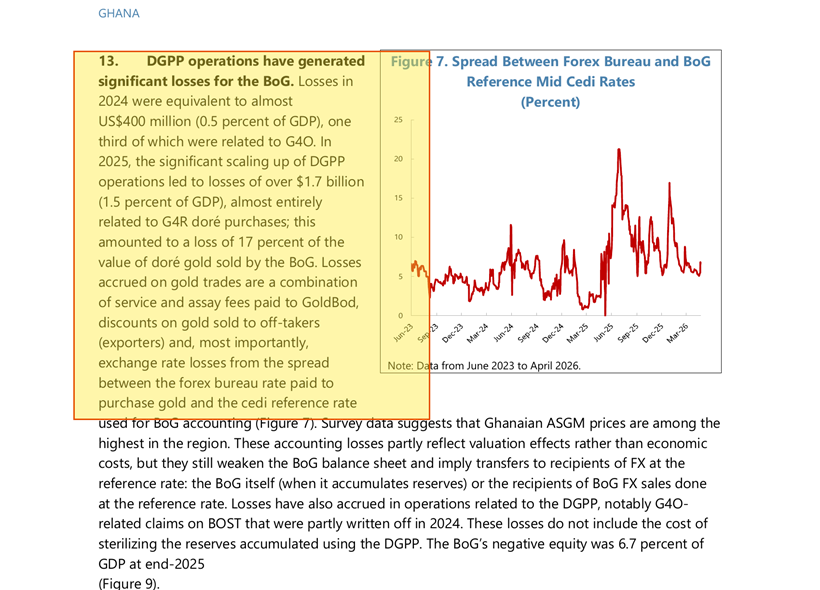
The figures check out. The IMF confirms that Domestic Gold Purchase Programme (DGPP) losses rose from roughly US$400 million in 2024 to "over $1.7 billion (1.5 percent of GDP)" in 2025, a loss equal to 17 percent of the value of the gold the programme sold. The companion Staff Report separately confirms Ghana's central bank, the Bank of Ghana, ended 2025 with negative equity of GH₵93.8 billion, or –6.7 percent of GDP, which the Minority also cited accurately.
The catch: Whose loss is it?
Here is where the Minority's framing runs into trouble. Nowhere in either IMF document, not in 47 separate mentions of "GoldBod" across the 182-page Staff Report, and not in paragraph 13 itself, does the IMF say GoldBod caused the loss, or that the loss sits on GoldBod's books.
Paragraph 13 explicitly attributes it to "the BoG": "DGPP operations have generated significant losses for the BoG," the paper states, before listing GoldBod's fees as only one of three contributing components, alongside off-taker discounts and, "most importantly," the exchange-rate spread between the price gold was bought at and the rate used for the central bank's own accounting.
This is the crux of GoldBod's rebuttal, and on this narrow point, it is accurate.
“No where in the under-referenced IMF reports is the GoldBod accused as having caused losses incurred by the Bank of Ghana under the Bank's DGPP... I challenge Afenyo Markin to point to any page, paragraph, sentence or phrase.” — Sammy Gyamfi, GoldBod CEO, 19 August 2026
What the IMF report actually says:
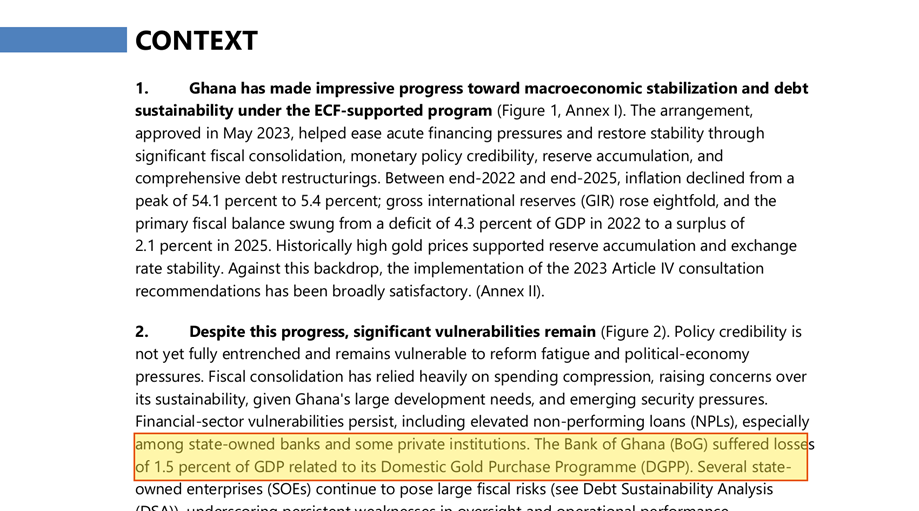
The IMF's own account of the institutional history supports this. GoldBod was established only in April 2025 and spent that year as a fee-earning buying agent for the Bank of Ghana's Domestic Gold Purchase Programme, paying an assay fee of 0.258 percent and a service fee of 0.5 percent, a combined 0.758 percent, GoldBod says is "a paltry" share of the 17 percent loss.
It did not take over full ownership of the programme, including its trading and pricing risk, until GoldBod's expanded trade model began in April 2026 and a formal memorandum of understanding transferred the programme from the Bank of Ghana in July 2026, well after the 2025 losses in dispute.
What GoldBod's own books show
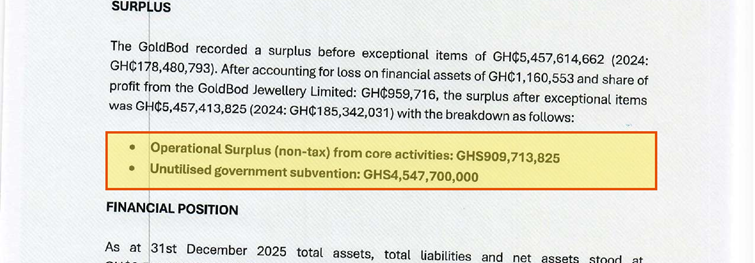
GoldBod's audited financial statements for the year ended 31 December 2025, signed off by the Auditor-General with an unqualified "true and fair view" opinion and no adverse findings, show a surplus of GH₵5,443,990,347, up from GH₵185,342,031 in 2024. On the face of it, this appears to settle the matter.
It is more complicated than the headline figure suggests. GoldBod's own notes to the accounts disclose that GH₵4.5477 billion of that surplus is an unutilised government capital subvention, a cash injection to fund gold-purchasing operations, not trading revenue.
Strip that out, and GoldBod's core operating surplus from fees was GH₵909.7 million (or GH₵896.29 million, per the notes' own "without subvention" comparison). That is still a surplus, not a loss, so GoldBod's central claim holds, so presenting the full GH₵5.44 billion figure as trading profit overstates the picture by roughly fourfold.
So, did GoldBod make a loss?
No. On its own corporate books, audited and certified without qualification, GoldBod recorded a surplus in 2025, both including and excluding the government subvention. That claim is verifiably true.
But the Minority was not simply inventing a number. The GH₵22 billion / US$1.7 billion figure is real, is correctly quoted from the IMF almost word-for-word, and represents a genuine and serious loss, just one that sits on the Bank of Ghana's balance sheet under a programme GoldBod administered for a fee, not one GoldBod incurred itself.
Both sides are technically correct about the number they are each choosing to emphasise; the dispute is really about attribution, not arithmetic.
The IMF itself frames this as a live governance concern rather than a settled question of blame. It calls, in the same reports both sides are citing, for GoldBod to further reduce costs, which had already fallen from roughly 14–15 percent of gold purchased in 2025 to around 11–12 percent by early 2026, against a 5 percent target, and for "increased transparency" and "strengthened safeguards" around the programme going forward.
An external audit of the DGPP "from its inception" was under way at the time of the IMF's review, with results expected in the third quarter of 2026, the outcome most likely to settle, definitively, how the loss should be apportioned between the institutions involved.
THE BOTTOM LINE: GoldBod did not make a loss. The Bank of Ghana did, under a programme GoldBod worked for. Both the Minority's headline figure and GoldBod's claim of no losses are, read narrowly, true, which is precisely why the two sides have been talking past each other.
Latest Stories
-
Temporary control room leaves Ghana’s power system vulnerable — Energy Ministry
34 seconds -
Ghana’s NGOs should strengthen local government, not replace it
6 minutes -
Former Liberian vice-president charged in drug-trafficking probe
15 minutes -
Mahama targets 700 Saglemi housing units for completion by March 2027
28 minutes -
Titus-Glover campaign team members injured in accident near Dambai
42 minutes -
Eight projects win €2m Ghana grants for vaccine and drug research
53 minutes -
Ghana steps up Ebola surveillance amid rising cases in Africa
1 hour -
Acting Rent Control Commissioner directs landlords, hostel operators to issue rent cards
1 hour -
Nsawam Prison to host Teacher Licensure Examination for inmates for first time
1 hour -
IES demands stronger safeguards amid temporary Akosombo power arrangement
1 hour -
Four workers dead after being hit by train in Japan
1 hour -
Fact-check: Did GoldBod make a loss in 2025? Here’s what the records show
2 hours -
Rev. Adzraku Kevi calls for more women in leadership
2 hours -
Dagbon Kingdom suspends Damba Festival to honour late Overlord
2 hours -
Harry and Meghan’s UK security arrangements remain a ‘private matter’ – Andy Burnham
2 hours