

Audio By Carbonatix
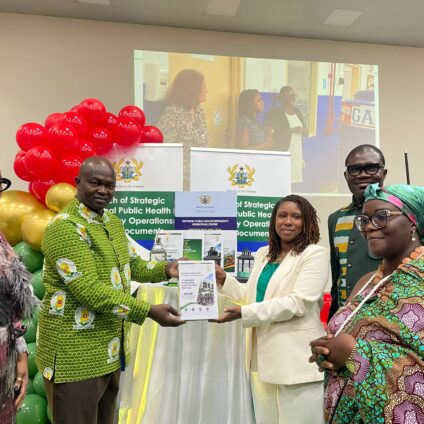
The Ghana Health Service (GHS) has launched a new Public Health Emergency Operations Centre (PHEOC) framework to strengthen Ghana’s preparedness and response to disease outbreaks and other public health emergencies.
The framework brings together institutions, information, expertise, and resources to enable a more coordinated response when emergencies occur.
Speaking at the launch, GHS Director-General Professor Samuel Kaba Akoriyea said the PHEOC system would provide a platform for coordinated action without taking over the statutory responsibilities of other institutions.
“Importantly, the PHEOC does not replace the statutory mandates of other institutions. Rather, it provides a platform through which their mandates, capabilities, information and resources can be brought together to support coordinated public health emergency action,” he said.
Five strategic and operational documents were launched as part of the initiative.
They are the National PHEOC Strategic Plan 2026–2030, National PHEOC Handbook 2026, National PHEOC Standard Operating Procedures, Volume One, National Health Workforce Surge Strategic Plan 2026, and National Public Health Workforce Surge Management Standard Operating Procedures, Volume Two.
Professor Akoriyea said the framework would support Ghana’s implementation of the International Health Regulations 2005, address gaps identified through the Joint External Evaluation and strengthen the country’s broader health security agenda.
The GHS Director-General said the experiences of the Ebola outbreak in West Africa and the COVID-19 pandemic had demonstrated the need for countries to build emergency preparedness before crises occur.
He recalled the isolation of Liberia and Sierra Leone during the 2014 Ebola outbreak and the widespread disruption caused by COVID-19 several years later.
“Barely five years later, in 2019 and 2020, you and I witnessed our world shut down, travel limitations with numerous lockdowns, economic activities reduced to a minimum,” he said.
He said Ghana must draw lessons from those experiences to ensure that future emergencies do not overwhelm the country's response systems.
Professor Akoriyea cautioned that the effectiveness of the framework would ultimately depend on implementation rather than the documents themselves.
“The launch of these documents is not an end in itself. It marks the beginning of the next and more important phase—the phase we call implementation,” he said.
He called on stakeholders to ensure that emergency operations centres remain functional, connected and sustainable.
“Our task now is to move from documents to action, from structures to functionality, and from preparedness on paper to readiness in practice,” he added.
According to him, Ghana's emergency response system must be capable of coordinating action before, during, and after a public health emergency.
“Success is measured by our readiness to coordinate seamlessly when an emergency occurs,” he said.
Professor Akoriyea also stressed the need for public health emergency preparedness to extend beyond the health sector.
He called for stronger collaboration among government institutions, security and emergency services, academia, research institutions, civil society, the private sector and development partners.
“Public health emergency preparedness and response cannot be the responsibility of the health sector alone. It requires connected leadership and strong multisectoral coordination, timely information sharing, clear accountability and collective action,” he said.
The development of the framework involved the Ministry of Health, GHS, regional health directorates, other ministries, departments and agencies, security and emergency services, academia, professional bodies, civil society organisations and private-sector stakeholders.
Development partners, including the United States Centers for Disease Control and Prevention, the World Health Organization, Africa Centres for Disease Control and Prevention, and the Korea International Cooperation Agency, also supported the process.
Professor Akoriyea acknowledged that the newly launched documents would require continuous improvement as Ghana gains more experience in managing public health emergencies.
“Every book has Edition 1, Edition 2, etc. And it means that there will be setbacks. It’s not going to be perfect, but we are creating the platform for the next generation to take over and develop Edition 2,” he said.
He subsequently declared the national PHEOC documents officially launched and urged stakeholders to translate the framework into practical action.
The GHS believes the initiative will strengthen Ghana's ability to detect, coordinate and respond to future health emergencies while building a more resilient national health security system.
Latest Stories
-
NPP sets August 31 to September 3 for vetting of national officer aspirants
49 minutes -
Can Chairman Wontumi contest NPP National Chairman?
52 minutes -
NPP 2026 National Officers Elections: Nomination window ends with 50 aspirants in race for nine positions
1 hour -
Labadi Beach Hotel marks 35 years with plans for new investments and developments
1 hour -
Was Afenyo-Markin’s GoldBod criticism justified or exaggerated?
1 hour -
Energy Commission, Ghana Hotels Association train Bono East hoteliers on energy efficiency
1 hour -
NSMQ 2026: Boa Amponsem roars into one-eighth as Berekum SHS, Bolgatanga Girls’ bow out from prelims
1 hour -
NSMQ 2026: Asanteman SHS books one-eighth spot as Senya SHS’s 2nd bid ends in heartbreak
2 hours -
GHS unveils new framework to improve Ghana’s preparedness for health emergencies
2 hours -
Suspected robber crashes stolen taxi into traders while fleeing mob at Ejisu
2 hours -
NSMQ 2026: Kumasi Academy secures one-eighth spot after commanding win over Bueman SHS, Hohoe EP SHS
3 hours -
Republic Bank-JoyNews Habitat Fair: Day 2 ends on high note as patrons enjoy exciting discounts
3 hours -
Big Push: Upper West MPs inspect N12 works, optimistic improved roads will curb robberies
3 hours -
India is turning to ancient water systems as modern ones run dry
3 hours -
NSMQ 2026: Anum Presby survive tense battle to deny St. Charles Minor Sem. one-eighth spot
4 hours