

Audio By Carbonatix
The Ghana Health Service (GHS) has launched a new Public Health Emergency Operations Centre (PHEOC) framework to strengthen Ghana’s preparedness and response to disease outbreaks and other public health emergencies.
The framework brings together institutions, information, expertise, and resources to enable a more coordinated response when emergencies occur.
Speaking at the launch, GHS Director-General Professor Samuel Kaba Akoriyea said the PHEOC system would provide a platform for coordinated action without taking over the statutory responsibilities of other institutions.
“Importantly, the PHEOC does not replace the statutory mandates of other institutions. Rather, it provides a platform through which their mandates, capabilities, information and resources can be brought together to support coordinated public health emergency action,” he said.
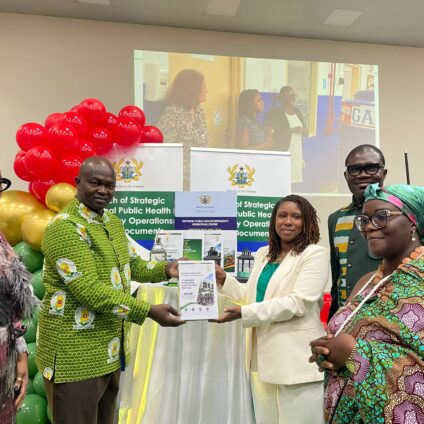
Five strategic and operational documents were launched as part of the initiative.
They are the National PHEOC Strategic Plan 2026–2030, National PHEOC Handbook 2026, National PHEOC Standard Operating Procedures, Volume One, National Health Workforce Surge Strategic Plan 2026, and National Public Health Workforce Surge Management Standard Operating Procedures, Volume Two.
Professor Akoriyea said the framework would support Ghana’s implementation of the International Health Regulations 2005, address gaps identified through the Joint External Evaluation and strengthen the country’s broader health security agenda.
The GHS Director-General said the experiences of the Ebola outbreak in West Africa and the COVID-19 pandemic had demonstrated the need for countries to build emergency preparedness before crises occur.
He recalled the isolation of Liberia and Sierra Leone during the 2014 Ebola outbreak and the widespread disruption caused by COVID-19 several years later.
“Barely five years later, in 2019 and 2020, you and I witnessed our world shut down, travel limitations with numerous lockdowns, economic activities reduced to a minimum,” he said.
He said Ghana must draw lessons from those experiences to ensure that future emergencies do not overwhelm the country's response systems.
Professor Akoriyea cautioned that the effectiveness of the framework would ultimately depend on implementation rather than the documents themselves.
“The launch of these documents is not an end in itself. It marks the beginning of the next and more important phase—the phase we call implementation,” he said.
He called on stakeholders to ensure that emergency operations centres remain functional, connected and sustainable.
“Our task now is to move from documents to action, from structures to functionality, and from preparedness on paper to readiness in practice,” he added.
According to him, Ghana's emergency response system must be capable of coordinating action before, during, and after a public health emergency.
“Success is measured by our readiness to coordinate seamlessly when an emergency occurs,” he said.
Professor Akoriyea also stressed the need for public health emergency preparedness to extend beyond the health sector.
He called for stronger collaboration among government institutions, security and emergency services, academia, research institutions, civil society, the private sector and development partners.
“Public health emergency preparedness and response cannot be the responsibility of the health sector alone. It requires connected leadership and strong multisectoral coordination, timely information sharing, clear accountability and collective action,” he said.
The development of the framework involved the Ministry of Health, GHS, regional health directorates, other ministries, departments and agencies, security and emergency services, academia, professional bodies, civil society organisations and private-sector stakeholders.
Development partners, including the United States Centers for Disease Control and Prevention, the World Health Organization, Africa Centres for Disease Control and Prevention, and the Korea International Cooperation Agency, also supported the process.
Professor Akoriyea acknowledged that the newly launched documents would require continuous improvement as Ghana gains more experience in managing public health emergencies.
“Every book has Edition 1, Edition 2, etc. And it means that there will be setbacks. It’s not going to be perfect, but we are creating the platform for the next generation to take over and develop Edition 2,” he said.
He subsequently declared the national PHEOC documents officially launched and urged stakeholders to translate the framework into practical action.
The GHS believes the initiative will strengthen Ghana's ability to detect, coordinate and respond to future health emergencies while building a more resilient national health security system.
Latest Stories
-
Mobile Money Fintech LTD, UMB train hairdressers and beauticians
3 hours -
Asylum votes show people want help, says Kemi Badenoch
4 hours -
Badenoch welcomes expanded grooming gangs inquiry
4 hours -
GACL MD sues Samuel Buabeng over alleged Facebook defamation
4 hours -
Christa Pike in critical condition after surviving two lethal injections, lawyer says
4 hours -
Kemi Badenoch backs face covering ban at protest
4 hours -
Man City not ‘above the rules’, says No 10 after backlash to Burnham remarks
4 hours -
Real Madrid submit ‘substantial’ dossier in Barca payments case
4 hours -
Messi completes purchase of second Spanish club
5 hours -
Government must engage horticulturists on tomato crisis – GhIH
5 hours -
King Promise’s ‘Can’t Tame Us’ becomes official Chelsea anthem
5 hours -
Afenyo-Markin demands Baffour Awuah’s release from EOCO’s custody, end to alleged political intimidation
5 hours -
Rapper Rick Ross arrested on domestic violence charges
5 hours -
Minority demands security review of Ghana-Colombia visa waiver and port deals
5 hours -
Pursue drug kingpins, not persecute political opponents – Afenyo-Markin tells EOCO
5 hours