

Audio By Carbonatix
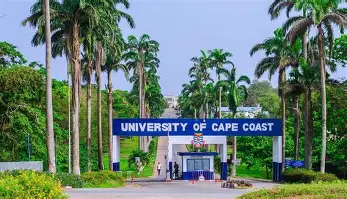
The University of Cape Coast (UCC) has officially launched the Africa Ocean Institute (AOI), a multidisciplinary platform aimed at advancing ocean knowledge, developing innovative solutions, and promoting the sustainable management of Africa’s coastal and marine resources.
The launch, held at the Academic Board Chamber on the UCC campus, was presided over by the vice-chancellor, Professor Denis Worlanyo Aheto.
The Registrar of the School, Gideon Abbeyquaye, Esq., said African coastal and marine ecosystems were facing several interconnected challenges.
“African coastal and marine ecosystems are confronted by the combined challenges of climate change, biodiversity loss, and pollution alongside illegal fishing, maritime insecurity, and the unsustainable exploitation of marine resources.”
The launch marks the culmination of decades of work and vision in coastal management at UCC, dating back to the 1990s.
In 1996, the university was identified as a forerunner of institutional advancement in integrated coastal management. This led to the establishment of a dedicated team to build awareness and capacity around coastal areas.
Although the initial effort was later interrupted, the idea continued to develop and has now culminated in the establishment of the Africa Ocean Institute.
Bringing together expertise
Professor Denis Worlanyo Aheto said the idea for the institute had its roots in discussions held years ago.
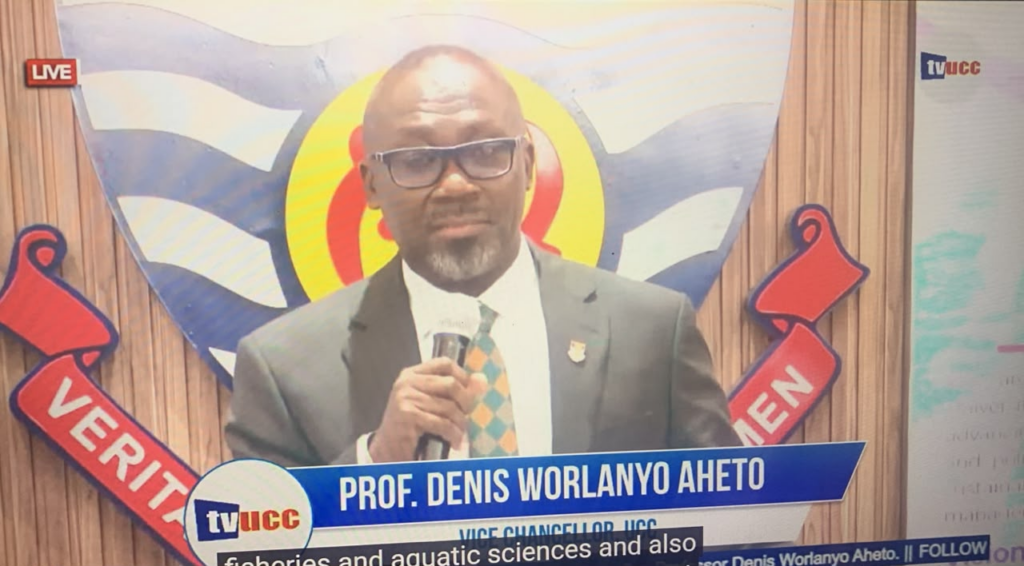
“The idea of this AOI, the discussion actually started in the corridors of Dakar…”he said.
The AOI has been established as a multidisciplinary, science-based institutional platform that brings together the complementary expertise UCC has developed over the years.
The institute has been designated as a graduate training hub and will operate alongside other prominent institutes within the university, including the Institute of Education Planning and Administration and the Institute for Development Studies.
The strength of the AOI lies in bringing together three distinct but interconnected university entities.
They are the Centre for Coastal Management, a World Bank Africa Centre of Excellence in Coastal Resilience; the Department of Fisheries and Aquaculture Science, which serves as an African Union Centre of Excellence for Training in Marine Fisheries and Coastal Zone Management; and the newly established Centre for Marine Affairs.
The Centre for Coastal Management provides specialised knowledge in climate change, biological and coastal development and related areas.
The Department of Fisheries and Aquaculture Science provides the academic foundation through its expertise in fisheries, aquatic sciences, aquaculture and related fields.
The Centre for Marine Affairs contributes expertise in policy, governance, law and outreach, with a focus on the blue economy, ocean law, ocean governance and the relationship between marine resources, society and development.
Together, the three entities are expected to provide a holistic approach to ocean studies.
Focus on Africa’s blue economy
The establishment of the institute is driven by the need to harness the opportunities presented by Africa’s oceans while addressing the challenges facing coastal and marine resources.
Its mission is to “advance ocean knowledge, inspire solutions, and transform Africa’s Blue Future.”
The blue economy represents a significant economic opportunity for the continent, with activities estimated to generate between US$296 billion and US$300 billion annually and support approximately 50 million jobs.
Fisheries alone contribute an estimated 10 million tonnes of catch annually. If the catch were processed locally, it could potentially increase Africa’s gross domestic product by US$50 billion each year.
The potential of the blue economy is particularly important given Africa’s geography. Of the continent’s 54 countries, 32 are coastal states, with many national capitals strategically located along the coast.
The blue economy has consequently become an increasingly prominent part of Africa’s development agenda.
Research and training
The AOI is expected to provide an international platform for innovative, demand-driven and interdisciplinary research.
It will also focus on training scientists, professionals, and practitioners to address the continent’s coastal and marine challenges.
Ultimately, the institute is dedicated to promoting the sustainable management of physical coastal and marine resources.
Through this approach, the Africa Ocean Institute seeks to help Africa harness the wealth of its oceans while preserving those resources for generations to come.
Latest Stories
-
Black Star International Film Festival announces 2026 official selection, with films from 11 countries
24 minutes -
Freedom worth fighting for: Ukraine marks 35 years of independence
27 minutes -
Minority files fresh motion seeking parliamentary probe into reported $1.7bn GoldBod loss
31 minutes -
Justin Kodua urges delegates to endorse him ahead of October polls
33 minutes -
Government eases Bawku motorbike restrictions from August 25
35 minutes -
Jeffrey Nortey honoured for digital influence at National ICT Week 2026
35 minutes -
Minority challenges Gyamfi to substantiate extortion allegations against Afenyo-Markin
42 minutes -
OSP acknowledges three petitions linked to Afenyo-Markin-Gyamfi dispute
43 minutes -
Iran faces ‘greatest financial offensive ever’, says US treasury secretary
44 minutes -
Amansie West Assembly inaugurates road safety committee to curb crashes
44 minutes -
NLA urges local union to halt strike, return to negotiation table over pay dispute
56 minutes -
Four arrested over murder of South African boxing champion Zolani Tete
1 hour -
UG students urged to acquire practical skills to drive AfCFTA implementation across Africa
1 hour -
The GoldBod Riddle: When everyone’s numbers are right, who do we believe?
1 hour -
Immigration officer dead, police officer critically injured in fatal crash at Assin Fosu
1 hour