

Audio By Carbonatix
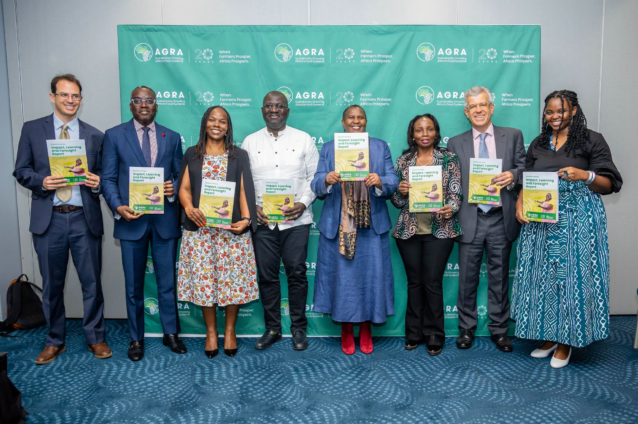
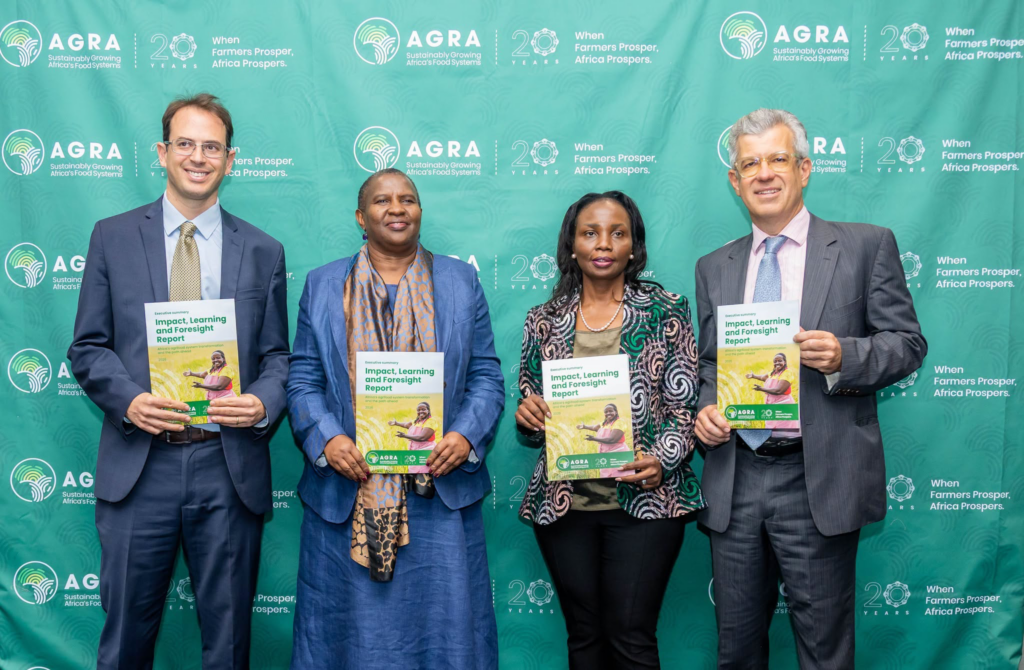
Africa’s food systems must be judged by what farmers earn, a new Impact, Learning and Foresight Report published by AGRA has said.
The report says that while Africa has made significant progress in strengthening its agrifood systems over the past two decades, more work is needed to transform the continent’s food systems.
The report titled “Africa’s agrifood system transformation and the path ahead” draws on two decades of evidence and learning, and was commissioned to mark 20 years of AGRA’s work on the continent.
It draws on independent evaluations, outcome assessments, published research and consultations with governments, funders, researchers and private-sector actors, supplemented by AGRA’s own monitoring data.
Established in 2006 with former Ghanaian UN Secretary-General Kofi Annan as its first board chair, AGRA is a pan-African institution focused on scaling agricultural innovations that help small-scale farming enterprises increase incomes, improve livelihoods, and enhance food security.
The report says that 20 years ago, breeding capacity had been depleted, and there were only about 12 private African seed companies in sub-Saharan Africa, excluding South Africa.
Today, Africa has several hundred national seed companies, averaging about 20 per country.
National agricultural research systems have also been revitalised, while drought-tolerant maize has expanded from approximately 500,000 hectares to about 8.5 million hectares since 2010.
The report says progress has also been recorded in input supply and access. Fertiliser use, which stood at approximately 8 kg per hectare 20 years ago, has increased to between 17 and 22 kg per hectare across the continent—representing more than a twofold increase.
Farmers are increasingly able to access quality inputs within 10 kilometres, compared with distances of more than 15 kilometres in the past.
The emergence of crop- and soil-specific fertiliser blends is also helping to make input use more targeted.
The report also says that agricultural advisory and farming systems have evolved similarly. Twenty years ago, government farm advisory services had been severely constrained following budget reductions in the 1990s, while full-service private advisory models were largely nonexistent.
Today, full-service outgrower models are emerging. More than 33 million farmers are registered to access digital agricultural services, while regenerative and climate-smart agricultural practices are increasingly being scaled.
More than 10 million farming households are now accessing extension and agricultural services through full-service outgrowers.
More progress made
The report says the progress extends beyond the farm gate to offtake and aggregation. Twenty years ago, the midstream of the agricultural sector was largely “hidden,” with many small and medium-sized enterprises unaccounted for or overlooked, while agricultural policy focused overwhelmingly on the farm. Today, SMEs move approximately 65% of food consumed and account for between 30% and 40% of value added in food chains.
Off-farm agrifood employment is also becoming increasingly important, with approximately one in four new labour-market entrants finding employment in agrifood activities. The volume of food moving from rural areas to African cities has grown approximately ninefold, demonstrating the expanding importance of agricultural markets and food distribution systems.
The report says Africa has also made significant progress in regional market access and trade. Twenty years ago, intra-African agrifood trade was valued at about US$5.4 billion, with high trade barriers, no continental agreement, and largely unharmonised rules. Today, the African Continental Free Trade Area is in force, and intra-African agricultural trade has reached approximately US$17 billion. Processed goods now account for about 46% of this trade. Overall, intra-African agrifood trade grew approximately threefold between 2003 and 2023.
Another major change has been the growth of investment and finance in agriculture.
Twenty years ago, agriculture was widely viewed as “unbankable,” with virtually no agriculture-focused private-equity or venture-capital vehicles, blended-finance mechanisms, or specialised investment platforms. Today, the sector is attracting agricultural funds, blended finance and industrial capital. New digital financial mechanisms, including mobile money and e-vouchers, are also emerging. Since 2013, more than US$1.8 billion in venture capital has flowed into African agrifood technology—a market that essentially did not exist 20 years ago.
The report notes there has also been substantial progress in agricultural policy.
Twenty years ago, the Comprehensive Africa Agriculture Development Programme (CAADP) was still new, with few national compacts, investment plans or accountability mechanisms in place. Today, 45 countries have CAADP compacts, alongside 31 national investment plans and four biennial review processes. Variety-release systems, input regulation, digital farmer registries and e-vouchers are increasingly operational. The policy journey has also produced important milestones, including the Abuja Fertiliser Declaration of 2006 and the Nairobi Soil Health Declaration of 2024.
Gains yet to result in transformation
The report, however, acknowledges that the gains have not added up to transformation. Yields have not risen to the required levels, farmers' incomes remain below global averages, and farmers are not yet prospering. Many other actors across agrifood value chains, as well as the institutions and services that enable them, are not yet flourishing either.
The current trajectory will not deliver the Kampala Declaration and CAADP 3.0 targets for 2035. Achieving those targets, and the wider transformation they are designed to advance, will require an integrated agenda and sustained delivery, rather than simply scaling up the current approach.
The report observes that although Africa has not yet achieved the agrifood transformation it needs, measured against where African agriculture stood 20 years ago, and in many respects 40 years ago, there has been important progress and foundation-building.
Latest Stories
-
UN committee says countries must consider reparations for slave trade
11 minutes -
Oil prices rise as latest fighting resurrects Middle East supply disruption risks
20 minutes -
Kenya airport staff strike delays thousands of passengers
29 minutes -
OSP Act lacked checks to rein in Special Prosecutor, Kpebu says
40 minutes -
Public trust crisis around Special Prosecutor is fueling attacks on OSP – Kpebu
59 minutes -
South African airline defends low-altitude aerial stunt over packed stadium
1 hour -
Special Prosecutor needs adult supervision – Martin Kpebu
1 hour -
Africa’s food systems must be judged by what farmers earn – AGRA
2 hours -
Raphinha & Lamine Yamal score twice as Barcelona beat Rayo Vallecano
3 hours -
Everton agree £40m fee for Monaco striker Balogun
3 hours -
Mudryk to Spurs as Chelsea’s Sanchez heads to Como
3 hours -
Saka scores agaian as Arsenal beat Aston Villa
3 hours -
Man City open talks with Chelsea over Enzo Fernandez move
4 hours -
Man City agree £65m deal for Everton’s Ndiaye
4 hours -
Kushner states regret over World Cup sell-off plan
4 hours