

Audio By Carbonatix
Today, Ghana observes Founder’s Day, and while many of us will appreciate the chance to rest, spend time with family, attend an event, or simply step away from our normal routines, I find myself wondering what this day is actually asking of us.
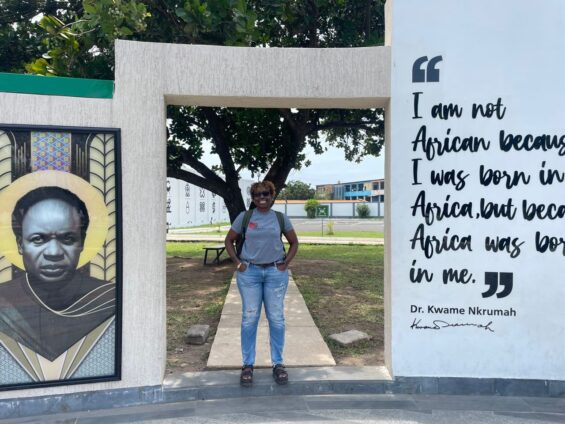
We can post photographs of Osagyefo Dr. Kwame Nkrumah, repeat his words, dress in our beautiful Ghanaian colors, and speak proudly about the history of our independence. But somewhere between remembrance and celebration, we must also honestly examine what we have done with the freedom, responsibility, and possibilities handed to us.
Otherwise, Founder’s Day risks becoming another holiday we celebrate without allowing its meaning to challenge us.
I approach this day from an interesting place because I am both American and Ghanaian. I have experienced Ghana from the outside and now from within, and living here has caused me to examine both identities in ways I probably never would have otherwise.
I can appreciate what other countries have built without believing Ghana must imitate them, and I can love Ghana without pretending that everything here is working as it should. In fact, I believe loving a country requires enough courage to question it, enough commitment to work for it, and enough honesty to acknowledge when we ourselves are contributing to the problems we complain about.
That is what keeps bringing me back to one of Nkrumah’s most enduring declarations: “We face neither East nor West; we face forward.” More than six decades later, those words still demand something from us. Forward was never supposed to mean waiting for someone from the East or West to decide what development should look like for Ghana or Africa.
It was not supposed to mean measuring our worth by the amount of foreign funding we could attract or the number of international organizations willing to validate our ideas. Forward required Africans to imagine, build, govern, produce, educate, innovate, and ultimately take responsibility for Africa.
This does not mean Ghana should close its doors to international partnerships, foreign investment, development assistance, or knowledge exchange. We live in an interconnected world, and there is tremendous value in genuine partnership. However, partnership and dependency are not the same thing, and we have to become much more intentional about recognizing the difference.
Someone contributing a dollar, euro, or pound toward an African initiative should not automatically receive the intellectual authority to determine what our communities need, how our development should proceed, or what success should look like. Financial contribution cannot become a substitute for local knowledge, and generosity should never quietly transform into ownership.
Nkrumah told African leaders in 1963 that, the independence of our separate States is meaningless, unless the whole of Africa becomes free and united. His generation fought for political independence, but ours must continue defining what meaningful independence requires in the twenty-first century.
What does freedom mean if we export raw materials and import expensive finished products made from those same resources? What does it mean if other people own much of the technology we depend upon, control the platforms through which we communicate, hold the capital our entrepreneurs need, and increasingly collect the data that will shape the next generation of artificial intelligence? Political independence gave us the authority to determine our future. It did not guarantee that we would build the systems necessary to secure it.
Our young people are one of the clearest places where that work must happen. We often speak proudly about Africa having one of the youngest populations in the world, but youthfulness by itself is not an achievement.
A young population without quality education, opportunity, mentorship, employment, skills, capital, and meaningful pathways toward ownership can quickly become a frustrated one. We cannot continue telling young people they are the leaders of tomorrow while excluding them from meaningful participation today. If we believe they are our future, then our budgets, institutions, schools, businesses, community organizations, and national priorities should demonstrate that belief.
There are encouraging efforts underway. Under President John Dramani Mahama’s administration, programs including the National Coders Programme, National Apprenticeship Programme, Adwumawura, and investments in research and innovation are attempting to address parts of this challenge.
The 2026 Budget allocated resources to coding and digital skills, apprenticeship training, entrepreneurship, and the Ghana National Research Fund. These investments matter because Ghana cannot talk seriously about competing in a modern global economy while treating research, technical education, entrepreneurship, and digital literacy as optional extras.
Yet government programs alone cannot produce the Ghana we want. A coding program can provide technical knowledge, but it cannot manufacture discipline. An entrepreneurship initiative can provide opportunity, but it cannot guarantee integrity. An apprenticeship can teach a trade, but society must still respect skilled work and create an environment in which that person can build a dignified livelihood.
Government has responsibilities, certainly, but so do families, educators, businesses, professionals, traditional leaders, religious institutions, civil society organizations, communities, and young people themselves. National development cannot be outsourced to the Presidency.
Agriculture presents another test of our seriousness. We have repeated for generations that agriculture is the backbone of Ghana, yet our treatment of farmers does not always reflect the importance we claim they have. The future Ghanaian farmer should not simply be someone working harder with a cutlass.
Agriculture must increasingly involve technology, research, irrigation, climate-smart practices, storage, processing, logistics, financing, branding, manufacturing, data, and access to markets. Farming should be an industry in which a young Ghanaian can see intellectual challenge, innovation, entrepreneurship, and the possibility of building wealth.
The government’s Feed Ghana Programme and broader agricultural transformation agenda are intended to increase domestic production, improve food security, reduce dependence on imports, and strengthen value addition. Ghana is also pursuing greater local cocoa processing, which raises a question we should have been asking for decades: Why are we satisfied with producing raw materials while other countries create substantially more value from what grows beneath our feet?
Cocoa should not leave Ghana as one economic opportunity and return as another country’s finished product, brand, employment opportunity, intellectual property, and profit. The same principle must extend across agriculture and our natural resources if we are serious about building an economy that creates and retains more value at home.
Technology presents an even more urgent version of that challenge. As artificial intelligence transforms economies around the world, I keep asking whether Africa intends to help build this technological future or simply become one of its largest markets. There is a significant difference between using AI and participating in the ownership, research, infrastructure, governance, and development of AI.
If the platforms are built elsewhere, the computing infrastructure is owned elsewhere, the algorithms are designed elsewhere, the intellectual property is registered elsewhere, and African data helps improve systems whose economic value ultimately accumulates elsewhere, we must ask whether we are creating technological independence or introducing a more sophisticated form of dependency.
Our young people therefore need opportunities to do more than use the newest tools. They need opportunities to code, research, engineer, question, design, create, govern, invest, and own. African innovators should also be able to solve African problems without believing that an idea becomes legitimate only after someone outside the continent funds or approves it. International expertise and investment can strengthen what we build, but Africa cannot perpetually be the project while somebody else remains the project manager.
This brings me to the government and the role of citizens. I believe President John Dramani Mahama’s administration is doing important work and pursuing policies that deserve serious attention. The 24-Hour Economy initiative seeks to expand productive activity and employment beyond traditional working hours.
The Big Push is focused on infrastructure. Feed Ghana is addressing agricultural production and food security. Adwumawura and apprenticeship initiatives focus on entrepreneurship and skills development, while investments in research and digital skills recognize the importance of preparing Ghana for a changing global economy. Efforts to strengthen value-for-money oversight in public expenditure are equally important because development is not simply about how much the government spends; it is about whether citizens receive the value they were promised.
Supporting good national policies, however, cannot mean abandoning accountability, just as demanding accountability cannot mean hoping an administration fails because we belong to another political party. Ghana cannot progress if we only want the country to succeed when our preferred party occupies the Presidency.
When a government policy fails, ordinary Ghanaians experience the consequences. When public money is wasted, it is Ghanaian opportunity that disappears. When schools underperform, roads deteriorate, businesses struggle, or young people lose hope, our party colors do not insulate us from the consequences. Political competition has its place in a democracy, but our loyalty to political organizations should never become greater than our loyalty to the country those organizations are competing to govern.
Accountability must also extend beyond politicians. We regularly ask whether the President, ministers, Members of Parliament, and public officials are doing their jobs, but how often do we turn that same question toward ourselves? Are we doing the work we are paid to do? Are we giving people the service they deserve?
Are teachers teaching with commitment? Are contractors building to the standards for which they were paid? Are business owners treating workers fairly? Are public servants actually serving the public? Are professionals mentoring those coming behind them? Are people entrusted with public resources protecting those resources as carefully as they would protect money belonging to their own families? We cannot demand excellence from Ghana while offering mediocrity to Ghana.
There is a powerful statement attributed to Nkrumah: “Action without thought is empty. Thought without action is blind.” Whatever sector we apply those words to, the challenge is clear. Ghana does not suffer from a shortage of conferences, committees, reports, launches, panels, workshops, strategic plans, or beautifully written proposals.
We have discussed our potential extensively. The evidence of our commitment must ultimately become visible in what changes: a child whose opportunities expand, a farmer whose income increases, a young Ghanaian who develops technology and retains ownership of it, a business that grows and creates employment, a community that becomes cleaner, or an institution that functions properly even when nobody important is watching.
For those of us connected to the diaspora, that accountability has another dimension. Ghana cannot simply become the place we love loudly in December. Our relationship with this country must go further than vacations, property ownership, nightlife, investment opportunities, and beautiful declarations about coming home.
If we claim Ghana, then Ghana’s challenges belong to us too. Coming home must eventually mean contributing knowledge, building institutions, creating employment, mentoring someone, investing responsibly, supporting communities, transferring skills, or finding some meaningful way to participate in the country’s development. My American identity has given me perspectives and opportunities for which I am grateful, but my Ghanaian identity continually asks what I am doing with them here.
Perhaps that is what Founder’s Day should really do to us. It should make us uncomfortable enough to examine what we are founding ourselves. Nkrumah’s life and political legacy will continue to be studied, debated, praised, and criticized, as the lives of consequential leaders should be. Yet whatever position one takes on every aspect of his leadership, it is difficult to ignore the magnitude of the question his generation placed before ours: What will Africans do with African freedom?
That question belongs to us now. What will we do with our land, our cocoa, our gold, our intellectual capacity, our culture, our creativity, our technology, our data, and, most importantly, our children? Will we continue waiting for someone else to discover our potential, fund it, validate it, research it, write another report about it, and eventually profit from it? Or will we develop the discipline to transform potential into institutions, products, industries, knowledge, ownership, and opportunities that remain here?
So on this Founder’s Day, I am less interested in simply saying “Happy Founder’s Day” than I am in asking what each of us is founding. What are we building that will outlive us? Who are we teaching and mentoring? What problems are we solving? What institutions are we strengthening? What knowledge are we passing forward?
What are we willing to contribute when nobody is applauding, funding, photographing, or rewarding us? These are not questions reserved for presidents, ministers, CEOs, or wealthy people. They belong to every citizen who expects Ghana to become something greater.
Ghana does not need all hands on deck only when there is something personal or political to gain. Nation-building requires people willing to contribute even when somebody else receives the recognition.
It requires citizens who understand that another Ghanaian’s progress does not diminish their own and that strengthening an institution we may eventually leave is still worthwhile because that institution belongs to the country. It requires those who voted for the government and those who did not, those who live here and those who have returned, those with significant resources and those whose contribution may simply begin with doing their own work exceptionally well.
Nkrumah said, “We face neither East nor West; we face forward.” The more I reflect on those words, the more I wonder whether the most important word in that sentence is not East, West, or even forward. Perhaps it is we. Ghana will not move forward because one President wants it to, and Africa will not move forward because one generation talks about it.
Progress requires the farmer and the programmer, the teacher and the entrepreneur, the government official and the community volunteer, the traditional leader and the young innovator, those living at home and those returning from abroad.
Today, we remember those who dreamed of freedom. Tomorrow, we still have to decide what we are going to do with it. If Founder’s Day means anything beyond a day away from work, perhaps it should remind us that responsibility for Ghana did not end with the generation that founded it. They handed that responsibility forward, and now it is in our hands.
The question is whether we are prepared to carry it.
Latest Stories
-
Ahafo Ano South West DCE laid to rest as Muslims hold final Juma’ah prayers
1 hour -
Ghanaian professor Kofi Akamani shot dead in US; wife arrested
1 hour -
Sammy Gyamfi says 2018 NACOC removal from port inspections weakened drug checks
2 hours -
Greater Accra region accounts for 77% of total secured credit in half-year 2026 – BoG
2 hours -
Founder’s Day: We face forward, but are we moving?
2 hours -
Sheenah Naturals unveils Akuaba Collection at Beauty Inside Out Conference
2 hours -
T-bills: 91-day, 364-day yields to trade slightly higher in second half of 2026
2 hours -
Black Stars: It’s our decision to leave Kudus to recover – Queiroz
2 hours -
Sammy Gyamfi backs Mahama’s directive to restore NACOC’s at ports
2 hours -
Queiroz provides insight into Kudus’ decision to withdraw from Black Stars squad
3 hours -
I’m not changing after 47 Years – Queiroz fires back at critics
3 hours -
Nkrumah Never Dies: Celebrating the visionary who awakened a continent
4 hours -
Hassan Ayariga calls for Ghanaian ownership in strategic investment deals
4 hours -
Black Stars: Thomas-Asante receives late call-up for September-October games
5 hours -
NPP Techiman South demands immediate release of detained Nurse Salomey Awiti Baffoe
5 hours