


Audio By Carbonatix
As part of efforts to inspire the next generation to embrace agriculture and secure the future of the sector, the Sustainable Management Services (SMS) under the auspices of ECOM Ghana has launched the Agriculture Our Future Clubs initiative in basic schools within its operational areas.
The clubs are designed to go beyond classroom learning, exposing pupils to opportunities in agribusiness, science, technology, processing, marketing and entrepreneurship.
So far, the initiative has been rolled out in 40 basic schools across 12 districts within ECOM Ghana’s operational areas. All the clubs have already secured farmlands and commenced cultivation of various crops and rearing livestock.
At the official launch at Old Edubiase in the Adansi North District, the Acting General Manager of Sustainable Management Services (SMS) at ECOM Ghana, Emmanuel Baffoe-Bonnie, explained that the initiative stems from a growing concern in agriculture is the issue of the ageing farmer population in the country.
Citing data from the Ministry of Food and Agriculture, he said the average Ghanaian farmer is 55 years old, but the situation is even worse in cocoa-growing communities, where most farmers are over 50 and young people are increasingly gravitating towards non-agricultural careers, making the future of agriculture uncertain.
According to him, although agriculture remains the backbone of Ghana's economy and many global communities, contributing over 20% of Ghana's Gross Domestic Product (GDP) and employing more than half of its workforce, most young people still do not see it as a profitable and exciting career path.
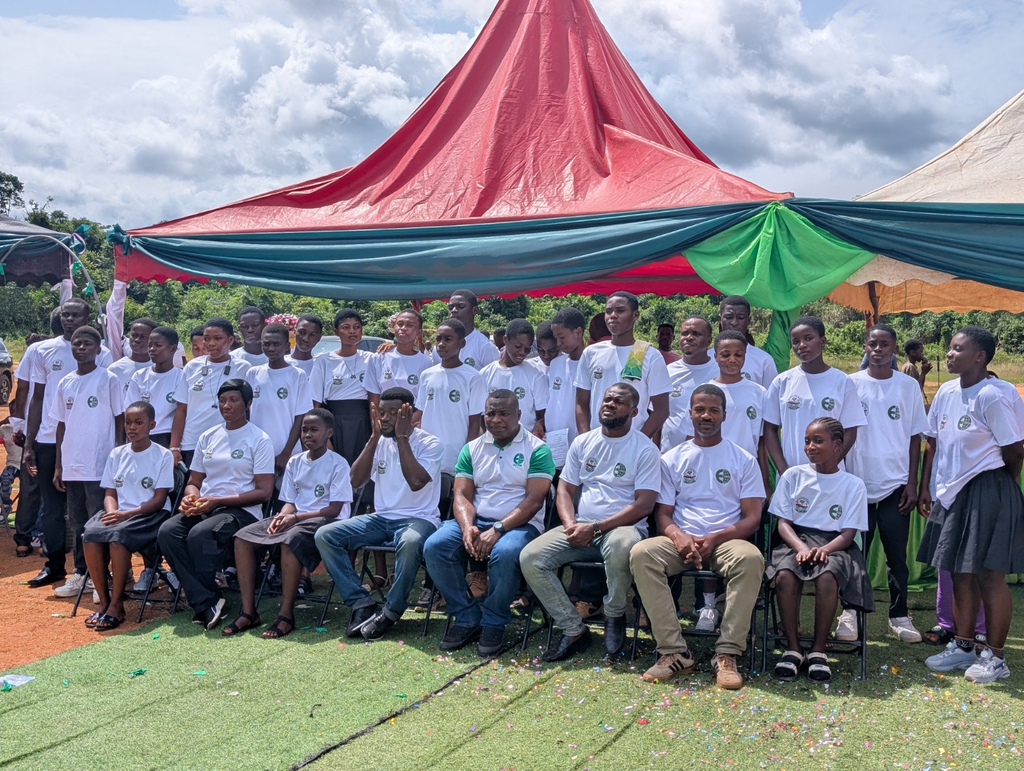
He said the Agriculture Our Future Clubs initiative is aimed at changing that perception.
"Agriculture remains the backbone of many of our communities and continues to support livelihoods, food security, and national development. Yet, many young people do not see agriculture as an attractive career path," he said.
"If we do not inspire the next generation to develop an interest in agriculture, who will produce the food we eat and sustain the crops that support our economy in the future?" he asked.
Mr. Baffoe-Bonnie said the vision of the clubs is to raise a generation that understands agriculture, appreciates its value and recognises the opportunities it offers.
Through the clubs, children will gain knowledge in good agricultural practices, environmental conservation, climate awareness, nutrition, savings and entrepreneurship, as well as leadership, teamwork, creativity and problem-solving skills.
The Acting General Manager stressed that child protection remains central to the initiative, explaining that there is a clear distinction between introducing children to agriculture in a safe, educational manner and exposing them to child labour.
"Every child deserves the opportunity to learn, grow, and pursue their dreams without being subjected to hazardous work, abuse, or exploitation," he emphasized.
He said club members are being sensitised on children's rights, child labour prevention, personal safety and responsible participation in agriculture, while the clubs serve as safe spaces for children to express their views and build confidence.
He added that teachers serving as Club Coordinators have been trained in effective club management and child protection to serve as mentors.
Call for Partnership
Mr. Baffoe-Bonnie stated that ECOM Ghana cannot achieve the vision alone and called for sustained partnership from the Ghana Education Service, Ministry of Food and Agriculture, District Assemblies, traditional authorities, school leaders, teachers, parents and community members.
"Together, we can create an environment that encourages children to learn, innovate, and thrive while ensuring their rights, safety, and wellbeing are protected," he said.
He encouraged club members to be curious and explore the opportunities in agriculture, noting that agriculture is not a last resort but a field of opportunity, innovation and prosperity.
"Today, as we inaugurate these clubs, we are planting much more than trees. We are planting curiosity, knowledge, confidence, leadership, and opportunity. Above all, we are investing in the future of our children and the future of agriculture," he said.
"Agriculture is not a profession of the past. It is the foundation of our future. Agriculture is our future, and our children are an important part of that future," he added.
Farm Work as Punishment
Speaking on the role of education in nurturing children's interest in agriculture, the Adansi North District Director of Education, Alhaji Ibrahim Abubakar Amankwah, urged teachers to desist from using farm work as a form of punishment.
He said teachers have a critical role to play in making agriculture attractive to pupils, adding that using weeding, land clearing and other farm-related activities as punishment discourages them from developing an interest in the sector.
"Teachers have a role to play in schools to make agriculture attractive to students. In the first place, teachers must stop using farm work, clearing of land or weeding as a punishment for breaking school rules. Such rules discourage young people from seeing farming as a normal, attractive and valuable activity," Alhaji Amankwah said.

He urged teachers and club coordinators to adopt confidence-building strategies and mentorship approaches to raise pupils' self-esteem and strengthen belief in their own agricultural abilities.
Alhaji Amankwah emphasized the need to combine classroom teaching with practical experience on school farms and gardens to sustain pupils' interest.
"When we keep teaching the importance of agriculture in the classroom and practically engage in agricultural activities in our school farms or school gardens, pupils will definitely develop interest in it," he said.
He further called on schools to bridge the gap between theory and practice by moving agriculture out of textbooks.
"Let us put together the theories and bridge the gap between theory and practice. Teachers should move agriculture out of the books by utilizing school gardens to plant, harvest and enjoy. By so doing, agriculture will look attractive to all pupils who engage in it," he added.
Removal of Agricultural Science as Standalone Subject
Meanwhile, the District Director of Food and Agriculture for Adansi North, Mr. Prince Asare expressed concern over the removal of Agricultural Science as a standalone subject from the basic education curriculum.
According to him, the merging and eventual abolition of Agricultural Science as a single subject weakens hands-on practical training and dampens youth interest in farming.
Mr. Asare noted that the implementation of new educational reforms in the 2012 academic year in Ghana led to the abolition of Agricultural Science as a core subject in basic schools.
He warned that without early exposure to agriculture, the country risks future food insecurity and rising youth unemployment.
He therefore appealed to policymakers to reinstate Agricultural Science as a core subject in basic schools, particularly at a time when the sector ministry has directed district agricultural directors to recognize and reward basic schools actively engaged in farming as part of the National Farmers' Day Awards.
Stakeholders in the agricultural sector who graced the inauguration welcomed the initiative, commending the management and staff of Sustainable Management Services and ECOM Ghana for the intervention.
They described the establishment of the clubs as timely and crucial for reigniting young people's interest in agriculture and ensuring the sustainability of the sector.
Latest Stories
-
Chief Justice urges employers to tackle mental health stigma in workplaces
27 minutes -
Analysis: Ghana’s yellow fever numbers reveal a gap between vaccination and protection
58 minutes -
Education Ministry welcomes suspension of teachers’ strike
1 hour -
Vice Chancellors Ghana appeal to striking university administrators to resume work
1 hour -
KNUST postpones 2026/2027 academic year reopening indefinitely amid GAUA strike
1 hour -
Fire destroys mattress factory at Sokoban in Kumasi
2 hours -
ECOM-SMS Ghana launches ‘Agriculture Our Future Clubs’ to address threat of ageing farmer population
2 hours -
Nicholas Atsu Kumi
2 hours -
Cherif Sarr: Economic participation needs more pathways, not one prescribed route
2 hours -
Cyber Security Authority: Ghana led Operation Blackout, not FBI
2 hours -
GH¢800,000 goods destroyed as fire engulfs Kia Rhino truck on Apedwa-Kibi Road
2 hours -
Chief Justice calls for supportive workplaces to address mental health stigma
3 hours -
NVI CEO defends GH¢13m spending on training, workshops and conferences
3 hours -
Ghana targets first locally manufactured vaccine by 2027
3 hours -
Teachers suspend strike after reaching agreement with government
3 hours