


Audio By Carbonatix
One editorial criticising Kenya’s government was all it took to get seasoned journalist Denis Galava unceremoniously sacked from his job.
A senior editor at one of Africa’s most respected newspapers, the Daily Nation, and a popular commentator on national politics, Galava had written hundreds of editorials during his time.
But at the beginning of the year he wrote an opinion piece that pulled no punches. Addressing the president, Uhuru Kenyatta, he said that the country deserved better leadership from its politicians, lambasting the president’s record in office.
“We reject the almost criminal resignation and negligence with which your government has responded to our national crises this past year,” he wrote.
“With the exception of a few family businesses and tenderpreneurs who raked in billions of shillings – thanks largely to political patronage – everyone is losing money in this country.”
It caused uproar. Galava was suspended days later, pending a disciplinary hearing. He was told he hadn’t “followed the correct procedure” for publishing and last week his contract was terminated with immediate affect.
Galava doesn’t believe his dismissal has anything to do with procedure. “It was not fair because I have written many other editorials before, I have been a managing editor for four years, and the question of procedure has never arisen. I’ve never had to run an editorial past anyone,” he said.
@DenisGalava stand tall for exercising your freedom of expression #IStandWithGalava
— Martha Karua (@MarthaKarua) 1:10 PM - 20 Jan 2016
For him, it demonstrates increasing censorship of the country’s once-vibrant media – long hailed as one of the most open in Africa – by a media house too scared to defy the president. “My view is that the editor is taking instructions from State House [the seat of the president], and is now hiding behind procedure,” he said.
Joyce Kimani of the Kenya Correspondents Association doesn’t buy the “procedure” explanation either. She said that Galava’s dismissal is symptomatic of wider government efforts to shut down criticism from the media.
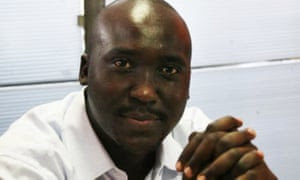
Kenyan journalist and editor Denis Galava. Photograph: Denis Galava/Twitter
“This signals the death of press freedom in Kenya,” she said, adding that Galava’s dismissal mirrors what has been happening on a local level for months, with local journalists facing unprecedented levels of intimidation.
Although Kenya’s constitution guarantees freedom of the press, Kenyatta’s government has ushered in a series of repressive media laws since coming into office in 2013. This has been accompanied by an increase in harassment, threats and attacks on journalists, all of which paint a bleak picture for independent media in the country.
Last week the arrest of blogger and journalist Yassin Juma caused outrage after he was accused of “misusing a communication device” and disseminating “sensitive” material relating an al-Shabaab attack in Somalia.
Many Kenyans took to Twitter to show their support for Juma and calling for his release.
— Halima (@herlima_) January 24, 2016
Someone tell me what 'misuse of communication gadget' is before I land in some police cell. #FreeYasinJuma
— gathara (@gathara) January 23, 2016
#FreeYasinJuma @Yassinjuma has provided important and credible reporting on #ElAdde. Is this why GoK wants to shut him down?
Cozying up to power
In a July 2015 report, the Committee to Protect Journalists reached bleak conclusions about the state of Kenyan media. “While most of the risks that Kenyan journalists face today are more subtle than an attack with a metal rod, they are nonetheless effective,” the report stated.
The Nation Media Group editor-in-chief, Tom Mshindi, did not respond to a request to comment but has previously denied that the decision to suspend Galava had anything to do with the content of the controversial editorial. “The lack of consultation where one writer takes a strong position on such an important issue single-handedly without broad discussion and consultation is a significant departure from established procedure,” he said in a statement.
But a wider trend evidenced by crackdowns on media and civil society organisations tells a different story. In its report the CPJ stated that increasingly, “media are manipulated by dominant corporations, and news outlets are subject to the whims of their politician-owners or publishers who want to cozy up to power”.
Latest Stories
-
Government just put a spin on SIGA report – Miracles Aboagye
8 minutes -
Big Chef Season 5: Two contestants face exit in Jollof Challenge
26 minutes -
SIGA’s ‘massive turnaround’ claim not borne out by data – Bright Simons
34 minutes -
Nhyiaeso Chief assures support to end encroachment on utility corridors in Kumasi
34 minutes -
Two lorry station masters arrested over alleged plot to kill creditor over ₵91k debt
1 hour -
SIGA’s claim on highest audited proportion inaccurate – Bright Simons
1 hour -
Money bouquets, spraying and dancing on cash unlawful – BoG warns
2 hours -
Sam George pushes for nationwide 4G upgrade of rural telephony sites
2 hours -
Local Government Ministry to support MMDAs to deliver gov’t agenda
2 hours -
At least five killed in Sudan’s South Kordofan in attack by rebel group
2 hours -
“Music is so stressful” – Headless YouTuber on why he won’t return
2 hours -
Cleveland police chief proud of force but being ‘let down’ by funding
2 hours -
Black Sherif drops new 6-track EP ‘Sun Sherif’
3 hours -
GTA partners Africa’s Brain Bank for Medical City groundbreaking
3 hours -
How to check 2026 WASSCE results on mobile phone
3 hours