

Audio By Carbonatix
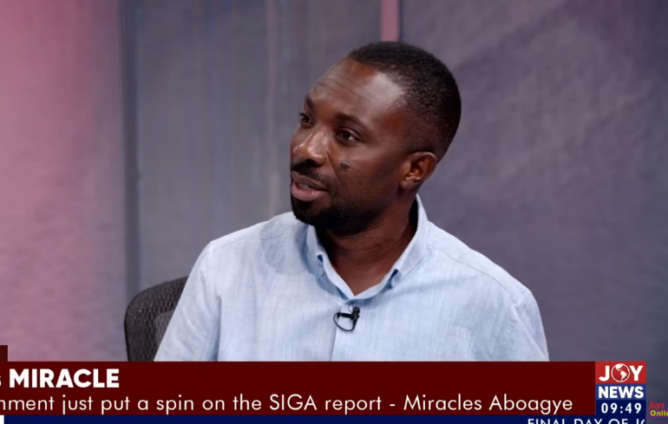
NPP Communications Director hopeful Dennis Miracles Aboagye has accused the government of putting a political spin on the latest State Interests and Governance Authority (SIGA) report by presenting reported profits by state-owned enterprises as evidence of a dramatic turnaround in their performance.
Speaking on JoyNews’ Newsfile on Saturday, September 5, Mr Abogye said the narrative surrounding the report began with the Minister of Government Communications and quickly spread across the media, creating the impression that state institutions had achieved an unprecedented transformation.
“The first post on this media report came from the Government Communications Minister. He started this whole spin,” Mr Aboagye said.
He added, “Within 30 minutes, all media houses were flying news cards and talking about accepting 19 billion cedis profits, which is supposed to be a dramatic turnaround of these state institutions that we know have fundamental reform structural issues.”
Mr Aboagye questioned whether institutions with longstanding structural challenges could realistically have been transformed within one year.
“Anybody that is going to do politics will tell you that there is no way that from January 7, 2025, to December 2025, we would have turned around COCOBOD and their issues,” he said.
He argued that where an institution such as COCOBOD suddenly reports a significant profit, the immediate response should be to investigate the source of the profit rather than automatically celebrate it as evidence of a turnaround.
“So, if COCOBOD is making profit, we slow down and we query the source of that profit,” he said.
Mr Aboagye also questioned the treatment of surpluses recorded by some institutions, particularly entities that receive public funds for specific programmes.
“Institutions who have received direct tax money to distribute to Ghanaian citizens who are beneficiaries, like YEE and COO, were now being quoted of making profit because money that were given to them, for them to pay Ghanaian beneficiaries, which they did not need or should pay them,” he said.
He criticised what he described as the celebration of unspent public funds as a sign of institutional efficiency.
“That is what is different. That is all,” he said.
Mr Aboagye stressed that the reported profitability of state-owned enterprises was not a new phenomenon and argued that the latest figures should have been placed in the context of previous SIGA reports.
“Before 2025, this report, the previous report had 35 SOEs making profit. It is not as if this is the first time these SOEs are making profit,” he said.
“It is not. You are the one who has created this conversation for yourself.”
According to him, the more useful exercise would have been to examine the performance of individual institutions and determine what had changed from one year to another.
“What we would have done now is that we would have gone into the organizations one by one, and now begin to ask, ‘Oh, what have you done differently? This is amazing. What are the issues?’” he said.
Instead, he argued, the government drew national attention to the aggregate figure.
“But you quickly brought everybody into the microphone and the lenses on everyone now,” Mr Aboagye said.
Mr Aboagye also challenged the interpretation of the reported GH¢19 billion figure, arguing that a significant portion did not necessarily represent profits generated through improved operations.
“Your own report says that, no, no, no, no. Even though I am telling you that we have made 19 billion, 6.5 billion of that money are just surpluses,” he said.
He argued that such surpluses could in some cases indicate that institutions had not fully utilised funds allocated to them.
“It means that those institutions actually may have underperformed,” he said.
“Because monies that were given to them for them to use to do their work and give us resources for the future, they left it in the bank.”
According to Aboagye, the accumulation of such funds is not necessarily a new development.
“And this is not new anyway. Almost every year it happens. It's not new. It's not new,” he said.
Latest Stories
-
Zonda Tec launches HOWO T3M truck to support agric and logistics
1 minute -
Obuasi SHTS scandal: Eduwatch calls for sex offenders’ register and mandatory background checks for teachers
14 minutes -
GloMeF CEO urges intensified public education on new road traffic regulations
25 minutes -
‘Any tax on ChatGPT is an attack on education and innovation’- Akim Swedru, MP
28 minutes -
Obuasi SHTS sexual abuse scandal exposes systemic failure in child protection – Moving Masculinity
29 minutes -
Hubtel CEO calls for national data-sharing framework to boost AI development
32 minutes -
Twelve Golden Rules of real estate development in Ghana, Africa
36 minutes -
Five new telephony cell sites in Ashanti Region to be activated in October 2026 – Sam George
36 minutes -
Mahama cuts sod for Afienya Industrial Park, targets 120 enterprises
41 minutes -
Rush for fuel from accident tankers is stealing, punishable by law – NPA boss, Edudzi Tamakloe
47 minutes -
GhIG pushes for legislation to regulate geoscientists’ activities
53 minutes -
Mfantsipim @150: Ace Anan Ankomah leads project to preserve school’s musical heritage
57 minutes -
Gov’t launches rCOMSDEP in Ahanta West, Mpohor Fiase to promote responsible community mining
59 minutes -
AI is forcing professionals to rethink how they deliver value – Hubtel CEO
1 hour -
Daily Insight for CEOs: Strengthening the CEO’s Leadership Legacy
1 hour