


Audio By Carbonatix
A small but increasing group of African governments is blocking social media during elections. Clare Spencer asks why and how this is done and how people get around it.
Why are African governments blocking social media?
It is safe to say governments aren't blocking social media to cut off the supply of cute kitten pictures.
It's political.
African tweeters tend to be more political than tweeters in other continents, according to research by Portland Communications.
And governments are blocking social media during elections - most recently in Congo-Brazzaville, Chad and Uganda.
For an indication of the political impact social media can make, you just need to look at the uprisings during the "Arab Spring".
"Social media did not cause the 'Arab Spring' but helped to co-ordinate it," Arthur Goldstuck from technology market research company Worldwide Worx, told the BBC.
Governments do not say they are worried that social media could pave the way for popular protests or even a revolution.
But security is often cited - including in the order for mobile operators to stop services in Congo-Brazzaville.
Congolese officials added that they were trying to prevent the "illegal publication of results".
Newsweek interpreted this as a possible attempt to thwart the efforts of election monitors.
The advent of the mobile phone enabled local observer groups to collate the results from individual polling stations around the country and add them up to see if the results were being rigged.
If mobile phones don't work, this can no longer be done.
However, results spread by opposition parties are also not necessarily accurate and Uganda's President Yoweri Museveni insisted that social media was blocked during the election to "stop spreading lies".
How do governments block social media?
Governments don't have the physical or technical ability to block sites, phones or texts themselves, explains Thecla Mbongue, analyst for trend forecasters Ovum.
They issue an order to the companies who do have that power.
Congo-Brazzaville's government issued an order to the country's mobile phone operators such as Airtel and MTN.
This effectively blocks the internet because very few Congolese use fixed lines to access the web.
Ms Mbongue says that the order in Congo-Brazzaville appeared to allow specified numbers to carry on using their mobile phones.
This came out when the communications minister denied the communications block - by tweeting.
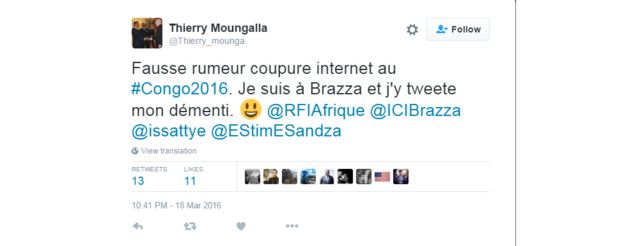
The interesting thing about the tweet for her is that someone replied with what appears to be a copy of the order sent to mobile operators.
It shows they were asked not to block specified numbers. Presumably, she says, that is why Mr Moungalla could tweet and others couldn't.
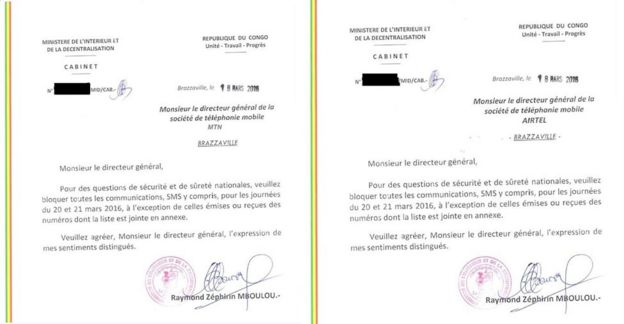
Airtel and MTN have not yet confirmed whether the orders that spread through social networks were authentic.
In the case of Uganda, the telecoms regulator ordered mobile phone operators just to block certain sites.
So people couldn't use Facebook, WhatsApp, Twitter and mobile money services.
Danson Njue, also from Ovum, says it is believed that the regulator was advised by top security and government officials to block the sites over security concerns.
Technically, this is a relatively easy task.
Websites are stored on servers which have IP addresses - a bit like a phone number.
The government can force internet service providers and telecoms companies to block access to a specific IP address.
Smartphone apps, like WhatsApp, will try to connect to its own server and it won't be able to if your internet service provider is blocking connections.
So it is fairly easy to pinpoint a specific site or app and block access.
This makes social networks fairly powerless.
Twitter did not even condemn the ban when the company noted it was blocked in Uganda.
 Image copyrightTwitter
But telecoms companies appear to be powerless too.
Ms Mbongue says she cannot think of a single example in sub-Saharan Africa where the telecoms provider has refused to comply with an order.
She speculates that phone companies could go to court to demand compensation for lost earnings. But she is unaware of this ever having happened.
This is in contrast to the Twitter ban in Turkey which was lifted after two weekswhen the constitutional court ruled the ban was a breach of the right to freedom of expression.
Mr Goldstruck adds that because mobile operators work under strict licensing conditions, they have to comply with such government directives.
It is different where there are numerous service providers and numerous routes out of the country, as in Egypt.
Twitter was blocked in Egypt in January 2011, when hundreds of thousands of protestors started to gather in Tahrir Square in the capital Egypt. They had used the hashtag #Jan25 to co-ordinate.
But it wasn't long before Twitter was working again.
Even in this case, internet access was still reduced dramatically, he says.
How do people get around the block?
Many people have found ways to get around government blocks by using internet proxies known as Virtual Private Networks (VPNs).
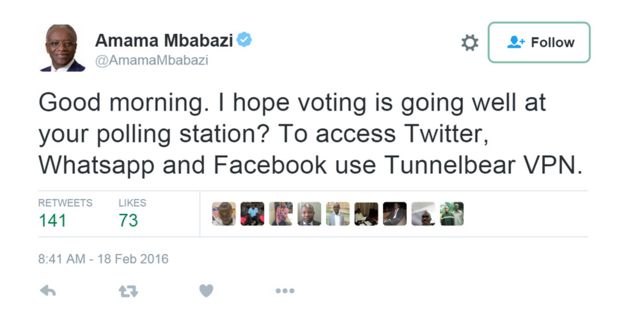
In Uganda an opposition leader even tweeted on the day of the election a recommendation to download a VPN app called Tunnel Bear.
The top 12 apps people were downloading in Uganda four days after the election were still VPN apps, according to analysts App Annie.
But Congo-Brazzaville and Chad cut off the whole internet and telephone which meant people couldn't use this technique.
VPNs get round government censorship by redirecting your internet activity to a computer in a different country, where the blocks have not been imposed.
This is also used by people to access content that might be restricted to a certain country - letting a European user watch American Netflix, for example.
What next?
Zimbabwe has suggested it could go one step further and create its own social networks that the state can monitor.
The country's state owned newspaper the Sunday Mail reports that local web developers are "stitching together" products similar to Facebook, Twitter and Skype "to enable great supervision".
The newspaper nods to China, where this has already happened.
Latest Stories
-
Politicisation could undermine parliamentary probe into cocaine seizures – Dr Osae-Kwapong
6 minutes -
EOCO chases MP: Can Section 41 cure lacuna in EOCO Act? – Inusah Fuseini asks
9 minutes -
GNFS, GWL inspect fire hydrants in Ministries enclave; 23 found faulty
14 minutes -
Gov’t directs release of 50,000 bags of grain to ECOWAS
16 minutes -
Ghana, Germany deepen cooperation on railways, labour mobility
21 minutes -
Huge crowds greet Pope in Paris for open-air Mass
32 minutes -
‘I never said I’ll declare a state of emergency’ – President Mahama on galamsey
1 hour -
Bobby Banson condemns EOCO’s attempted arrest of Nana Agyei Baffour Awuah
2 hours -
When Kumasi begins to look like somebody is in charge
2 hours -
Parliamentary probe into cocaine seizure would be a waste of time – Inusah Fuseini
2 hours -
Cocaine seizure: Focus on Ghana’s reputation, not partisan blame – Osae-Kwapong
2 hours -
Two Invitations, Three Interrogations: Did Baffour Awuah tell the whole story?
2 hours -
Drug cartels may be seeing Ghana as easy route – Lenin Anane Agyei
3 hours -
Ghana risks gaining notoriety as drug-trafficking hub – Bobby Banson
3 hours -
Government dismissed my drug trafficking warning, then tried to arrest me – Ntim Fordjour
3 hours