


Audio By Carbonatix
Sierra Leone needs "urgent support" for thousands of people hit by mudslides and massive flooding in the capital, the country's president says.
Ernest Bai Koroma said entire communities had been wiped out and that the "devastation was overwhelming us".
Nearly 400 people have been killed and hundreds more are missing after muddy rubble swept through the Regent area near the capital, Freetown, on Monday.
A mass burial of victims is planned to free up space in mortuaries.
Dozens more bodies were discovered on Tuesday as rescue efforts to recover people from destroyed houses in the area continue.
The Red Cross, which said that 312 bodies had been recovered on Monday, said that it was struggling to get equipment in to extricate bodies that were buried deep in the mud.
The aid agency added that an estimated 600 people were still missing.
ActionAid's humanitarian director, Richard Miller, said that "there are currently over 1,500 people reported missing", Sky News reports.
Meanwhile, Interior Minister Paolo Conteh told Sierra Leone's state broadcaster that thousands of people remain unaccounted for.
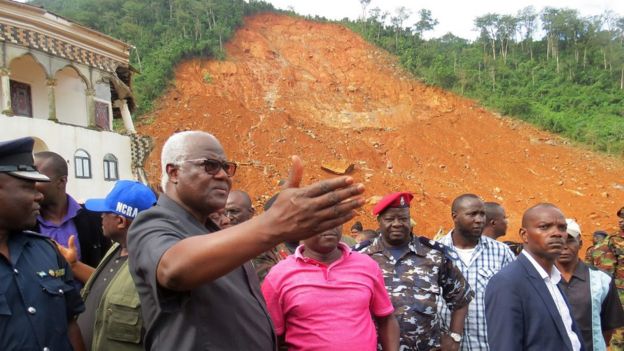
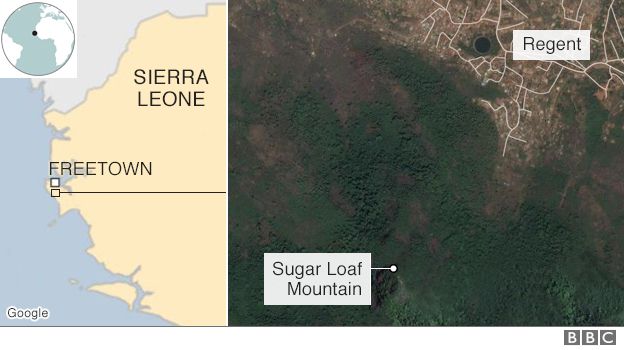
Homes in Freetown were engulfed after part of Sugar Loaf mountain collapsed following heavy rain early on Monday. Many victims were still asleep in their beds when disaster struck.
It is feared the number of dead will rise further. Another 3,000 people are estimated to have lost their homes.
Ishmael Charles, a charity worker for the Healey Relief Foundation and Caritas Freetown, told the BBC that words could not do justice to the scale of the tragedy.
"You will see a huge number of people crying with those who have lost their family members," he said.
"It's very difficult to paint what the reality looks like, because it's more scary and very sad and disastrous than anyone can be able to describe."
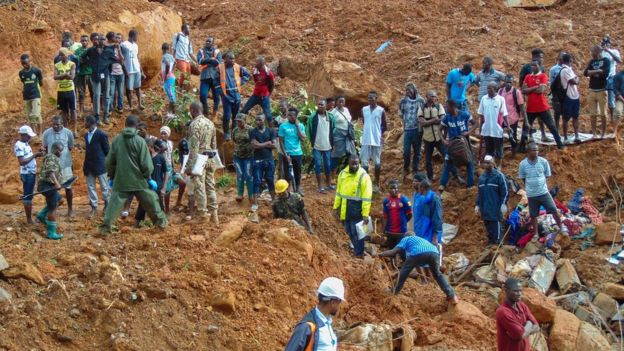
In the worst hit area, the Regent district, where dozens of houses were submerged when the hillside collapsed at about 06:00 GMT, those who survived spoke of the family members they had lost - or still hoped to find alive.
"My wife is dead. My children are all dead. This morning my children and I talked before I left for work. One of them even chose the socks I should put on," a man called Malikie told the BBC.
Another woman, called Adama, said she was still searching for her baby.
"We were inside. We heard the mudslide approaching. We were trying to flee. I attempted to grab my baby but the mud was too fast. She was covered, alive.
"I have not seen my husband, Alhaji. My baby was just seven weeks old."
International aid agency Save the Children said one member of staff, along with his children, had disappeared.
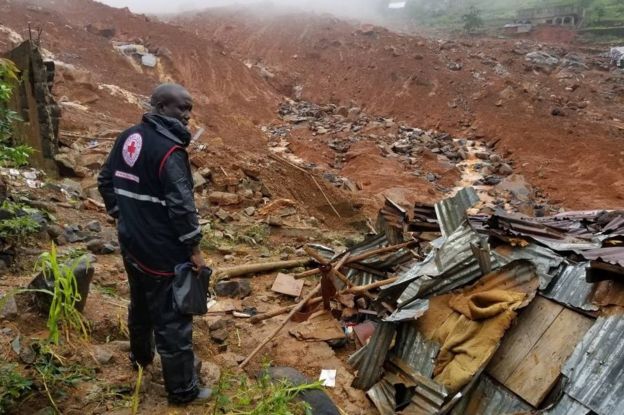
His colleague Ramatu Jalloh was driving past Regent at the same time that the wall of mud and debris hit the area.
"A lady ran on to the road and started gesticulating wildly," he said. "She called out to another lady who had been riding a bike in front of us who, after a brief conversation, started crying and looked very upset," she said.
"It was clear from their reactions that something terrible had happened. Soon afterwards, another man ran towards our car. He was crying about the number of lives that had been lost."
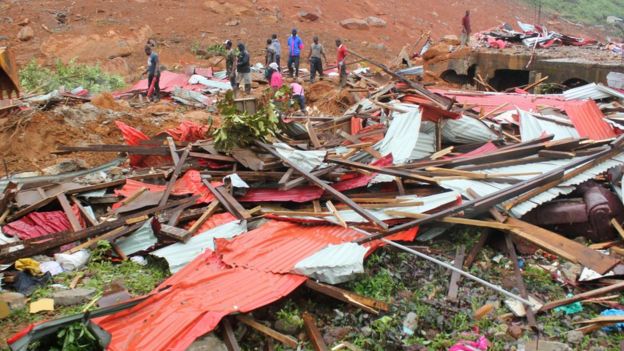
Fatmata Sesay, who lives on the hilltop area of Juba, managed to survive the mudslide after she and her family were woken by the pounding rain.
It was then they realised their home had been submerged in water.
"I only managed to escape by climbing to the roof of the house when neighbours came in to rescue me," she told AFP.
"We have lost everything and we do not have a place to sleep."
Earlier, President Koroma urged people to stay away from the affected areas.
"This tragedy of great magnitude has once again challenged us to come together, to stand by each other and to help one another," he said.
"Let me assure you that my government is fully engaged on this situation and in collaboration with our development partners we have already established an emergency response centre at Regent to coordinate our response and to provide relief to the survivors."
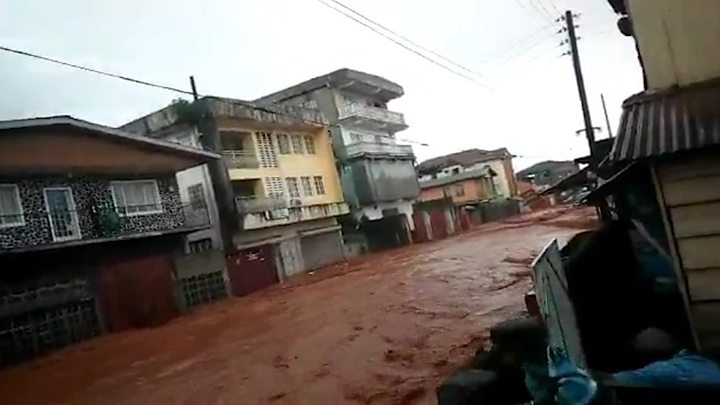
Photo: BBC Weather's Tomasz Schafernaker explains why Sierra Leone has been hit with torrential rain and mudslides
Flooding is not unusual in Sierra Leone, where unsafe housing in makeshift settlements can be swept away by heavy rains.
The rains often hit areas in and around Freetown, an overcrowded coastal city of more than one million people.
In 2015, Freetown endured deadly floods sparked by monsoon rains that killed 10 people and left thousands more homeless.
Latest Stories
-
Lawyers, prosecutors fume over abandoned 26-year-old Upper West High Court project
1 minute -
At least two dead in blast at Bolivia military barracks
33 minutes -
Tate brothers officially indicted with trafficking and sex crimes in Romania
36 minutes -
US envoys arrive in Moscow ahead of Ukraine talks
40 minutes -
Health Minister to brief media on Free Primary Healthcare programme on Monday
53 minutes -
‘It was inappropriate to make that comparison’ – Dr Pumpuni Asante on CJ’s SOE comment
1 hour -
Photos: Final-day shopping continues at Joy FM Back-to-School Discount Fair
2 hours -
Darkey and Frimpong set up J30 Accra boys’ doubles final
2 hours -
When war takes more than territory: The human cost of conflict
2 hours -
Review SHS placement policy to give more BECE candidates access – Kwesi Kwarteng
2 hours -
Tano South Municipal Assembly moves to curb road carnage with speed ramps
2 hours -
Duvor Klu, Gakpo win J30 Accra girls’ doubles title
2 hours -
ITF Juniors Tournament: Duvor Klu claims with straight-sets victory over Gakpo
2 hours -
‘Decision to retire has been tough’ – Isaac Dogboe
2 hours -
Domelevo backs OSP probe into alleged GH¢70,000 payment to Appiagyei
2 hours