


Audio By Carbonatix
Facebook founder Mark Zuckerberg has apologised to EU lawmakers for the company's role in the Cambridge Analytica scandal and for allowing fake news to proliferate on its platform.
Mr Zuckerberg apologised for Facebook's tools being used "for harm".
But his testimony did not please all MEPs at the meeting, some of whom felt he had dodged their questions.
One leading UK politician later said the session at the European Parliament had been a "missed opportunity".
"Unfortunately the format of questioning allowed Mr Zuckerberg to cherry-pick his responses and not respond to each individual point," said Damian Collins, chair of the UK Parliament's Digital Culture Media and Sport Committee.
The format was very different from that of Mr Zuckerberg's testimony to US lawmakers in April.
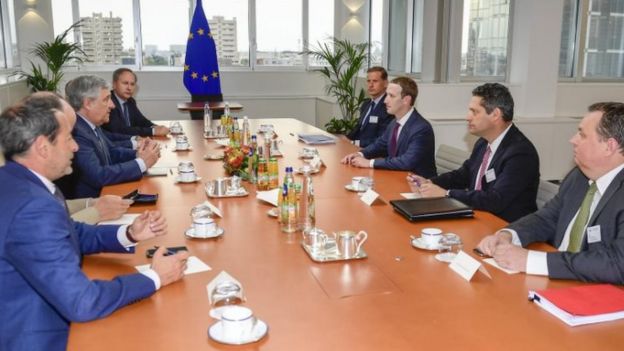 Image copyrightEUROPEAN PARLIAMENT
Image captionMr Zuckerberg met European Parliament President Antonio Tajani before the Q&A session
While the US politicians took turns to cross-examine the Facebook chief in a series of back-and-forth exchanges, the leaders of the European Parliament's various political groups each asked several questions apiece.
The tech chief had to wait until they were all delivered before responding.

Huge long questions/speeches from European politicians and the format is terrible- Zuckerberg has to listen to them all before answering
End of Twitter post by @ruskin147
Mr Zuckerberg spent 22 minutes going through the huge number of questions put to him during the session and was able to pick and choose which to give answers to.
Several of the politicians expressed frustration at this, and one accused Mr Zuckerberg of having "asked for this format for a reason".
A spokesman for Facebook later contacted the BBC to say it had not chosen the structure. This was subsequently confirmed by the parliament's president, Antonio Tajani.
In a follow-up press conference, Mr Tajani added that the MEPs had been aware Mr Zuckerberg's time was limited yet had decided to use up much of the allotted period speaking themselves.
He also drew attention to the fact that the chief executive had agreed to provide follow-up written answers.
Unaddressed topics
Mr Zuckerberg did not address questions about whether Facebook was a monopoly and how it plans to use data from its WhatsApp division.
Nor did he directly answer questions about shadow profiles or whether non-Facebook users' data should be collected.
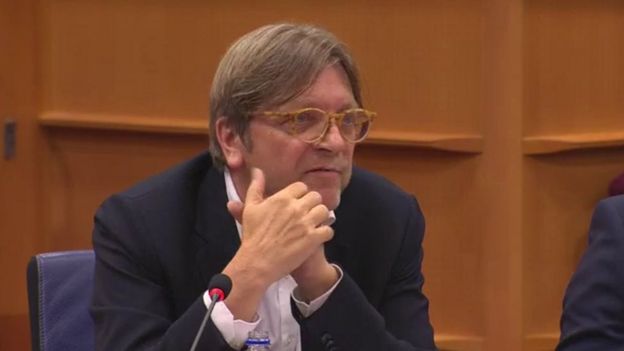 Image copyrightEUROPEAN PARLIAMENT
Image captionGuy Verhofstadt had threatened not to attend when the event was set to be restricted from public view
Several of the MEPs had also voiced scepticism about the business.
Guy Verhofstadt MEP had asked Mr Zuckerberg if he wanted to be remembered as "the genius who created a digital monster", which the Facebook boss did not answer.
British MEP and leading Brexiteer Nigel Farage expressed his view that Facebook was not a politically neutral platform, asking whether the social network "wilfully discriminated" against right-of-centre commentators.
Mr Zuckerberg did respond to this point, saying Facebook had "never made a decision about what content was allowed on the basis of political orientation".
Tackling other questions, he also said he expected to find other apps that had misused customer data and pointed out that an internal investigation into thousands of third-party developers to see if there similar cases to the Cambridge Analytica scandal would take "many months".
So far, he said, Facebook had suspended more than 200 apps.
- Facebook-Cambridge Analytica data scandal
- U-turn over Facebook chief's EU meeting
- Who's policing Facebook?

Analysis:
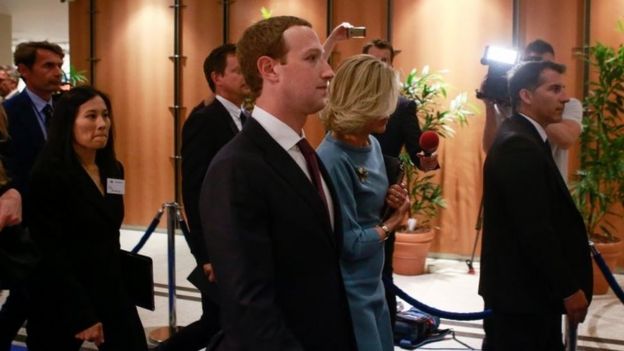 Image copyrightEPA
By Dave Lee, North America technology reporter
The European Parliament has been left wanting more.
The format of the meeting meant that rather than tackle specific concerns - particularly about the tracking of non-Facebook users - Mr Zuckerberg was able to group the questions into broad areas.
That meant he could give broad answers.
Reading any blog from the company published in the past three months would give you much the same information as we heard today.
This clearly angered several MEPs, who expressed frustration over what they saw as insufficient responses to their concerns.
Then again, how detailed can you be when you have been given less than half an hour to answer huge, almost existential, questions?
Facebook is under close examination, but maybe so too should be the way politicians question these incredibly powerful figures.
If you're following along, here's a scorecard for Mr Zuckerberg's "tough" committee appearances: Congress achieved little, Europe even less.
'Committed to Europe'
The meeting between Mr Zuckerberg and the European Parliament's political group leaders had originally been planned to be held in private.
But that sparked a wave of criticism resulting it being livestreamed via the web.
One popular topic among the MEPs was an imminent shake-up of data privacy rules.
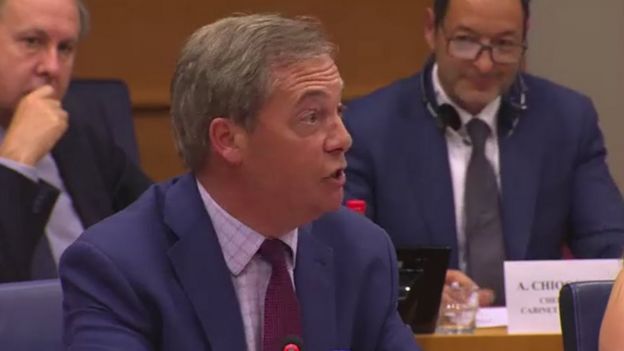 Image copyrightEUROPEAN PARLIAMENT
Image captionNigel Farage challenged Facebook's claims to impartiality
Facebook recently transferred 1.5 billion of its international users from the jurisdiction of its European headquarters, in Ireland, to that of its US headquarters, with some speculating this was to avoid costly legal action resulting from breaches of the EU's General Data Protection Regulation (GDPR).
The sweeping changes to data laws will give consumers much more control over how their personal details are used.
Several of the MEPs challenged Mr Zuckerberg over whether he was truly committed to obeying the regulation.
Media captionWATCH: What is GDPR?
He responded that he expected Facebook would be fully compliant with the law by the time it came into force on Friday.
He added that the app had already presented European members with the revised settings required and "a large percentage" of the users had already reviewed them.
UK MPs are keen to pose their own questions to Mr Zuckerberg about the Cambridge Analytica scandal but the Facebook founder has so far declined to make a trip to the UK.
Latest Stories
-
Ato Forson thanks constituents for 18 years of support
6 minutes -
T-bills auction: Government exceeds target by 51%, interest rates fall again
9 minutes -
Avoid comparing governments, Catholic Bishops tell Chief Justice
48 minutes -
140 migrants in single dinghy rescued in English Channel
1 hour -
FIFA president Infantino will stand for re-election
1 hour -
Catholic Bishops reject calls for Chief Justice’s resignation over political remarks
1 hour -
Germany’s far-right AfD set for big win in eastern state, just short of majority
2 hours -
Catholic Bishops urge Chief Justice to avoid remarks that could raise doubts about impartiality
2 hours -
Mrs Doris Emma Doryumu (Nee Dove)
2 hours -
Illegal mining concessions easier to obtain than lawful ones in Ghana – Prof Frimpong-Boateng
2 hours -
At least 5 dead after Amazon cargo plane barreled off runway at Miami airport
2 hours -
Frimpong-Boateng proposes Environmental Restoration Fund funded by mineral royalties
3 hours -
Corrupt individuals are worse than pathogens; their actions cause premature deaths – Prof Frimpong-Boateng
3 hours -
No illegal mining operation will find refuge on Akyem Essase lands — Chief declares
3 hours -
Flight price rises due to ‘foolish leaders’ starting wars, Virgin’s Branson says
3 hours