

Audio By Carbonatix
Adults and teens concerned about their screen time are turning in their smartphones for “dumber” models.
Buried in the settings of many smartphones is the option to look up how much on average you are staring at your phone per day.
It can bring an uncomfortable realisation, that what was supposed to be a useful piece of technology has become an obsession.
“Social media is built around FOMO (fear of missing out), so I felt like I couldn’t get off it,” 16-year-old Luke Martin, from Canada, told the BBC.
“Instantly I got Instagram and it was a downward spiral.”
Luke is not alone.
According to a study by Harvard University, using social networking sites lights up the same part of the brain that is also triggered when taking an addictive substance. This has raised concerns about phone habits among youth.
In the UK, research by Ofcom estimates that around a quarter of children aged five to seven years old now have their own smartphone.
Links have been shown in some studies between the use of social media and a negative effect on mental health - especially in children.
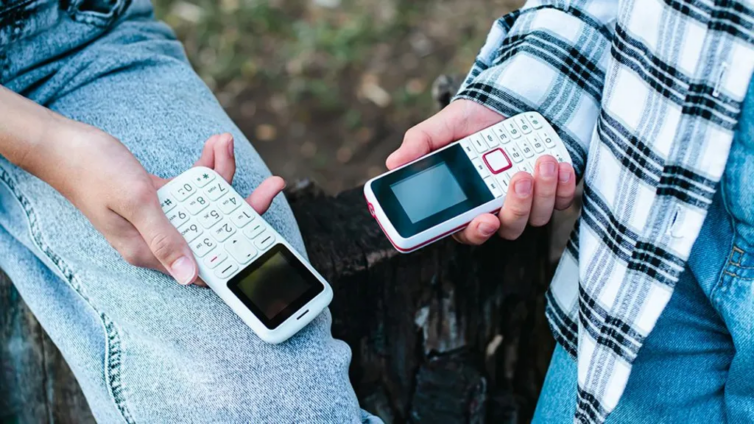
Some campaigners want age limits to be introduced for smartphone use. Others, like Luke, are choosing to swap their smartphones for much simpler devices, so-called “dumbphones”.
His new phone only has texts, calls, maps, and a few other limited tools.
“My friends’ usage is like four to five hours I think, and that’s how much mine used to be before I got this,” he said.
“Now mine’s like 20 minutes a day which is really good because I only use it for what I need it for.”
Parents are also turning to dumbphones, not only for their children but to help themselves be more present for their families.
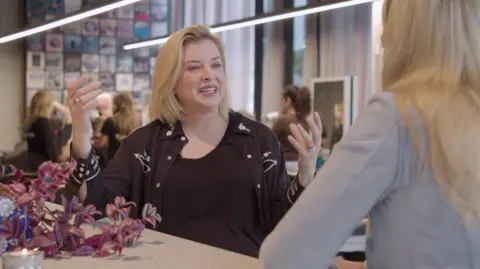
Lizzy Broughton, who has a five-year-old son, recently bought an old-school style Nokia “flip” phone.
“It helped me recalibrate my own habits, I have way more quality time with my son,” she explained.
She says that when it’s time for him to get his own phone, she’ll choose a similarly pared-down model.
“It doesn’t feel like the best idea to just start with a smartphone,” she said. “It’s like we’re handing over the world like try to figure out how to navigate that.”
Sales of dumbphones have been increasing in North America. At Dumbwireless in Los Angeles, store-owners Daisy Krigbaum and Will Stults cater to customers looking for low-tech devices.
“We have a lot of parents looking to get their kid that first phone, and they don’t want them drifting off on the internet,” he said.
But giving up the smartphone is easier said than done. Mr Stults said some schools require pupils to have certain apps. And it is difficult to hold the line when children see their friends being given expensive smartphones, said Ms Broughton.
“It’s going to require a community of parents to actually be like, can we do this differently?” she said.
One workaround is a device called “unpluq”, which you tap against the phone to wirelessly block certain apps, like social media.
“Parents can control the smartphone with this tag, and also monitor the usage,” Mr Stults said.
There are several phones that have now been developed particularly for users who want to avoid an addiction to mindless scrolling.
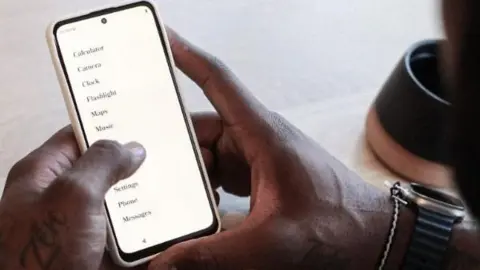
Chris Kaspar founded the company Techless to develop an “intentionally boring” but sleek device that looks much like an iPhone. The latest version is dubbed the “Wisephone II”.
“It has no icons, just words, two colours, and two fonts.” He describes it as “very peaceful, very tranquil”.
It will have some limited third-party tools, such as the taxi application Uber, but no social media.
“We’re asking this question—what’s actually good for us?” Mr Kaspar said.
He first developed the phone with his teenage foster daughters in mind and says 25% of their sales are to children, but that it is marketed to adults.
“If you have a phone that’s branded as a kids’ device there’s some shame associated with that. So we made a very adult, sophisticated, Apple-esque, really nice device,” he said.
With revenue from apps and social-media advertisements in the billions of dollars, the big companies have little motivation to encourage different habits, he said.
Meanwhile, Canadian teen Luke says he is planning to stick with his new device, much to the amusement of friends.
“They think it’s pretty weird but at this point I’m like it doesn’t really matter because it’s helped me so much,” he said.
“It’s definitely taken me into a better spot right now.”
Latest Stories
-
Let The Constitution direct Chieftaincy to deliver “All Development Is Local”
52 minutes -
John Jinapor outlines renewable energy, nuclear power priorities for 2027
1 hour -
Ghana explores centre of excellence for hearing, communication and cochlear implant care
2 hours -
Schizophrenia-related disorders lead mental health cases recorded in Ghana
3 hours -
Dutch authorities enlist Ghana in hunt for fugitive drug lord Bolle Jos
3 hours -
Ghana housing finance conference adopts communiqué to improve affordable housing access
7 hours -
Special Initiatives Minister urges Wa Technical Institute to enrol more girls as EU-backed solar training lab opens
8 hours -
In the matter of my first year at the Bar
8 hours -
ActionAid Ghana calls for an end to child marriage, greater investment in girls’ rights
8 hours -
Newsfile to tackle World Cup visa scandal, beach demolitions, education strikes, BRICS bid
9 hours -
UK-Ghana Trade & Investment Summit: Trade Resource Centre to help businesses maximise UK-Ghana trade opportunities
9 hours -
Embassy of Denmark celebrates World Maritime Day
9 hours -
Linking LEAP to productive inclusion could cut extreme poverty by 2030 – UNICEF
10 hours -
Trade Ministry backs use of creative arts to rehabilitate prison inmates
10 hours -
Negotiations with government to continue despite strike suspension – GNAT
10 hours