

Audio By Carbonatix
Ministers of Health, partners, and global health leaders have issued an urgent call to speed up Africa’s malaria response, warning that a “perfect storm” of challenges could reverse hard-won gains.
Despite progress such as a 16% drop in malaria cases between 2000 and 2023, the WHO African Region continues to carry more than 95% of the global malaria burden.
The fight is now threatened by shrinking budgets, growing resistance to medicines and insecticides, and the spread of invasive mosquito species.
Climate shocks and extreme weather are also shifting malaria transmission patterns, while humanitarian crises are increasing community vulnerability. At the same time, funding cuts from traditional donors are putting more strain on already limited health programmes.
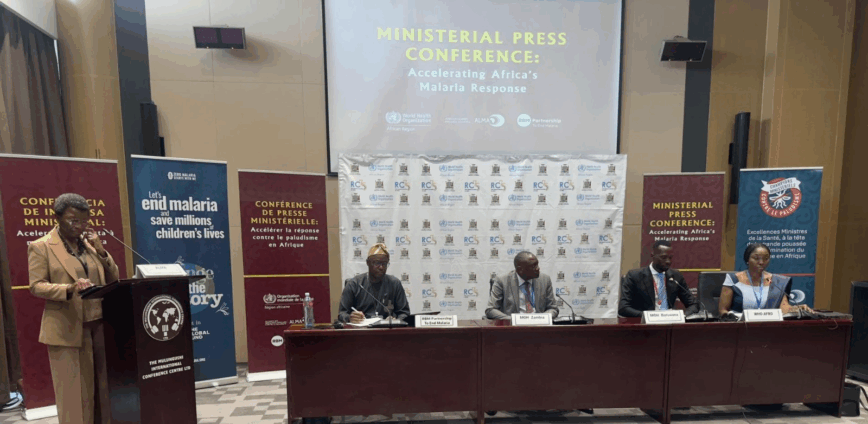
Speaking at the Seventy-fifth Session of the WHO Regional Committee for Africa (RC75) in Lusaka, Zambia, WHO Regional Director for Africa, Dr Mohamed Yakub Janabi, said malaria is at the frontline of Africa’s health security. He urged countries to act quickly to confront emerging threats and strengthen resilience.
“We need renewed political will, increased domestic financing, strong country leadership, and well-coordinated partnerships to continue with the delivery of impactful interventions that safeguard communities and accelerate the path to elimination,” Dr Janabi.
Dr Michael Adekunle Charles, CEO of the RBM Partnership to End Malaria, emphasised the critical need for financing saying that, the current resources cover less than half of what is required globally and to accelerate malaria elimination, the continent must close the funding gap through bold domestic investment and continued global support.
“Malaria financing saves lives, strengthens health systems, and enhances Africa’s readiness to confront future pandemics.”
The ministerial side-event further saw the unveiling of the Malaria Ministerial Champions commitments and the Champions’ Accountability Scorecard.
The Champions Initiative empowers Ministers of Health to champion malaria elimination by mobilising resources, driving cross-border collaboration, and scaling up innovations, while the Scorecard provides a common tool to track progress, share best practices, and hold leaders accountable.
Executive Secretary of the African Leaders Malaria Alliance (ALMA), Joy Phumaphi, said the malaria is more than a health issue, it is a development challenge and through the Ministerial Champions Initiative that, Africa is mobilising action, strengthening accountability, and ensuring malaria remains at the top of continent’s development agenda.
“Earlier this year, 10 Ministers of Health were appointed as Champions, and during this Regional Committee meeting, additional leaders are expected to join the growing cohort, which is proof that there is a strong momentum and demand for political leadership in the fight against malaria,” she added.
Assistant Minister of Health of Botswana, Lawrence Ookediste, stressed the importance of collective action in the fight against malaria, saying the role of the Ministerial Champions is to create political space, mobilize resources, break down barriers, and ensure malaria is integrated into national and regional development agendas.
“I am pleased that we now have a Ministerial Malaria Champions Accountability Scorecard to help us track the commitments we are making as champions,” Lawrence said.
According to Lawrence, it gives the continent a common reference point, with clarity, accountability, and the full weight of political leadership behind this collective effort.
Minister of Health of Zambia and Chair of RC75, Dr Elijah Muchima, reaffirmed Zambia’s commitment and leadership in advancing malaria elimination, citing already ongoing efforts.
Minister of Health of Zambia and Chair of RC75, Dr. Elijah Muchima, reaffirmed Zambia’s commitment to advancing malaria elimination, citing ongoing national efforts.
He noted that through the End Malaria Council, Zambia has mobilized public and private resources to sustain vector control, procure essential commodities, and support community health workers (CHWs).
One initiative, the Buy a Bicycle campaign, has already provided more than 18,600 CHWs with bicycles to reach remote rural communities.
“Ending malaria must be a priority that we own and fund beyond the support we receive from global partners,” he said.
Latest Stories
-
David Selassie Anthony declares bid for NDC Deputy National Organiser
5 minutes -
Amin Adam proposes 13 measures to strengthen Ghana’s debt transparency and market confidence
27 minutes -
Mahama announces $2bn annual investment to accelerate industrialisation
32 minutes -
Amin Adam urges monthly disclosure of Sinking Fund as Ghana prepares for DDEP repayments
42 minutes -
Stronger banks will fuel business growth and jobs – ADB MD
43 minutes -
Galamsey: ‘Rivers that fed our grandparents now run the colour of chocolate milk’ – Sam Jonah
45 minutes -
We have been scammed by NDC, government is only doing PR – Abanga Fuseini
46 minutes -
Republic Bank–JoyNews Habitat Fair opens in Ho today
47 minutes -
BoG pledges stability to attract investment, urges stronger Africa–Asia partnerships
51 minutes -
Amin Adam warns treasury bill dependence could expose Ghana to refinancing risks
51 minutes -
Ghana better placed to withstand commodity price shocks – IMF
54 minutes -
GAPTE intensifies efforts to increase bus availability for Aayalolo contra-flow
56 minutes -
Amin Adam warns cedi depreciation could reverse Ghana’s debt relief gains
60 minutes -
Fiscal discipline crucial for pension fund investments – Finance Minister
60 minutes -
BoG Governor rallies IMF to back Africa’s digital sovereignty
1 hour