

Audio By Carbonatix
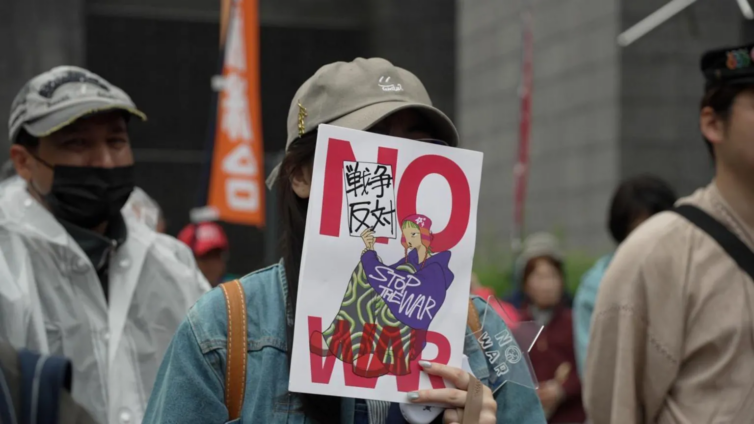
On a Tokyo street corner, in the pouring rain, a swelling crowd gathered with drenched placards and sodden flags. On one of them was written just two words, in large, bold Japanese kanji: "No War".
It's a sentiment gaining more and more traction in Japan, which is currently witnessing its largest anti-war protests in decades.
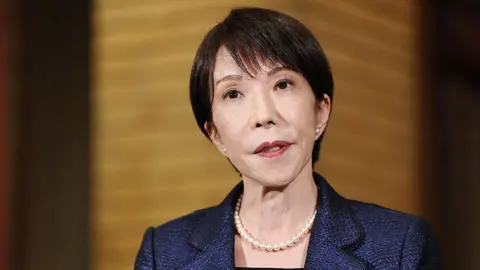
Since coming to power in October 2025, Japanese Prime Minister Sanae Takaichi has taken major steps away from the country's post-war pacifist stance, lifting long-standing restrictions on arms exports and expanding Japan's military role abroad.
The government says such moves are necessary in an increasingly tense region. But for many residents, it's raising alarm.
As fears grow that Japan is becoming a war-capable nation, protests are gaining momentum.
Public protests in Japan tend to be relatively restrained. There's a strong cultural understanding of social harmony and not causing disruption. So when people do take to the streets in large numbers, it usually signals something deeper.
This time, the issue is Japan's national identity.
The PM pushing for change
After World War Two, Japan adopted a constitution that includes Article 9, which prohibits the maintenance of armed forces and renounces war as a right of sovereignty.
Now, Takaichi says this framework no longer reflects reality. Geographically, Japan sits in a challenging neighbourhood with an assertive China, an unpredictable North Korea, and Russia nearby. And the United States, its closest ally, has been encouraging Tokyo to play a more active security role.
She's not the first Japanese leader to push for changes to Japan's postwar security framework.
Over the past few decades, conservative leaders, most notably from the ruling Liberal Democratic Party, have called for amendments to Japan's 1947 constitution. Former Prime Minister Shinzo Abe had advocated revising Article 9 to formalise the role of the self-defence forces.
Under Abe, the Diet passed a controversial security bill in 2015 to expand the role of Japan's armed forces. This allows Japan to exercise limited self-defence, including supporting allies under attack.
On 21 April, however, the Japanese government took a significant step: lifting its long-standing ban on exporting lethal weapons. It argued that allies must support one another in an increasingly severe security environment.
That decision struck a nerve with the Japanese people.
Outside the prime minister's office, as the rain suddenly cleared and sunlight broke through, the crowd swelled, and the chanting grew louder. This wasn't just an older generation holding on to the past. Many in their twenties and thirties were there too.
Akari Maezono, who is in her 30s, held brightly painted paper lanterns calling for peace.
"I'm angry that these changes could be made without properly listening to us, the public," she said.
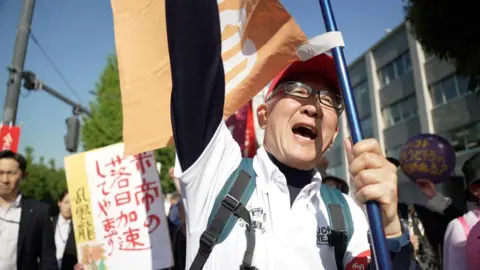
Nearby, an older gentleman stood tall, holding a bright red banner.
"The Japanese constitution, Article 9 in particular, must be protected at all costs," he said. "It kept Japan from being drawn into past conflicts like the US-Iran war. Without it, we surely would have entered the war by now."
'No more war'
Japan's 1947 constitution was enshrined just two years after the end of World War Two, when the United States defeated the country by dropping atomic bombs on Hiroshima and Nagasaki, killing some 200,000 people by the end of 1945.
Article 9's "pacifist clause" renounced war as a sovereign right of Japan, and stipulated that the country would not maintain military forces for the purpose of waging war - a principle that has since been reinterpreted to allow the self-defence forces to exist.
Supporters saw pacifism as a moral improvement on Japan's wartime militarism.
But even then, Article 9 wasn't universally accepted. It was controversial due to perceived foreign imposition, with critics arguing it was heavily shaped by the US. There were also security concerns about Japan's vulnerability amid rising Cold War tensions.
For many, though, especially those with living memory of conflict and the atomic bombings, any shift away from pacifism ignites fear. Recently, survivors of the Hiroshima atomic bomb pressed for the abolition of nuclear arms at the United Nations, calling for a human society free from nuclear weapons and war.
"Nuclear weapons were used because we went to war," said Jiro Hamasumi at the 2026 review conference of the Nuclear Non-Proliferation Treaty. He is a hibakusha, a Japanese word to describe bomb-affected people.
"No more war, no more hibakusha," he added.
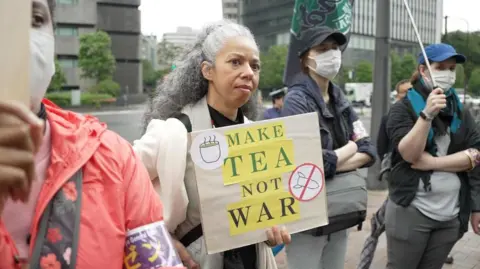
Some fear Japan could be drawn into conflict again, a sentiment that is playing out on the streets. Demonstrations have been spreading beyond Tokyo with rallies organised in other major cities like Osaka, Kyoto, and Fukuoka. Attendance is reportedly growing week by week, with posts on social media platforms like X playing a big role.
Younger Japanese, who feel they have more at stake in what comes next for Japan, are sharing details of the demonstrations and bringing along their friends.
But while the protests have swelled to some of Japan's largest in decades, they highlight just one side of the story.
A country divided
Across Japan, opinion is divided. Recent polls point in different directions. Some suggest growing support for a stronger military to keep up with the current world environment. Others show clear resistance.
Those in favour of constitutional revisions argue that Japan's security environment has fundamentally changed.
They say Article 9, written in the aftermath of defeat, is too restrictive, and that Japan must be able to deter aggression, support allies, and respond proactively to crises in the region.
For them, giving the military greater legitimacy is not about ignoring pacifism, but about ensuring the country can survive an increasingly unstable world.
Meanwhile, those against any revisions say incremental changes risk hollowing out the pacifist clause. They warn that strengthening military power and loosening long-standing restrictions could draw Japan into overseas conflicts.
For many, Article 9 is not just a legal constraint, but a moral commitment shaped by the devastation of past wars.
During the protests, in a streetside convenience store, a cashier's comments highlighted the division among the Japanese people.
"They're always here," he said of the protesters, with some impatience. Then he added: "Time for a new Japan."
That is the choice the country now faces: whether to hold on to a pacifist identity shaped by the past, or adapt to a more volatile future.
In a country where change has often come carefully and slowly, the question now is not just what Japan decides, but how quickly it's willing to decide it.
Latest Stories
-
Ghana’s tuna industry in crisis as 20 hook-and-line vessels collapse
6 minutes -
South Tongu MP launches apprenticeship programme for 159 young people
19 minutes -
The Pusiga connection behind Gertrude Atongi’s work in New York
46 minutes -
Teachers took promotion exams in December to beat government clearance deadline – GNAT
48 minutes -
NPA launches 2026 staff welfare week with focus on teamwork and employee wellbeing
51 minutes -
Ghana, Saint Kitts and Nevis sign labour deal to strengthen protections for Ghanaian nurses
57 minutes -
Delayed promotions put teachers’ retirement benefits at risk – GNAT
60 minutes -
No ‘Bawumia candidates’ in NPP executive elections – Anthony Karbo
1 hour -
Over 3,000 displaced as flooding overwhelms Hohoe communities
1 hour -
Sunyani East NPP executives begin reconciliation drive ahead of 2028 polls
1 hour -
Agric Minister engages Ga Mantse on agriculture transformation agenda
1 hour -
Aayalolo expansion targets private car users, not trotro operators – Mahama Ayariga
1 hour -
KNUST, GMTF explore AI partnership to transform healthcare delivery
1 hour -
MTTD records 9,000 preventable crashes, over 900 deaths in eight months
2 hours -
UN Secretary-General expresses optimism about future, pledges support for Mahama, AU
2 hours