

Audio By Carbonatix
Officials in Japan have warned of an increased risk of a "huge" earthquake in the next week after a 7.7 magnitude quake struck off the north-east coast, triggering an evacuation order and warnings of 3m (10ft) tsunami waves.
Thousands of people were told to leave coastal areas for higher ground after the quake in waters off Iwate prefecture, 530km (330 miles) north of the capital Tokyo.
The biggest tsunami waves measured 80cm. Tsunami warnings and advisories were lifted hours after the quake on Monday.
But Japan's meteorological agency has warned that quakes "causing even stronger shaking" could occur in the next week, producing bigger waves.
Authorities said the risk of an 8.0-magnitude or higher quake was "relatively higher than during normal times".
People in Japan are still scarred by memories of a huge quake in 2011 that triggered a tsunami, which killed more than 18,000 people and caused a meltdown at the Fukushima nuclear plant.
After Monday's undersea quake, recorded at a depth of 10km, warnings of possible bigger waves were issued to residents in areas nearest the epicentre - in Japan's main island, Honshu, and the northern region of Hokkaido.
Tremors were felt as far away as Tokyo.
In Hokkaido, tsunami alerts remained in place hours after the quake struck at 16:52 local time (08:52 BST).
"As soon as we heard the earthquake alert, everyone ran downstairs," Chaw Su Thwe, a Myanmar national living in Hokkaido, told the BBC. "However, this time the shaking was relatively mild.
"Right now, local authorities are using loudspeakers in the neighbourhood to warn people about a possible tsunami and to stay alert," she added. "Office workers have been allowed to leave work early."
A number of bullet trains were affected, and 100 homes were without power, Japan's Cabinet Secretary Minoru Kihara told reporters. He said there were no immediate reports of major damage or injuries.
Train services resumed on Monday night.
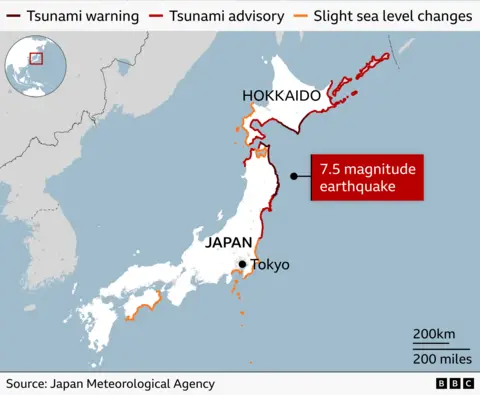
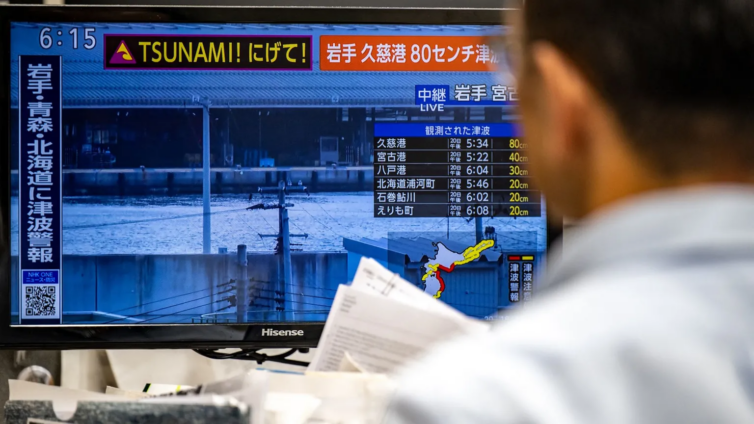
More than 170,000 people across several prefectures were ordered to evacuate after tsunami warnings were issued across parts of Japan's east coast.
The warning was the second-highest of three levels of alert, with people being told to leave coastal and riverside areas and move to higher ground or an evacuation building.
"Tsunami waves are expected to hit repeatedly. Do not leave safe ground until the warning is lifted," Japan's Meteorological Agency (JMA) told reporters in the hours after the quake - a plea echoed by Prime Minister Sanae Takaichi, who urged people to get to "higher, safer places".
It was later downgraded to a tsunami alert, before being removed entirely shortly before midnight local time.
Japan's precarious location on the Ring of Fire means it experiences about 1,500 earthquakes a year, and accounts for 10% of quakes measuring 6.0 magnitude or higher worldwide.
In March 2011, Japan was hit by the devastating 9.0-magnitude earthquake off the coast to the south of Iwate province, the most powerful earthquake it had ever recorded.
The meltdown at Fukushima was one of the worst nuclear disasters in history. Since then, the government issues warnings and advisories for people to get to higher ground.
Latest Stories
-
80–90% of gold purchased and exported is now refined in Ghana– Sammy Gyamfi
6 minutes -
Dichemso M/A teachers go house-to-house to get absent pupils back to class after strike suspension
9 minutes -
Meet Dr Hazel and Nhyira: Mother and daughter called to the Ghana Bar
12 minutes -
Black Star Fashion Week: Can Ghana turn the runway into a tourism attraction?
13 minutes -
Ghana sends 61 health workers to Grenada under Labour Export Programme
25 minutes -
Central banks should avoid reacting too strongly to headline inflation – IMF
31 minutes -
Kumasi: One injured, shops destroyed in Atasemanso fire in Kumasi
45 minutes -
Global economy proving resilient, growth projected at 3.1% in 2026 – IMF
49 minutes -
NDC targets all 6 parliamentary seats in Ahafo Region for 2028
52 minutes -
Ghana targets thousands of overseas nursing jobs under Labour Export Programme
54 minutes -
Pius Hadzide explains why Sports Ministry always attracts scandals
55 minutes -
APL says GoldBod terminated US$1bn Goldstream deal over failure to meet obligations
60 minutes -
Daily Insight for CEOs: Making better decisions under pressure
1 hour -
Weta rice farmers seek urgent support after floods destroy crops
1 hour -
Mahama commits GH¢200m in 2027 Budget to complete Police Hospital expansion
1 hour