


Audio By Carbonatix
Apple sold fewer iPhones than expected in its most recent quarter but higher selling prices meant the tech giant still beat Wall Street forecasts.
The firm said it sold 41.3 million iPhones in the three months to the end of June, up just 1% from last year.
But the average iPhone selling price hit $724, well above the expected $694.
The firm said its $999 iPhone X - launched last year - remained its most popular iPhone model in the quarter and had driven the higher sales price.
Strong revenue growth of 31% from Apple's services business, which includes the App store, Apple Music and Apple Pay, also boosted its performance.
The services business is on track for more than $14bn in revenue in 2020, chief executive Tim Cook said.
"We couldn't be happier with how things are going," he said.
Overall the tech giant's revenue jumped 17% year-on-year to a quarterly record of $53.3bn (£40.6bn), with every region except Japan reporting double digit growth.
Profits rose to $11.5bn, up 32% compared to the same period in 2017.
Shares in the Californian tech giant jumped more than 3% in after hours trading in New York.
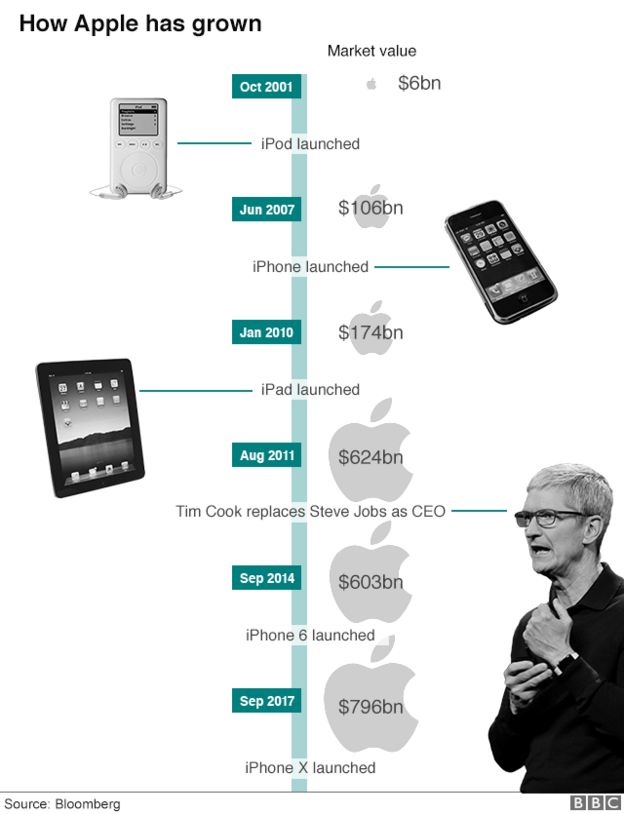
The gains brought Apple, already the world's most valuable company, one step closer to a market value of $1 trillion.
The strong demand for the firm's most expensive phones marked a contrast with the world's largest smartphone seller Samsung, which disappointed investorsby warning of lower than expected sales of its high-end Galaxy S9 .
But Apple faces increasing competition in the global smart phone market, which saw growth slip 0.3% last year, according to research firm International Data Corp.
Chinese tech company Huawei, which reported 15% revenue growth in the first half of this year, overtook Apple to become the world's second-biggest smartphone seller in the quarter, according to market research firm Canalys.
That left Apple in third place after Samsung and Huawei.
Tariff impact
Executives said they are confident about Apple's position. The firm forecast revenue in the range of $60bn to $62bn in the July to September period, indicating a fifth consecutive quarter of double digit growth.
Chief executive Tim Cook also downplayed concerns about how trade tensions between the US and China might affect Apple's business.
He said the firm had not been affected directly by the tariffs in place so far. It is still reviewing the implications of threatened tariffs on a proposed $200bn in Chinese goods, he added.
"Our view on tariffs is that they show up as a tax on the consumer and wind up resulting in lower economic growth and sometimes can bring about significant risk of unintended consequences," he said.
However, he said he was optimistic that "this will get sorted out".
Latest Stories
-
Mr President, Ghana was mentioned at the UN; why aren’t we talking about it?
2 hours -
Accra to convene Africa’s regulators and markets on tokenisation at AVAS 2026
2 hours -
The Paradox of Plenty — When every smartphone becomes a newsroom
2 hours -
GTA sensitises taxi drivers in ‘Know Ghana’ tourism campaign
3 hours -
Archbishop Agyinasare calls for responsible speech amid growing social media abuse
4 hours -
‘It will be inexcusable for gov’t not to honour payment of teachers’ arrears by 30th October’ – Haruna Iddrisu
4 hours -
Forbes’ World’s Best Employers 2026: No Ghanaian firm ranked among 900 companies
4 hours -
Electronic processing of teachers’ data: ‘The decision is the Controller’s’ – GES boss
4 hours -
Teachers’ Strike: Haruna Iddrisu questions paper-based processing of promoted teachers’ data
4 hours -
Savannah Region: Kunfusi bridge collapses again, leaving nearly 4,000 residents cut off
4 hours -
Teachers’ strike: GES targets Monday deadline to submit promotion data to Controller
4 hours -
Inflation to average 11.3% in 2027 – Fitch Solutions
5 hours -
‘I didn’t campaign for NDC to come and do this nonsense’ – Kpebu on EOCO’s conduct
5 hours -
Fitch Solutions maintains policy rate forecast of 14% by December 2026
5 hours -
Diaspora Nasara Caucus congratulates Mohammed Ali Suraj, new NPP executives
6 hours