

Audio By Carbonatix
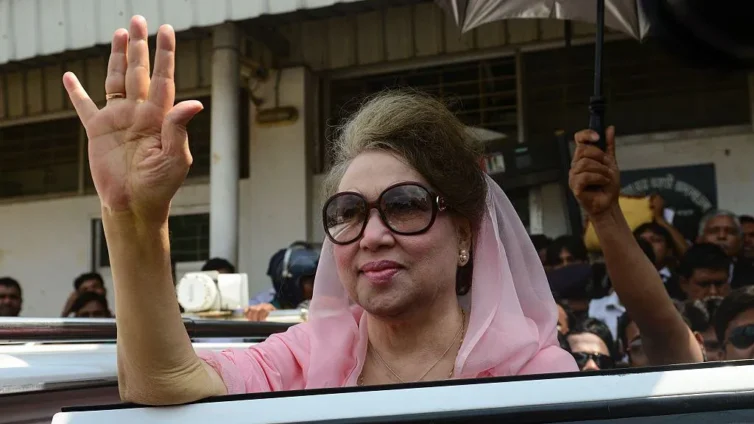
Bangladesh's first female prime minister Khaleda Zia has died at the age of 80 after suffering from prolonged illness.
Zia became Bangladesh's first female head of government in 1991 after leading her party to victory in the country's first democratic election in 20 years.
Physicians had said on Monday said her condition was "extremely critical". She was put on life support, but it was not possible to provide multiple treatments at the same time given her age and overall poor health, they said.
Despite her poor health, her party had earlier said that Zia would contest general elections expected in February, the first since a revolution which led to the ousting of Zia's rival, Sheikh Hasina.
Bangladeshi politics had for decades been defined by the bitter feud between the two women, who alternated between government and opposition.
"Our favourite leader is no longer with us. She left us at 6am this morning," Zia's Bangladesh Nationalist Party (BNP) announced on Facebook on Tuesday.
Crowds gathered outside Evercare Hospital in Dhaka where Zia was warded after news of her death broke. Photographs show police officers trying to stop them from entering the hospital premises.
Zia first came into public attention as the wife of Bangladesh's former president Ziaur Rahman, seen as a reserved presence alongside her husband. Following his assassination in a 1981 military coup, Zia entered politics and later rose to lead the BNP.
Known as an "uncompromising leader" after refusing to take part in a controversial election under military ruler General Hussain Muhammad Ershad in the 1980s, Zia broke through a male-dominated political landscape and transformed into one of Bangladesh's most formidable political leaders.
Her first term was widely praised for efforts to improve women's education and social development, with her government bringing back parliamentary democracy by amending the constitution with bipartisan support.
Her second term in 1996, which lasted only weeks, drew criticism for staging a one-sided election despite opposition demands for a neutral caretaker authority—a measure parliament approved before dissolving.
Zia returned as prime minister in 2001, stepping down in October 2006 ahead of a general election. Her administration faced sharp criticism over allegations of corruption.
Over the past 16 years, under the Awami League government, Zia became the most prominent symbol of resistance to a rule many saw as increasingly autocratic.
She boycotted the 2014 election after her rival Hasina scrapped the caretaker government system—a provision meant to ensure neutrality during national polls. Later, Zia was convicted on corruption charges and detained. She denied wrongdoing and said the charges were politically motivated.
She was released from last year, shortly after mass anti-government protests in Bangladesh toppled Hasina, forcing her into exile. The BNP had said in November that Zia would campaign in the upcoming general elections.
The BNP is eyeing a return to power, and if that happens, Zia's son Tarique Rahman is expected to become the country's new leader.
Rahman, 60, had only returned to Bangladesh last week after 17 years in self-imposed exile in London.
Zia had been in hospital for the past month, receiving treatment for kidney damage, heart disease and pneumonia, among other conditions.
Despite being kept away from public life due to her health, Zia remained a figurehead for opposition forces.
During her final days, interim leader Muhammad Yunus had called for the country to pray for Zia, calling her a "source of utmost inspiration for the nation".
In a statement on Tuesday, Yunus offered his condolences for the passing of Zia, whom he described as a "symbol of the democractive movement".
"The nation has lost a great guardian... Her role in the struggle to establish democracy, a multi-party political culture, and the rights of the people in Bangladesh will be remembered forever," he said in a statement.
Her family members, including Rahman, his wife and his daughter, were by her side in her last moments, BNP said.
"We pray for the forgiveness of her soul and request everyone to offer prayers for her departed soul," the party said in its statement on Tuesday.
Latest Stories
-
Iran war lands ‘triple blow’ to flood-ravaged Sri Lankans
22 minutes -
Gunmen kill at least 11 people at Afghanistan picnic spot
36 minutes -
Woman, 25, in court for stealing baby at Bogoso
37 minutes -
Trump unveils giant gold-accented victory arch design for US capital
40 minutes -
We spoke to the man making viral Lego-style AI videos for Iran. Experts say it’s powerful propaganda
45 minutes -
Hungarians vote in big numbers on whether to end Orbán rule and elect rival
46 minutes -
At least 30 feared dead in crush at Haitian tourist site
46 minutes -
Boxing: Abdul Ahmed wins WBA Africa Cruiserwight title after dispatching Nigeria’s Eradeye
59 minutes -
Nearly 2,000 displaced, schools damaged as windstorm wreaks havoc in Gushegu
1 hour -
Ghana’s Derrick Kohn to work under Marie-Louise Eta as she becomes first woman to coach men’s Bundesliga team
1 hour -
Accra Open Championships conclude with strong performances ahead of African Championships
1 hour -
Ghana to begin camping with 12 athletes after Accra Open Championships – Bawa Fuseni
2 hours -
Anthony Joshua declines showdown with Tyson Fury but admits they ‘probably’ clash next
2 hours -
Tyson Fury dominates Makhmudov, calls out Joshua next
2 hours -
I have supported highway authority financially to fix roads in my constituency – A Plus
3 hours