

Audio By Carbonatix
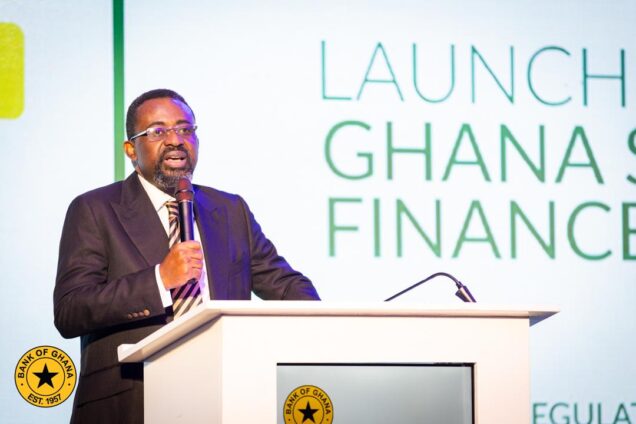
The Governor of the Bank of Ghana (BoG), Dr. Johnson Asiama, has called for stronger collaboration among Ghana's financial regulators, warning that climate and sustainability risks have become systemic challenges that no single institution can manage alone.
Speaking at the launch of the Ghana Sustainable Finance Roadmap in Accra, Dr. Asiama said the country's banking, insurance, pensions and capital markets regulators must align their strategies to build a resilient and sustainable financial system capable of supporting long-term economic growth.
He stressed that sustainable finance is no longer a voluntary initiative but a key pillar of financial stability, investment and economic resilience.
"In Ghana, financial stability is regulated across four sectors—banking, insurance, securities and pensions. Together, these pillars form an interconnected system whose strength depends on coordination, collaboration and a shared sense of responsibility," he said.
According to the Governor, emerging climate and sustainability risks transcend the traditional boundaries of financial regulation and require a unified response from all regulators.
"Risks of this kind respect none of these regulatory boundaries. A risk that moves across the whole system cannot be managed by any one institution sitting alone," he stated.
Dr. Asiama said the launch of the Sustainable Finance Roadmap signals Ghana's commitment to embedding sustainability across the financial sector through coordinated regulatory action.
"Achieving a truly sustainable financial ecosystem goes beyond individual mandates. It calls for coordinated, long-term collaboration among all relevant regulators aligned around a shared goal," he noted.
The Governor explained that sustainable finance has become increasingly important as global investors place greater emphasis on environmental, social and governance (ESG) standards when making investment decisions.
He noted that sustainable finance is reshaping global capital flows and investor expectations, presenting Ghana with an opportunity to attract new sources of investment while strengthening the resilience of its financial system.
Dr. Asiama also linked the urgency of the roadmap to the growing impact of climate change, citing the recent floods across parts of Ghana as a reminder that environmental shocks have direct consequences for the financial sector.
"A changing climate now bears directly on financial stability. Such risks do not stay in the environment alone; they travel into the financial sector through the value of assets, the cost of claims and the security of lending," he said.
Reflecting on the Bank of Ghana's sustainability journey, Dr. Asiama said the central bank began laying the foundation a decade ago with the establishment of the Sustainable Banking Principles Steering Committee in 2015.
That process led to the introduction of the Sustainable Banking Principles in 2019, which were voluntarily adopted by all 23 commercial banks in Ghana. With support from the International Finance Corporation (IFC) and Switzerland's State Secretariat for Economic Affairs (SECO), the Bank later introduced a framework to assess compliance, with industry-wide implementation reaching an average of 73 percent by September 2025.
He added that the Bank has since introduced its 2024–2028 Sustainability and Climate-related Risk Strategic Plan and a Climate-related Financial Risk Directive to strengthen the ability of regulated financial institutions to identify, assess and manage climate-related financial risks.
The Ghana Sustainable Finance Roadmap is expected to provide a common framework for regulators and financial institutions to integrate sustainability into governance, risk management and investment decisions, while supporting Ghana's broader development and climate objectives.
Latest Stories
-
NPP had more permanent fuel relief measures than current GH¢2 diesel cut – Amin Adam
20 minutes -
Photos from the 3rd Republic Bank-JoyNews Habitat Fair Clinic
22 minutes -
Ethiopia’s army promises restraint amid fears of new civil war
32 minutes -
Amin Adam calls for review of fuel taxes as diesel prices remain above GH¢18
1 hour -
World Vision Ghana, Ahafo districts sign MoU for universal WASH coverage
2 hours -
When the gold engine stutters: What Ghana’s Cedi and reserves are telling us about the new economic architecture
2 hours -
Two reportedly die after being trapped in mining pit at Juaboso
2 hours -
Petrosol cleans up Wa Municipal Hospital, to donate medical equipment
2 hours -
‘If NPP was ‘insensitive’ over fuel prices, NDC must accept same description now’ — Amin Adam
2 hours -
KiDi brings the hits to London in sold-out UK headline concert
2 hours -
The last goodbye of Ghanaian shot dead in the US
3 hours -
MCC opens door to Ghana again as MiDA revives development partnership
3 hours -
CSIR moves to turn scientific research into jobs, national growth
3 hours -
More patrons troop in as 3rd Republic Bank-JoyNews Habitat Fair clinic enters final day stretch
3 hours -
German, Russian foreign ministers hold rare talks amid rising tensions
3 hours