

Audio By Carbonatix
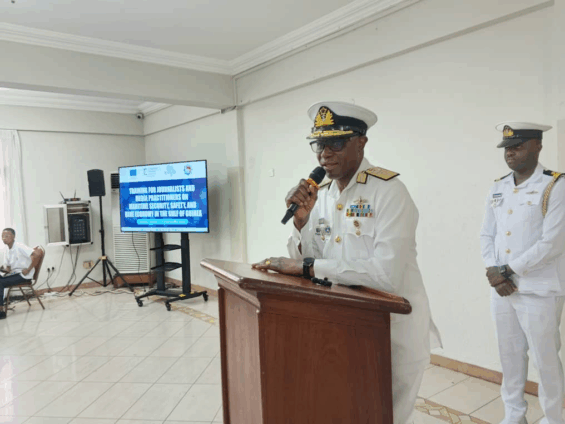
Rear Admiral Livinus Bessing, the Chief of Naval Staff, has charged the media to play its advocacy role to urge governments to adequately equip the Ghana Navy to be able to ensure maritime security for Ghana.
Rear Admiral Bessing said it was not as though the Navy could not effectively discharge its duties, but rather the lack of logistics was a big challenge hindering their operations.
He gave the charge at the opening ceremony of a three-day training for journalists and media practitioners on maritime security, safety, and the blue economy in the Gulf of Guinea.
It was organised by the European Union-Enhanced Maritime Action in the Gulf of Guinea (ENMAR) and the Gulf of Guinea Maritime Institute (GoGMI), with funding from the European Union and implemented by Expertise France.
The Chief of Naval Staff said not too long ago, a French navy ship called at the Tema Port and was able to make an arrest of over 10 tonnes of narcotic drugs in the country’s waters, stressing that “It’s because most of our navies, especially on the Gulf of Guinea, are not well resourced.
It is not because we do not know how to do our work, but we simply don’t have the needed tools to do our work,” he added.
He said it would take journalists and the media to play that kind of advocacy so that governments would see the need to provide such resources for the navy, explaining that the maritime environment was quite far and could not be easily seen from the shoreline, and that several things happened on the blind side of everyone.
Rear Admiral Bessing emphasised that the navy operated within an environment that needed media coverage, citing for instance that security issues from land were easily covered because it could be seen, but what happened at sea normally went unnoticed.
He pleaded with the media to increase its advocacy for the navy to be able to perform their duties and effectively play their role in guarding the nation’s marine territories.
He said Ghana loses about 200 million dollars to Illegal, Unregulated and Unreported (IUU) fishing and other maritime security issues, which could be handled by the navy with the requisite tools, regretting that they had been advocating for a flagship project to acquire two Offshore Patrol Vessels (OPVs) since 2010 without success.
“This project has gone through several governments, but we are yet to get it. The platforms cost less than 200 million dollars. You can imagine from 2010 till now, 200 million times 15 could have bought us several of the platforms, and this is the sort of advocacy I will wish to challenge you with,” he said.
Rear Admiral Bessing encouraged media practitioners to contact the navy for information about their activities at sea and the threats, such as piracy and drug trafficking, so they could advocate for the needed support for them, to help improve the protection of Ghana’s maritime domain.
Mr Albert K. Dwumfour, the President of the Ghana Journalists Association (GJA), in a keynote address, said various strategies and actions by the country underscored its leadership and commitment to safeguarding the maritime domain, while advancing the collective security of the Gulf of Guinea.
Mr Dwumfour noted that it was also the reason why the work of journalists profoundly mattered, adding that too often, maritime issues were treated as technical matters for specialists and remained hidden from the public eye.
However, when journalists make these issues visible and explain the human cost of illegal fishing, the risks of piracy, or the promise of a thriving blue economy, they could do more than just giving information.
“You hold leaders accountable, shape public debate, and create the conditions for better governance of our ocean space,” he said.
He urged the participating journalists to have the conviction, by the end of the work, that the maritime story was a Ghanaian story, a West African story, and ultimately a story about human security and sustainable development.
The GJA President observed that the ocean’s future must not be narrated by a few, stressing the importance of diversity of voices, which made media reporting stronger, debates richer, and democracies healthier.
Latest Stories
-
Iran war lands ‘triple blow’ to flood-ravaged Sri Lankans
26 minutes -
Gunmen kill at least 11 people at Afghanistan picnic spot
40 minutes -
Woman, 25, in court for stealing baby at Bogoso
41 minutes -
Trump unveils giant gold-accented victory arch design for US capital
44 minutes -
We spoke to the man making viral Lego-style AI videos for Iran. Experts say it’s powerful propaganda
49 minutes -
Hungarians vote in big numbers on whether to end Orbán rule and elect rival
49 minutes -
At least 30 feared dead in crush at Haitian tourist site
50 minutes -
Boxing: Abdul Ahmed wins WBA Africa Cruiserwight title after dispatching Nigeria’s Eradeye
1 hour -
Nearly 2,000 displaced, schools damaged as windstorm wreaks havoc in Gushegu
1 hour -
Ghana’s Derrick Kohn to work under Marie-Louise Eta as she becomes first woman to coach men’s Bundesliga team
1 hour -
Accra Open Championships conclude with strong performances ahead of African Championships
2 hours -
Ghana to begin camping with 12 athletes after Accra Open Championships – Bawa Fuseni
2 hours -
Anthony Joshua declines showdown with Tyson Fury but admits they ‘probably’ clash next
2 hours -
Tyson Fury dominates Makhmudov, calls out Joshua next
2 hours -
I have supported highway authority financially to fix roads in my constituency – A Plus
4 hours