

Audio By Carbonatix
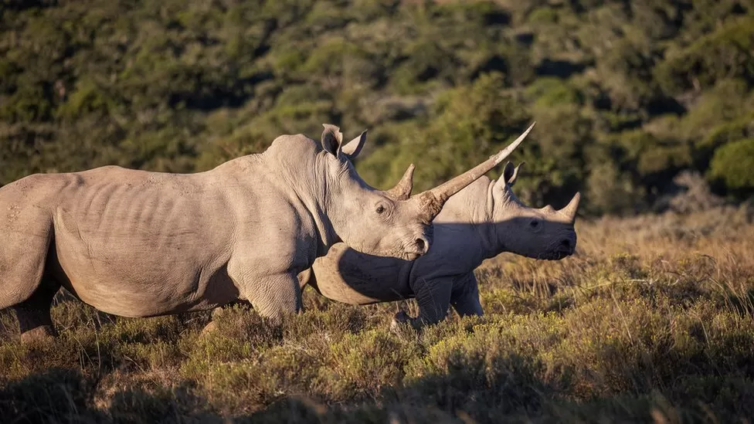
Conservation group African Parks plans to release 2,000 southern white rhinos into the wild after buying the world's largest private captive rhino breeding operation in South Africa.
The giant animals, the second-largest land mammal, are considered to be under extreme pressure due to poaching.
There are thought to be 18,000 southern white rhino left. They are classified as a near-threatened subspecies.
African Parks hopes to "rewild" the animals over the next 10 years.
The group secured emergency funding to buy the financially struggling 7,800-hectare (19,000-acre) rhino farm, known as Platinum Rhino, in South Africa's North West province, after owner John Hume put it up for sale in April.
African Parks' project marks one of the largest continent-wide rewilding programmes undertaken for any species.
CEO Peter Fearnhead said they initially had no intention of owning of a captive rhino breeding operation however they "fully recognise the moral imperative of finding a solution for these animals, so that they can once again play their integral role in fully functioning ecosystems".
The organisation says it plans to release the rhinos into secure, well-managed areas to protect them from poaching and it will work with funding partners, governments and other conservation groups to ensure this happens.
Mr Hume has received recognition as a conservationist however, he has also faced criticism for advocating the trade in rhino horn. He has argued that the trade was necessary to safeguard his rhinos from poaching and raise funds to sustain the farm.
The southern white rhino population plummeted to an all-time low of 30 to 40 animals in the 1930's however through effective conservation measures, the numbers surged to more than 20,000 in 2012.
There are only two surviving members of the other subspecies, the northern white rhino - both female and both in Kenya. It is thought that rhino-horn poaching brought about their near extinction.
Most of the southern white rhinos are found in South Africa, Namibia, Zimbabwe, and Kenya.
The International Union for Conservation of Nature says a species is "near-threatened" when it is thought it could be vulnerable in the near future.
Latest Stories
-
When vulnerability shows up, run – Rev. Daniel Annan cautions women
27 seconds -
FDI rises from $624m to $2.62bn as Tema industrial activity picks up – Mahama
6 minutes -
Artificial stability or sustainable equilibrium? Rethinking the Cedi’s performance
16 minutes -
GIPA CEO calls for investment to support Ghana’s economic transformation
21 minutes -
Banks to suspend lending to public sector workers under Controller and Accountant General’s payroll
30 minutes -
GAUA strike leaves some KNUST administrative offices operating below capacity
49 minutes -
Three suspected illegal miners arrested in Tano-Boin Forest Reserve
1 hour -
AratheJay brings Nimo Live Experience to Cape Coast on October 11
1 hour -
UBIDS hosts WAC-SRT closing conference as regional partners push for sustainability beyond funding cycle
1 hour -
FIFA Ranking: Ghana drop five places to 70th following AFCON qualifying defeats
1 hour -
No rift between Agric and Finance Ministries — Eric Opoku dispels rumours
1 hour -
BRICS: Jinapor cautions Ghana against ‘free lunch’ as NPP demands scrutiny
1 hour -
Bono East Education Directorate invites basic school teachers for SHS/SHTS reposting
1 hour -
Wa West MP commissions education and health infrastructure projects across rural communities
1 hour -
Daily Insight for CEOs: Building new revenue streams
1 hour