

Audio By Carbonatix
President John Mahama says the Tema industrial enclave is gradually reclaiming its former glory as Ghana records a significant increase in foreign direct investment (FDI).
According to President Mahama, FDI increased from US$624 million in 2024 to US$2.62 billion in 2025, representing a substantial rise in capital committed by foreign investors to the Ghanaian economy.
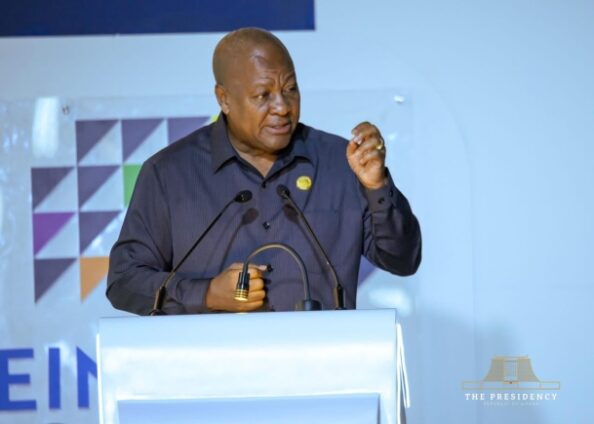
The President made the remarks on Thursday, October 8, at the commissioning of an expanded evaporated milk production line operated by Nestlé Ghana in Tema, where he linked the company’s investment to what he described as improving economic stability and a more favourable investment climate.
He said the renewed industrial activity in Tema was a particularly important sign of Ghana’s economic recovery, arguing that the industrial enclave was beginning to reclaim the prominence it enjoyed in the past.
“I’m pleased to say that Tema is regaining its glory days,” President Mahama said.
Tema industrial activity gathers pace
President Mahama pointed to developments across the Tema industrial corridor as evidence of increased economic activity, including the expansion of the Tema Port and the resumption of operations at the Tema Oil Refinery.
He also said his administration was working towards reviving the Volta Aluminium Company (VALCO), while noting that industrial activity within the enclave was continuing to expand.
“The ports of Tema have expanded. Tema Oil Refinery is back at work again. We’re working on reviving VALCO. The industrial enclave is progressing, and many industries like Nestlé existing in the Tema enclave are expanding their production,” he said.
The President attributed the renewed investment activity to what he described as an improved business and macroeconomic environment.
“This is because the investment climate is good,” he said.
Inflation and interest rates
President Mahama also highlighted developments in inflation and interest rates as indicators of improving economic conditions.
He said inflation, which he put at 23.8 per cent, had fallen to about 5.2 per cent, while interest rates were also declining, with spreads ranging between 9 and 13 per cent.
He further pointed to the performance of the Ghanaian cedi, saying the currency had regained strength after a prolonged period of pressure.
“And our long-suffering local currency, the cedi, has regained its strength and is relatively performing very well,” he said.
The President argued that these indicators should not be viewed merely as statistics but in terms of their impact on investment decisions.
“I do not recite these figures for their own sake because stability is not a number in the report. It is a difference between a company that shelves an expansion and one that decides to go forward with investments,” he said.
Stability and investor decisions
According to President Mahama, improved macroeconomic conditions can influence decisions taken by international companies when considering whether to commit additional capital to Ghana.
He cited the example of corporate decision-making outside Ghana, saying economic stability could give international boards greater confidence to approve investments in the country.
“It helps a boardroom in Switzerland to take decisions to commit capital to Tema with greater confidence,” he said.
The President, however, acknowledged that businesses operating in Ghana still face risks, particularly those associated with movements in the local currency.
“Businesses must still account for currency risk in their decisions,” he cautioned.
Nestlé expansion seen as industrial confidence
President Mahama described Nestlé Ghana’s expanded evaporated milk production line as an important demonstration of private-sector confidence in Ghana’s long-term economic prospects.
He said the investment was consistent with the government’s broader industrialisation ambitions under its Reset Agenda, which seeks to strengthen productive sectors of the economy and encourage investment.
“The line before us is a welcome sign of Nestlé’s confidence in Ghana’s long-term prospects, and it aligns with the industrial ambitions of our Reset Agenda,” he said.
The President’s comments place the expansion of Nestlé Ghana within a broader effort to position Tema once again as a major industrial and manufacturing centre.
Tema was developed as Ghana’s principal industrial and port city during the administration of Ghana’s first President, Dr Kwame Nkrumah. Over the decades, the area has hosted major manufacturing, petroleum, aluminium and other industrial operations.
President Mahama’s remarks suggest that the government sees the revival and expansion of industrial production in Tema as an important component of its wider economic strategy.
The reported increase in FDI, alongside the government’s emphasis on falling inflation, interest rates and improved currency performance, is being presented by the administration as evidence of changing economic conditions.
However, the President acknowledged that businesses must continue to factor currency risks into investment decisions, underscoring the importance of sustained macroeconomic stability as Ghana seeks to attract and retain long-term capital.
Latest Stories
-
Peki SHS old students to break ground for new entrance gate
4 minutes -
PAC Ranking Member accuses Health Ministry of ‘organised crime’ over GH¢10m outstanding car loans
19 minutes -
GAUA strike disrupts student registration at University of Ghana
23 minutes -
Tema is regaining its industrial glory days as Ghana’s industrial city – Mahama
26 minutes -
FBI says more than 130 detained in Ghana over scam operation targeting US victims
35 minutes -
BlaKid reflects on Shatta Wale collaboration and TGMA recognition
44 minutes -
When vulnerability shows up, run – Rev. Daniel Annan cautions women
48 minutes -
FDI rises from $624m to $2.62bn as Tema industrial activity picks up – Mahama
53 minutes -
Artificial stability or sustainable equilibrium? Rethinking the Cedi’s performance
1 hour -
GIPA CEO calls for investment to support Ghana’s economic transformation
1 hour -
Banks to suspend lending to public sector workers under Controller and Accountant General’s payroll
1 hour -
GAUA strike leaves some KNUST administrative offices operating below capacity
2 hours -
Three suspected illegal miners arrested in Tano-Boin Forest Reserve
2 hours -
AratheJay brings Nimo Live Experience to Cape Coast on October 11
2 hours -
UBIDS hosts WAC-SRT closing conference as regional partners push for sustainability beyond funding cycle
2 hours