

Audio By Carbonatix
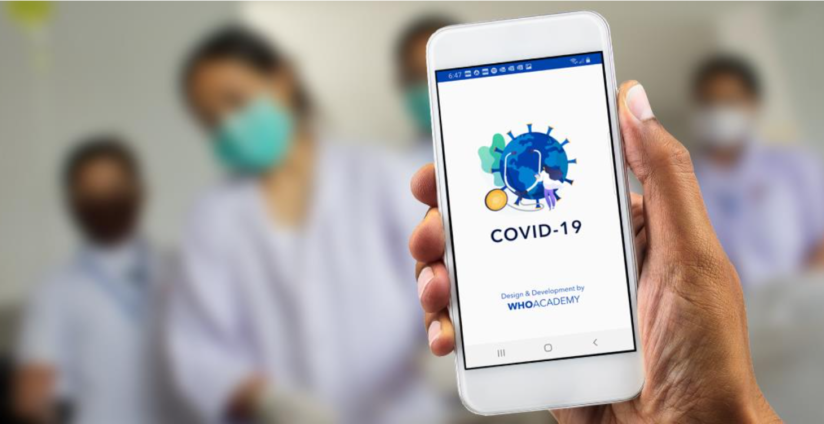
A mobile phone app can detect COVID in people's voices with "potentially high precision" using artificial intelligence (AI), according to researchers.
An AI model was said to be 89% accurate and cheap to use, which means it could be adopted in low-income countries where PCR tests are more expensive.
Results can be provided in less than a minute and are said to be a "significant improvement" on the accuracy of lateral flow tests, scientists said.
Infection normally impacts the upper respiratory tract and the vocal cords and so researchers decided to analyse changes in voices using an AI model to detect COVID.
Wafaa Aljbawi, a researcher at the Institute of Data Science at Maastricht University in the Netherlands, said: "These promising results suggest that simple voice recordings and fine-tuned AI algorithms can potentially achieve high precision in determining which patients have COVID-19 infection.
"Such tests can be provided at no cost and are simple to interpret. Moreover, they enable remote, virtual testing and have a turnaround time of less than a minute.
"They could be used, for example, at the entry points for large gatherings, enabling rapid screening of the population."
Data was used from the University of Cambridge's crowd-sourcing COVID19 Sounds app. This included 893 audio samples from 4,352 healthy and non-healthy people.
Users need to give information about their medical history, smoking status and demographics and record some respiratory sounds, such as coughing and reading a short sentence.
A voice analysis technique - called Mel-spectrogram - identified different voice features to "decompose the many properties of the participants' voices".
Ms Aljbawi added: "These results show a significant improvement in the accuracy of diagnosing COVID-19 compared to state-of-the-art tests such as the lateral flow test.
"The lateral flow test has a sensitivity of only 56%, but a higher specificity rate of 99.5%. This is important as it signifies that the lateral flow test is misclassifying infected people as COVID-19 negative more often than our test.
"In other words, with the AI LSTM model, we could miss 11 out of 100 cases who would go on to spread the infection, while the lateral flow test would miss 44 out of 100 cases."
The AI model is also being used for an app to predict exacerbations in chronic obstructive pulmonary disease.
The research is due to be presented to the European Respiratory Society International Congress in Barcelona on Monday.
Latest Stories
-
Amin Adam calls for review of fuel taxes as Diesel prices remain above GH¢18
7 minutes -
World Vision Ghana, Ahafo districts sign MoU for universal WASH coverage
37 minutes -
When the gold engine stutters: What Ghana’s Cedi and reserves are telling us about the new economic architecture
54 minutes -
Two reportedly die after being trapped in mining pit at Juaboso
1 hour -
Petrosol cleans up Wa Municipal Hospital, to donate medical equipment
1 hour -
KiDi brings the hits to London in sold-out UK headline concert
2 hours -
The last goodbye of Ghanaian shot dead in the US
2 hours -
MCC opens door to Ghana again as MiDA revives development partnership
2 hours -
CSIR moves to turn scientific research into jobs, national growth
2 hours -
More patrons troop in as 3rd Republic Bank-JoyNews Habitat Fair clinic enters final day stretch
2 hours -
‘If NPP was ‘insensitive’ over fuel prices, NDC must accept same description now’ — Amin Adam
2 hours -
German, Russian foreign ministers hold rare talks amid rising tensions
2 hours -
Gov’t to develop policy for Ghanaian Sign Language in education
3 hours -
Accra Academy defend ODADEƐ ’90 5-a-side title
3 hours -
Ghana risks EU gas market access over methane emissions – Expert warns
3 hours