

Audio By Carbonatix
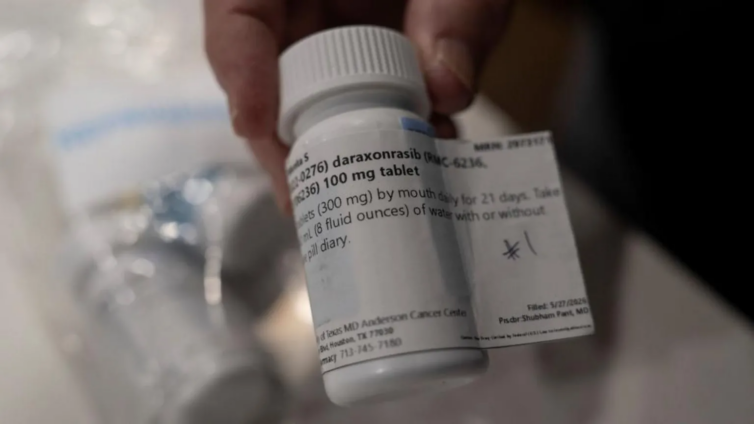
A pill has been found to almost double the survival time for advanced pancreatic cancer patients, with experts describing the trial as a game-changer.
The drug, called daraxonrasib, appears to be a breakthrough in managing a disease that has the highest mortality rate of all major cancers.
It helps prevent the spread of cancer by locking onto and shutting off the mutated KRAS gene, which is in more than 90% of pancreatic tumours and spurs cancer growth.
The trial, which included 500 patients in North America, Europe, and Asia, found the average survival time for patients on chemotherapy was 6.6 months, compared with 13.2 months for patients on daraxonrasib. It also caused fewer side effects.
"These results are landscape-changing for metastatic pancreatic cancer patients with a KRAS mutation," said Rachna Shroff, chief of the division of haematology/oncology at the University of Arizona Cancer Centre.
Pancreatic cancer is often spotted late and is notoriously difficult to treat. More than half of people with pancreatic cancer die within three months of diagnosis.
There are 11,500 diagnoses of the disease in Britain each year and around 10,200 deaths, according to Cancer Research UK. Actor Alan Rickman died of the disease in 2016, five months after diagnosis.
Symptoms can include jaundice, itchy skin, darker pee, paler poo, unexplained weight loss, tiredness and high temperature.
It can be difficult to diagnose because the symptoms often do not appear in the early stages and can point to other conditions.
The trial, led by American scientists and presented at the American Society of Clinical Oncology annual meeting in Chicago, involved 248 patients who received daraxonrasib and 252 who received chemotherapy.
Most had tumours with specific mutations of the KRAS gene.
As well as significantly extending the lives of patients, the drug, taken once daily, also caused fewer side-effects when compared to chemotherapy.
Severe side-effects were experienced by 43.6% of patients on daraxonrasib compared to 57.5% on chemotherapy.
Anna Jewell, director of services, research and innovation at Pancreatic Cancer UK, said the treatments were "some of the most exciting developments we have seen in pancreatic cancer for a very long time".
She added: "More time with those we love most is truly priceless. We must do everything possible to ensure the most promising new treatments are available here in the UK."
Latest Stories
-
Banks accounted for 86% total enquiries for credit in 2025
11 minutes -
Over 25m enquiries conducted by financial institutions for credit appraisals, others in 2025
27 minutes -
Eiffel Tower chief to quit after female staff replaced by men during religious visit
50 minutes -
South Africa to clean up high-risk areas after 12 women killed
1 hour -
Kpandai case sets the precedent – Habib Iddrisu challenges Speaker’s rejection of drug probe
1 hour -
Habib Iddrisu questions Speaker Bagbin’s rejection of motion after Parliament recall
1 hour -
More than 400 detained as France student protests escalate
2 hours -
Ballon d’Or Power Rankings: Lamine Yamal leads race for Golden Ball ahead of Rodri and Kane
3 hours -
‘Nothing worked for us’ – Gideon Mensah takes responsibility for Gambia defeat
3 hours -
Habib Iddrisu says rejected motion was exactly what triggered Parliament recall
4 hours -
Spain announces ban on evictions after protests over 87-year-old woman’s removal from flat
4 hours -
Habib Iddrisu ‘very surprised’ as Speaker rejects Parliament recall motion
4 hours -
Speaker’s decision to reject recall motion catches Dep Minority Chief Whip off guard
5 hours -
2026 Women’s Super Cup: FC Savannah beat Epiphany Warriors to win trophy for first time
5 hours -
Fifa accuses Uefa of ‘misinformation campaign’
5 hours