

Audio By Carbonatix
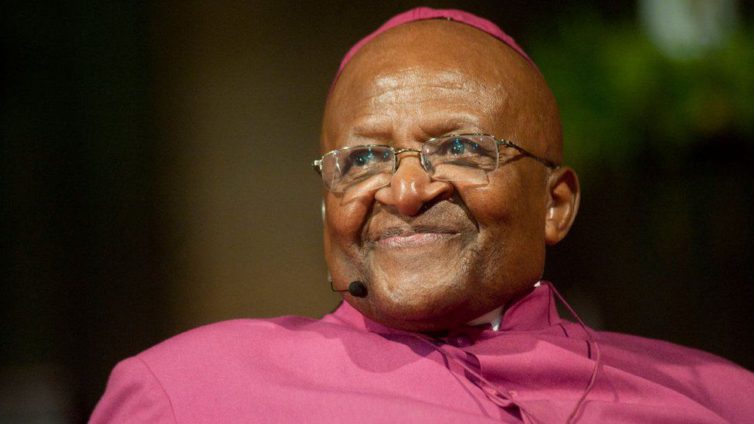
Desmond Tutu is remembered with so much joy and affection by so many different people around the world today, that it may seem hard to imagine a time or place when he was viewed, not as a courageous moral crusader, but as a devil.
It was the mid-1970s, and South Africa was ruled by a white-minority regime through a brutal system of racial apartheid. Nelson Mandela was in prison and his Soviet-backed liberation movement, the ANC, was outlawed.
Increasingly, white South Africans focused their fears and hatred on a diminutive but outspoken Anglican priest, recently appointed to a prominent Church position in Johannesburg.
"Tutu was the devil incarnate. Literally. One of our family friends said that. He was the embodiment of evil, and the hatred was just extraordinary," remembered John Allen, a white journalist who later became Desmond Tutu's official biographer.
"It was an era when the leadership of the liberation movements was banned, jailed or in exile, and here was this person who was saying what most black South Africans felt. Tutu really was public enemy number one, when Mandela was out of sight, out of mind. He had this extraordinary power to communicate. He would not honey his words so as not to offend white Anglicans," said Allen.
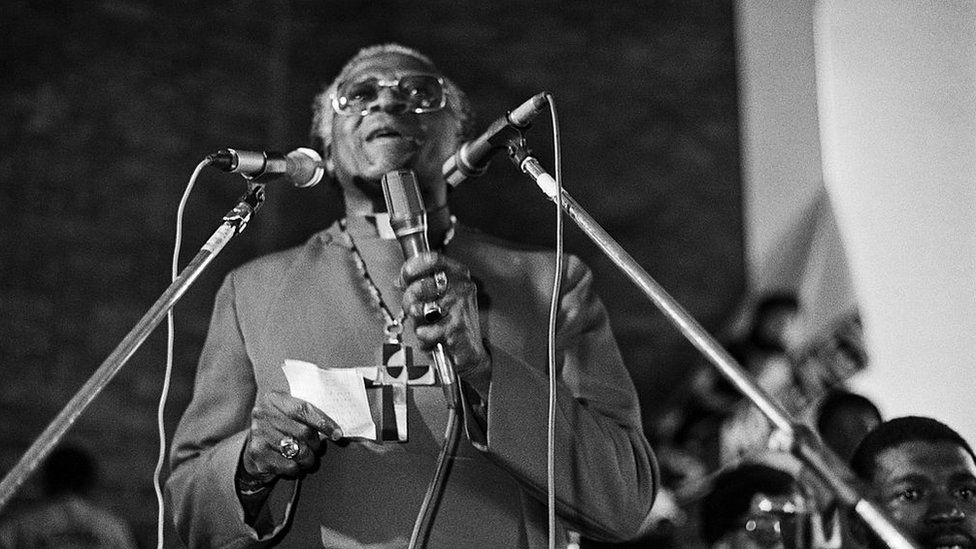
From his pulpit, Tutu spoke out against apartheid in a city where black people - their lives controlled by strict racist laws - required special passes simply to walk into "white" neighbourhoods.
"Tutu wasn't a front for political movements. I think that's what gave him his moral and spiritual freedom," said Peter Storey, who led South Africa's powerful Council of Churches. "It made him very powerful because he was up against an apartheid government that wrapped itself in the Church… and yet here was this black Anglican, able to hit the regime at one of their most vulnerable points.
"Desmond could point out to them - if you claim to be Christian, how can you possibly treat my people like this? This is why he was such an irritant to them."
Frank Chikane, a prominent liberation leader who was poisoned, and nearly killed, by the same apartheid security forces that also looked for ways to silence Tutu, said: "Tutu was the face of the liberation struggle. The voice of the people. He was a key prophetic voice. But he was non-violent, from beginning to end."
"It was a very scary moment," Peter Storey recalled, of the time when he and Tutu were kidnapped and taken into the bush by armed men who said they had instructions "to kill us".
"For some reason they let us go. Later… we were driving down the road back to Pretoria when Desmond said, 'let us pray.' He was at the wheel… and his eyes were closed. So, I held the wheel. I didn't want to give death another shot at us so soon afterwards.
"But that was Desmond. Nobody understands him unless they understand how deeply he was a man of prayer. I remember him saying, 'I'm not afraid of these people, because the worst they can do is kill me. And I'm not afraid of death," said Peter Storey.
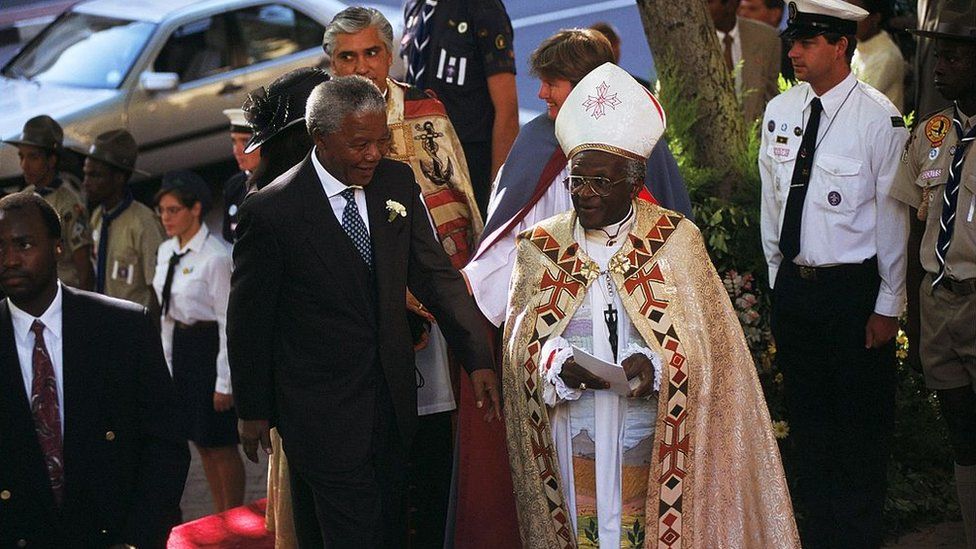
But Tutu - increasingly prominent as the face and voice of the liberation movement - combined fearlessness with a famously mischievous sense of humour, which often helped him to diffuse tensions when confronted with angry crowds in black townships, often after funerals.
"He had the ability to channel people's anger, and then the ability to say 'we are better than those people who are up against us, we don't have to be like them," Peter Storey said.
"And he would use humour at times like that. At the very darkest moments you would hear this diminutive bishop stand up and say to the regime, 'why don't you join the winning side before it's too late?' And people would laugh. But they would also know he was telling the truth because he was so utterly convinced that justice would prevail."
John Allen recalled: "There is a giggle. But to me it's a cackle. Mostly it was uproarious laughter. And he used to say that laughing is very close to crying."
Abroad, Tutu was also known for his humour when engaging with foreign leaders and pushing for the imposition of sanctions against South Africa's apartheid government, but he could be brutally frank too.
"He was very critical in terms of campaigning for sanctions. He was key, there's no doubt about it. He came at the right time," recalled Frank Chikane.
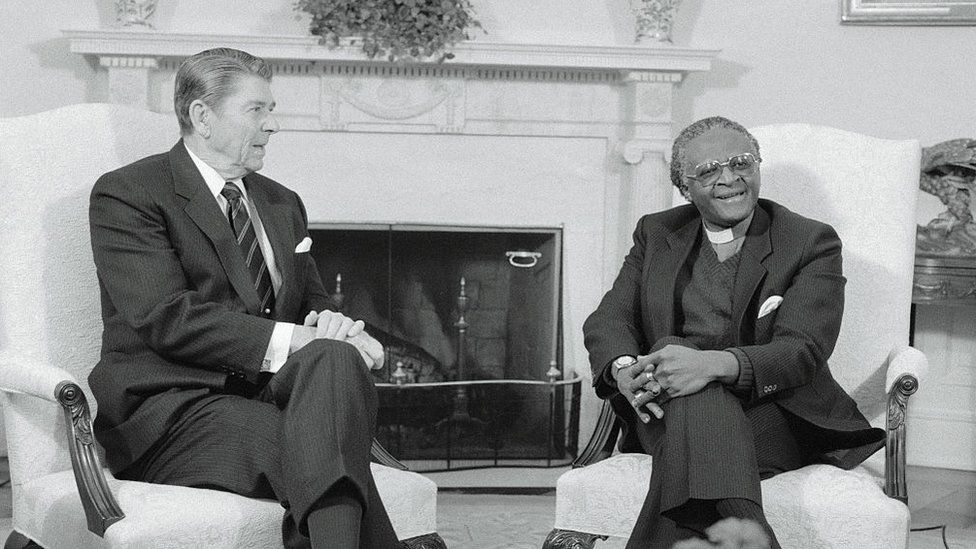
"Tutu was scathing of the blindness of people who - for economic and political reasons - had a stake in preserving white dominance in South Africa. His opinion of Ronald Reagan was scathing. He called him [a racist]. Tutu's role was to be clear cut, and not to allow himself to be sucked into the ifs and buts and compromises," said Storey.
Later, in the aftermath of South Africa's first democratic elections and the establishment of a Truth and Reconciliation Commission (TRC) to delve into the crimes of the apartheid era, those working closely with Tutu saw his public tears, and frequent songs, as the work of a man trying to hold a mirror up to a deeply damaged society.
"There were many moments when he would cry," said Pumla Gobodo-Madikizela, who served on the TRC's human rights violations committee.
"And he started the practise of singing… about the pain of our past. It was almost as if he was carrying the whole country on his shoulders. He walked into the room and you could feel the sense of hope - no question about it. He was almost like royalty, representing the journey towards freedom for everybody. He was driving the country towards peace and that process (at the TRC) would never have been what it was without him."
Peter Storey said: "We needed a healer. Tutu became the nation's pastor and helped us navigate that road to healing. The Truth commission became a safe space for people to share their pain. And also for the bad guys - if they were willing - to come and find some kind of healing themselves. And Desmond was, I think, the perfect person to help that happen while maintaining that incredibly steely strength which refused to be pressured… particularly by the ANC."
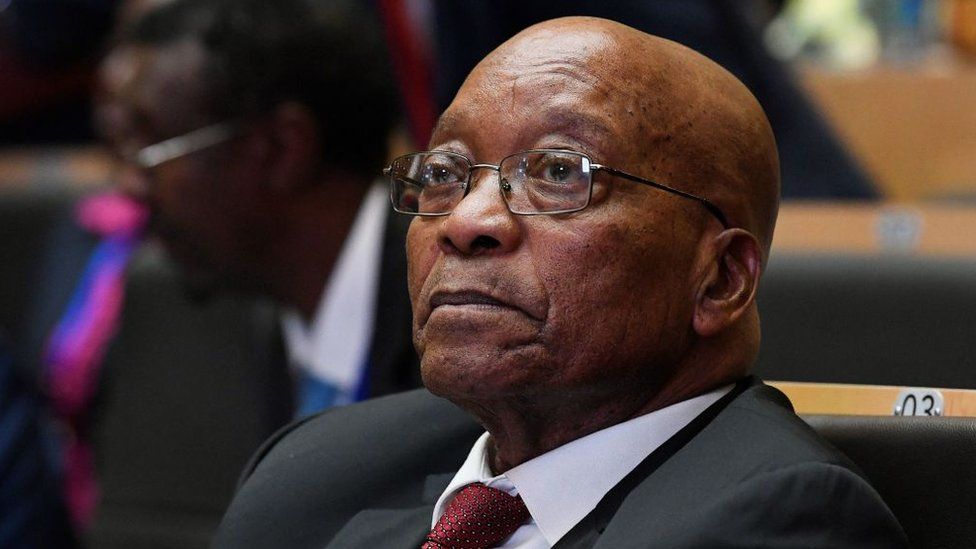
In more recent years, Tutu became fiercely critical of the ANC's failures in government, in particular its slide towards corruption. But President Jacob Zuma's administration chose to ignore, or sideline the archbishop, even attempting to prevent him from attending Nelson Mandela's funeral.
So how, in old age, did Tutu judge South Africa's current struggles - the inequality, unemployment and violence that continue to plague so many communities?
"I remember sitting with him not all that long ago and him saying, 'You know, Peter, we understand human nature. And so we shouldn't be surprised. But we are allowed to be very, very sad,'" said Peter Storey.
Latest Stories
-
Tamale Child Deaths: Vehicle owner arrested as IGP deploys homicide team
11 minutes -
From ShattaFest to MoMo Fest: Entertainment takes centre stage in youth engagement
17 minutes -
Nigerian military aircraft crashes, killing 32
22 minutes -
MTN encourages Ghanaians to use MoMo for saving, investing and financial planning
22 minutes -
Absa Bank Ghana names Stephen Ato Frimpong as Board Chair
30 minutes -
Pickford ‘almost caused crash’ with careless driving
32 minutes -
Author and former politician Jeffrey Archer dies aged 86
43 minutes -
No education reform can succeed without teachers – Education Ministry
52 minutes -
Gauff condemns racist abuse after China Open win
1 hour -
Medvedev disqualified for hitting spectator with ball
1 hour -
Oliseh scores twice in late comeback win for France
1 hour -
Pentagon stops using Anthropic AI tools after blacklisting company, BBC told
2 hours -
From despair to dance: Family of nurse Salomey Baffoe rejoices after GH¢100k bail granted
2 hours -
Kejetia Phase III pricing talks loom as government moves to restart stalled works
3 hours -
Nchiraa Yam festival: Two killed, 14 injured as police restore calm
3 hours