

Audio By Carbonatix
West African leaders have endorsed the legal and institutional framework for the ambitious Nigeria–Morocco African Atlantic Gas Pipeline, moving the project closer to implementation.
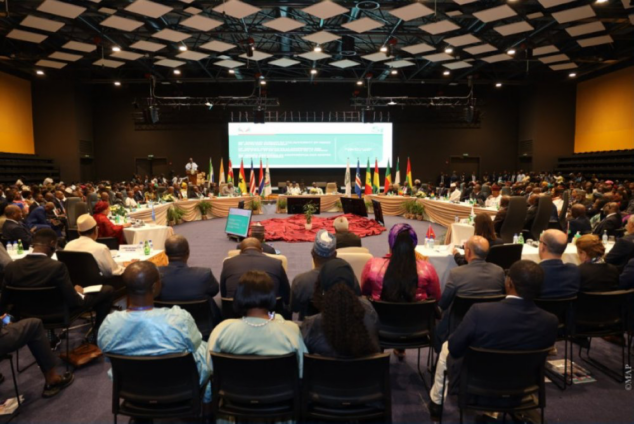
The agreement was signed in Freetown, Sierra Leone, on Sunday during the summit of Heads of State and Government of the Economic Community of West African States (ECOWAS).
The 6,800-kilometre pipeline is expected to transport Nigerian natural gas along Africa’s Atlantic coastline to Morocco, with the potential to supply European markets through existing connections.
The project, initially conceived as a bilateral initiative between Nigeria and Morocco, has now gained broader regional backing with the involvement of ECOWAS member states in its governance framework.
It was launched after a 2016 meeting between Morocco’s King Mohammed VI and former Nigerian President Muhammadu Buhari. It is being developed by Morocco’s National Office of Hydrocarbons and Mines (ONHYM) and the Nigerian National Petroleum Company Limited (NNPC).
Moroccan officials say the pipeline reflects King Mohammed VI’s vision of a more integrated and energy-secure Africa, built around shared infrastructure and regional cooperation.
The Freetown agreement marks a major institutional step, although further arrangements are expected to be concluded in Morocco involving Morocco, Nigeria and Mauritania.
Mauritania, like Morocco, is not an ECOWAS member but remains a key country along the proposed route.
The next phase will focus on establishing the project’s management structures, including a dedicated project company expected to be based in Casablanca and a Pipeline Higher Authority to be headquartered in Abuja.
These bodies will oversee operational, regulatory and financial issues while coordinating with participating governments, energy companies, investors and international financial institutions.
The project partners are expected to intensify efforts to secure financing after the completion of technical, environmental and engineering studies.
When completed, the African Atlantic Gas Pipeline will pass through 13 African countries before connecting to Morocco’s existing Maghreb–Europe Gas Pipeline network.
The pipeline is projected to transport about 30 billion cubic metres of natural gas annually. Up to 15 billion cubic metres could be supplied to Morocco and European markets, while the remaining volumes would support energy needs in participating West African countries.
The estimated cost of the project is about $25 billion, with construction expected to begin once financing and regulatory arrangements are finalised.
Beyond gas transportation, the project is being positioned as a regional development corridor that could improve electricity generation, support industrial growth and encourage investment across West Africa.
Several countries along the proposed route continue to face energy challenges, including power shortages and high production costs. Access to natural gas could help improve energy reliability and strengthen industrial competitiveness.
Supporters believe the pipeline could also encourage the development of domestic gas resources, create jobs and deepen economic cooperation among participating countries.
For Europe, the project could provide an additional source of natural gas as countries seek to diversify energy supplies amid global geopolitical uncertainty.
However, officials involved in the project say its primary focus remains improving energy access and supporting economic development within Africa.
The Nigeria–Morocco partnership remains at the heart of the project, combining Nigeria’s position as one of Africa’s leading gas producers with Morocco’s strategic location and infrastructure capabilities.
The Freetown endorsement signals a shift from a mainly bilateral initiative into a broader African integration project.
The next major challenge will be turning political support into concrete financing, construction and long-term operation of what could become one of Africa’s largest energy infrastructure projects.
Latest Stories
-
He entered at eight. He is now 16: Ghana’s children growing up in prayer camps
41 minutes -
‘Development must not always begin from Accra’ — Anwelle Foundation launched in Jirapa
44 minutes -
PKO trio eye victories at Odwira Festival
3 hours -
346 Ghana Navy recruits pass out after 26 weeks of intensive training
3 hours -
Newsfile to discuss EOCO-MP arrest, drug trafficking, speech arrests and $235m water debt
4 hours -
JoyNews gets results as listeners raise GH¢40,000 to help 17-year-old student with cerebral palsy attend SHS
4 hours -
Vice President calls for stronger local pharmaceutical production to reduce medicine imports
5 hours -
The brewing tension at KNUST; Beware the Ides of October….
5 hours -
Health Ministry moves to integrate traditional medicine into mainstream healthcare
5 hours -
550 pupils in Kintampo South get educational lifeline as ‘Seeds of Hope’ reaches farming communities
6 hours -
Opoku Mensah urges Christian Council, House of Chiefs to speak up on democratic freedoms
6 hours -
Teacher unions’ strike: Minority demands immediate payment of teacher arrears, 20% deprived area allowance
6 hours -
The Accra-Kumasi Expressway: Building it right
6 hours -
Beyond gold exports: Building value and economic resilience from Ghana’s gold
6 hours -
2027 AFCONQ: Ghana under pressure as Gambia beat Somalia 2-1
7 hours