

Audio By Carbonatix
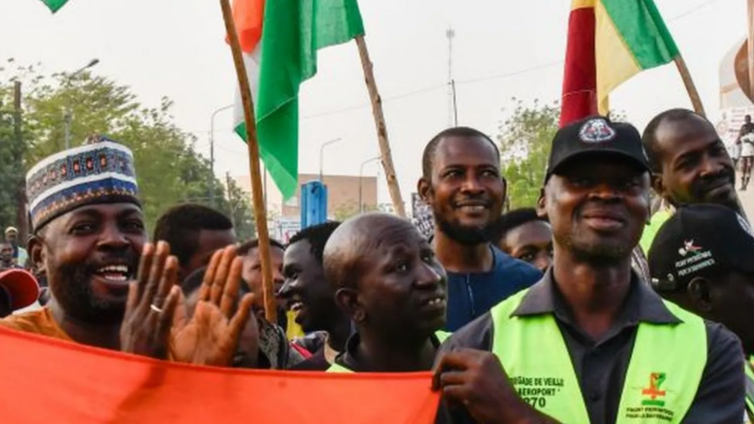
Nigeria has accused Mali, Burkina Faso and Niger of letting their people down by quitting the Economic Community of West African States (Ecowas).
It is the first comment from the chair of the economic and political body since the three governments announced their decision to leave on Sunday.
The three states were already suspended from Ecowas after recent coups.
Their military rulers have distanced themselves from ex-colonial power France and strengthened ties to Russia.
Arguing that they wanted to restore security before organising elections, they formed a mutual defence pact in September called the Alliance of Sahel States.
They accuse Ecowas of being influenced by external powers and failing to help them tackle the jihadist violence in their countries.
Reports from Niger on Monday said 22 people had been killed in a suspected jihadist attack on a village near the border with Mali. A local official said people had arrived in Motagatta in the Tillaberi region on motorbikes and started shooting people.
Withdrawal will hit hard given that the community guarantees visa-free travel and the right of settlement and work in member countries, according to an analysis by AFP news agency.
Mali, Burkina Faso and Niger were all founding members when Ecowas was set up nearly 50 years ago.
Relations between the three countries and the with Ecowas had been tense after coups took place in Niger in July, Burkina Faso in 2022 and Mali in 2020. Ecowas called on all three countries to return to civilian rule.
In its statement on the three countries' departure, Nigeria's foreign ministry accused them of not acting in good faith and criticised their military leaders.
"Unelected leaders engage in a public posturing to deny their people the sovereign right to make fundamental choices over their freedom of movement, freedom to trade and freedom to choose their own leaders," it said.
The ministry added that Nigeria, which is by far the biggest member of Ecowas and is Niger's main economic partner, remained willing to engage with the three countries.
Last week, Burkina Faso announced it had received 25,000 tonnes of free wheat from Russia, which re-opened its embassy there in December. The embassy had been closed since the collapse of the Soviet Union.
Russia, condemned by Western states for waging war in Ukraine, has been seeking to forge new alliances in Africa and elsewhere.
But it is just one of several major actors now stepping up efforts to court political and economic influence in Africa alongside not only China but also India, Turkey, the Gulf states and South Korea as well as Western nations and Japan.
Latest Stories
-
Total expenditure as of July 2026 amounted to GH¢147.07bn, 16% below target – BoG
2 hours -
Total revenue & grants stood at GH¢144.5bn in July 2026, slightly below target – BoG
3 hours -
Ghana Sports Fund urges sports federations to submit credible proposals and measurable targets
3 hours -
Sally Rooney books withdrawn in UK over Palestine Action support
3 hours -
Musk says US government may be behind slowdown of Ukraine drone speeds
3 hours -
Picking Chief Justices nearing retirement could give Mahama immense power – Bentil
3 hours -
Netflix to shed 1,000 jobs in steepest cuts since 2022
4 hours -
Burnham had two hospitality dinners with Man City chairman, deleted records show
4 hours -
Semenyo ‘froze’ after alleged racist abuse, court told
4 hours -
‘Shameless’ – Mourinho critical of Vinicius Jr ban timing
4 hours -
Loyalty can outweigh competence in Chief Justice selection – Bentil
4 hours -
Man City suffer as PSG masterclass sets up Champions League win
5 hours -
Customer Service Africa CEO urges business leaders to observe staff and customer interactions
5 hours -
On night of mayhem for Liverpool, Barcola arrives in style
5 hours -
Muzic Mensah finds healing and renewed love in new single ‘WayƐ Late’
5 hours