

Audio By Carbonatix
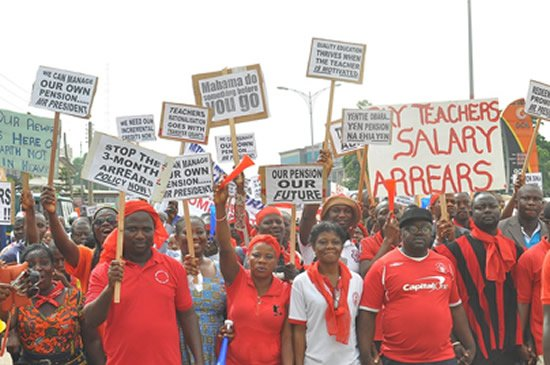
Education policy think tank Africa Education Watch (Eduwatch) has called for an urgent resolution to the nationwide strike by Ghana’s pre-tertiary teacher unions, warning that continued disruption of classes is denying pupils valuable instructional time and could affect learning outcomes.
The strike, which began on September 25, 2026, has entered its 12th day, with teachers demanding action on a number of outstanding issues, including the placement of promoted teachers on their appropriate salary scales, payment of related arrears, the conclusion of negotiations on a new Collective Agreement and the implementation of the Deprived Area Allowance.
In a statement issued on Wednesday, October 7, Eduwatch said the continued industrial action was having implications not only for teaching and learning but also for the well-being of vulnerable children who rely on schools for services such as school feeding.
“Every additional day of disruption reduces instructional time and compromises children’s right to education,” the organisation said.
It warned that the effects could be particularly serious for children from low-income households who depend heavily on public schools for both education and social support.
Eduwatch has urged the Fair Wages and Salaries Commission (FWSC), Ministry of Finance, Ministry of Education, Ghana Education Service (GES), Controller and Accountant-General’s Department (CAGD) and the teacher unions to intensify negotiations and reach a time-bound agreement to end the strike.
The organisation said the interests of learners should remain central to the discussions.
It also called on the CAGD and GES to act immediately to ensure that teachers who have been promoted receive the salaries and other compensation due to them.
Eduwatch said the current dispute also raised questions about how collective bargaining in the education sector was being managed.
According to the organisation, the existing Collective Agreement was due to expire in June 2026, while the teacher unions had indicated that proposals for its review were submitted several months before the expiry date.
“This raises legitimate concerns regarding why meaningful negotiations were not concluded ahead of expiry, with industrial action becoming the trigger for greater urgency at the negotiating table,” Eduwatch said.
It argued that negotiations on collective agreements should begin well before existing agreements expire, with clear timelines and milestones for reaching a settlement.
“Collective bargaining should be managed proactively, with negotiations commencing sufficiently ahead of the expiry of existing agreements, guided by clear milestones for conclusion,” the organisation said.
Eduwatch said delays that eventually result in industrial action ultimately impose the greatest cost on learners through lost classroom time.
“Stronger institutional accountability is therefore required to ensure that avoidable administrative and negotiation delays do not repeatedly translate into disruption of teaching and learning,” it added.
Beyond the immediate dispute, Eduwatch said the recurring problems surrounding teacher promotions, payroll placement, payment of arrears and incentives pointed to wider weaknesses in the management of the teaching workforce.
It therefore proposed a series of reforms aimed at making the system more efficient, predictable and transparent.
One of its key recommendations is the digitisation of processes between the GES and CAGD.
Eduwatch is also calling for greater decentralisation of the teacher promotion process.
It said the highly centralised system creates bottlenecks, particularly when large numbers of teachers have to be processed through the same administrative channels.
The organisation proposed that Regional Education Directorates should take greater responsibility for the assessment, verification and routine processing of promotions, while the GES Council maintains national oversight and approves recommendations.
Eduwatch said resolving the current strike should go beyond reaching an agreement that brings teachers back to the classroom.
It called for the immediate payment of outstanding promotion allowances, the conclusion of negotiations on the new Collective Agreement and measures to restore lost instructional time.
It also urged the government and education sector institutions to implement reforms that would prevent similar disputes from recurring.
“Protecting instructional time and the right to education requires not only resolving the present strike, but also building efficient, predictable, transparent and accountable systems for managing Ghana’s teaching workforce,” Eduwatch said.
Latest Stories
-
Account for GH¢650bn allocated to existing programmes before new economy – Oppong Nkrumah to gov’t
8 minutes -
‘You’re an action man’ – Abena Osei-Asare hails Rent Commissioner’s hostel fee crackdown
9 minutes -
Mahama directs Finance Minister to allocate GH¢1bn for Housing Fund in 2027 Budget
15 minutes -
NPP celebrates Bawumia on birthday, prays for 2028 election victory
15 minutes -
Mahama recounts ‘exhausting and frustrating’ struggle to find a home as a young spouse
21 minutes -
‘Take damaged banknotes to commercial banks for replacement’ – BoG warns against repairing cedi notes for resale
28 minutes -
Lebanon’s Hezbollah gets $200 million from Iran to help displaced, sources say
29 minutes -
Bisa Kdei to launch annual Highlife music event ‘The Convention’
29 minutes -
BoG cautions public against digital financial fraud, ‘double-your-money’ schemes
30 minutes -
WPL 2026/27: Ampem Darkoa Ladies to start title defence against Northern Ladies
42 minutes -
WPL 2026/27: Hasaacas Ladies face Army Ladies in opening round as GFA announce Southern Zone fixtures
54 minutes -
Eduwatch calls for urgent resolution of teachers’ strike and reforms
55 minutes -
Media worker, journalist remanded over alleged GH¢800k fraud
56 minutes -
Safeguard all personal, financial information, including Mobile Money PINs, ATM PINs – BoG to general public
59 minutes -
Gov’t launches roadmap to implement Social Protection Act, Regulations and Affirmative Action Regulations
59 minutes