


Audio By Carbonatix
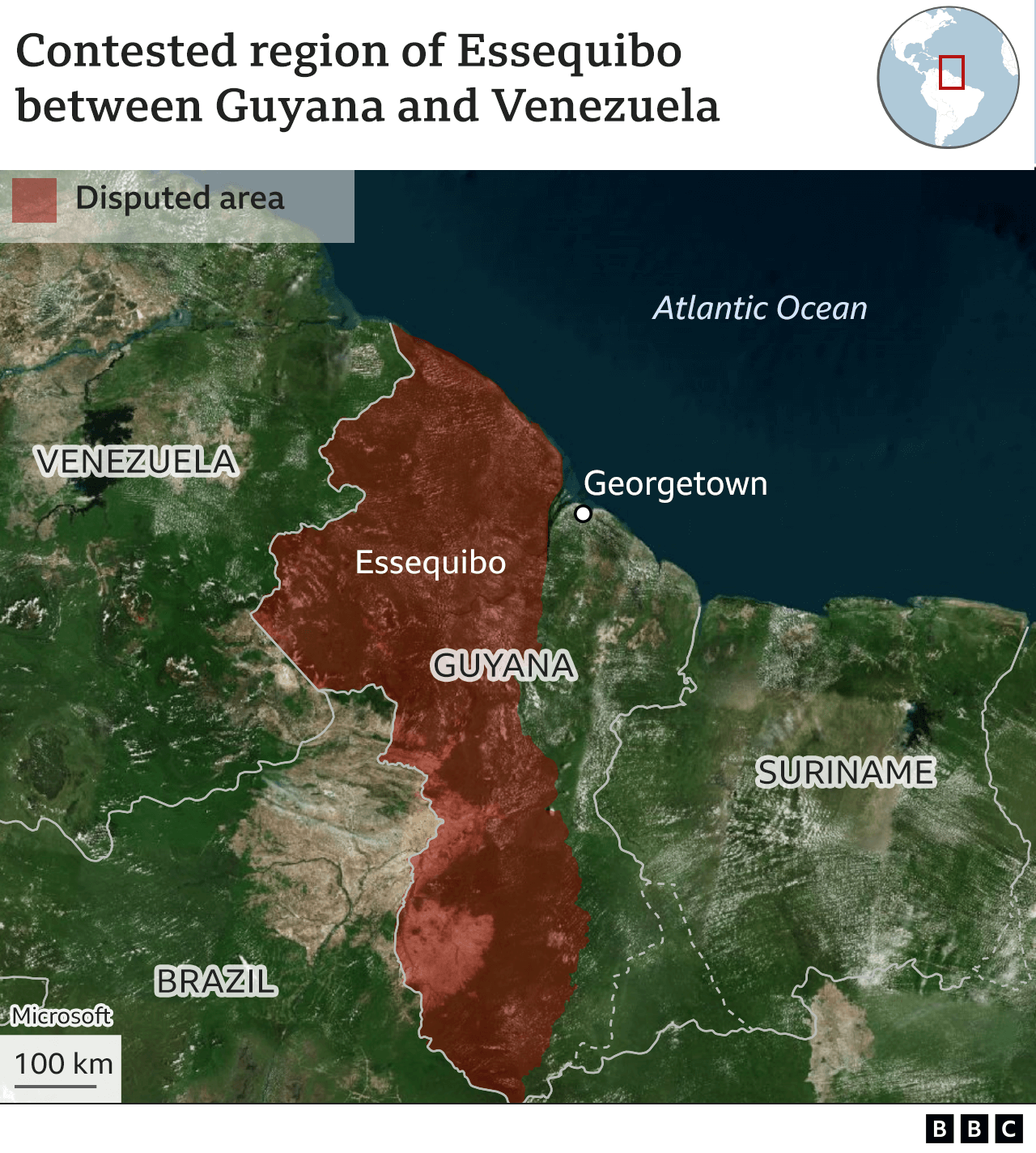
Venezuelan President Nicolás Maduro is plunging ahead with its plans to take over Essequibo, the oil-rich region controlled by neighbouring Guyana.
He has ordered the state oil company to issue extraction licences there and proposed the National Assembly pass a bill making the area part of Venezuela.
Guyana has put its defence forces on full alert in response.
Venezuelan voters on Sunday approved a referendum claiming rights over Essequibo, ratcheting up tensions.
In a Facebook address slamming Mr Maduro's "missteps", Guyana's President Irfaan Ali said he had already spoken to the UN secretary general and is asking the UN Security Council to consider intervening.
"This is a direct threat to Guyana's territorial integrity, sovereignty and political independence," he said. "Guyana views this as an imminent threat... and will intensify precautionary measures to safeguard its territory."
He also sought to reassure the country's investors - mainly oil companies - that their money is safe.
On Sunday, more than 95% of voters in Venezuela's referendum approved establishing a new Venezuelan state in the region. While only two million people voted - making up roughly 10% of eligible voters - Venezuela's claim to Essequibo enjoys broad support in the country.
The country has long maintained that an 1899 decision to award the 159,500-sq-km (61,600-sq-mile) region to the UK was unfair.
The matter is currently before the International Court of Justice, although Venezuela says the court does not have authority to rule on it. The court has warned Venezuela not to take any action that may alter the status quo in Essequibo.
Essequibo has been under the authority of Guyana - and before it British Guiana - for more than a century, but Venezuela has long sought to control it.
The discovery of oil in waters off Essequibo's coast in 2015 helped fire up the current dispute. Tensions increased further in September this year, when Guyana held an auction for exploration licences in those waters.
Guyana's wealth is mostly based on oil production and exports, which has made its economy one of the fastest growing in the world in recent years.
Venezuela, meanwhile, is trying to pull out of a multi-year economic crisis, which has been exacerbated by US sanctions imposed on its oil sales over the 2018 election of Mr Maduro. The country has the largest proven oil reserves in the world.
Latest Stories
-
NPP behind every monumental agenda in Ghana – Miracles Aboagye
2 minutes -
Ho Airport not a misplaced priority — GACL Board Chair
4 minutes -
Nationwide sensitisation of haulage truck drivers ahead of Axle Load Enforcement
4 minutes -
Vice President backs community tourism at Vodza Regatta 2026
7 minutes -
Tree Crops Development Authority says media reports on rubber exports are misleading, demands apology
14 minutes -
Kotoko suffer shock 2-1 defeat to Samartex in Kumasi
24 minutes -
Scrap sanitation levy amid fuel price hikes — Miracles Aboagye
25 minutes -
Rapper Offset injured in shooting near Florida casino, officials say
33 minutes -
Sporting CP vs Arsenal Champions League preview: Where to watch, predicted line-ups, form, coaches’ thoughts
48 minutes -
Real Madrid vs Bayern München Champions League preview: Where to watch, predicted line-ups, form, coaches’ thoughts
54 minutes -
CIB Ghana Post-MPC policy seminar urges action to turn macroeconomic stability into jobs
56 minutes -
Maguire signs one-year contract at Man Utd
59 minutes -
GACL chairman says airport levy to fund projects, completion targeted within 24 months
1 hour -
Sugar sacks now used to bag cocoa under Mahama government – Annoh-Dompreh raises concerns
1 hour -
President Mahama will sign LGBTQ Bill when it reaches him — NDC’s Wonder Madilo
1 hour