

Audio By Carbonatix
The European Union (EU) has emphasized its commitment to support sustainable agricultural projects aimed at increasing yields and empowering small holder farmers.
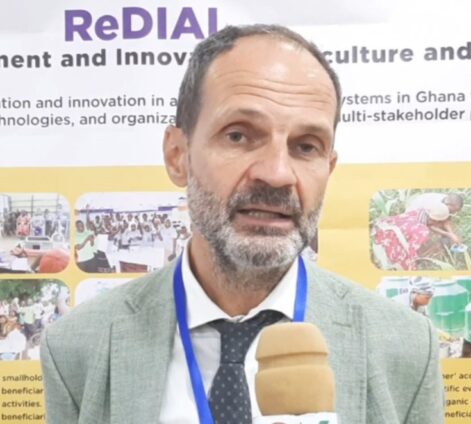
The Head of Cooperation at the EU delegation to Ghana, Massimo Mina noted that employing sustainable innovative technologies will improve the living conditions of farmers on rural areas.
He spoke at the Research for Development and Innovation Agriculture and Learning – ReDIAL’s closing workshop for beneficiary farmers.
“Through the ReDIAL project, we have seen tangible improvements in the capacity of small holder farmers to improve their knowledge in improved farming technologies; as we close the project, we are confident that the gains made will be sustained through the capacities built, partnerships forged, and communities empowered.”
ReDIAL focused on providing innovative agricultural solutions to small holder grains and cereal farmers, particularly the marginalized, in Ghana’s major food producing zones of Techiman in the Bono East Municipal, Ejura in the Ejura Sekyedumase District of the Ashanti Region.
The rest are Yendi in the Northern Region, Sefwi Wiawso in the Western North Region and Donkorkrom in the Kwahu Afram Plains North District of the Eastern Region.
The four-year project introduced the multi crop threshers to over 11500 small holder farmers in the five project zones, threshing 330,200 kilograms of high-quality grains for almost 1000 farmers (i.e. maize, cowpea, rice and beans) at no cost to them.
This initiative significantly contributed to reduction in post-harvest grain loses in these zones for small holder and marginalized farmers.
The Coordinator of the ReDIAL Project and Executive Director of Friends of the Nation, Donkris Mevuta emphasized that the introduction and testing of FarmSense technology which instantly measures the fertility status of a farmer’s land for cultivation and provides figures of the nitrogen, phosphorus and potassium levels yielded critical results “ignoring soil fertility considerations can result in lower yields, affecting farmers’ income and threatening food security.”
Meanwhile, the project is not only fixated on the promotion of innovation and agricultural development but facilitating the resolution of farmer-herder conflict especially in the Kwahu Afram Plains and the Ejura farming zones.
The ReDIAL Project has been successful in enhancing stakeholders and farmers’ knowledge on soil fertility. It also enlightened and empowered smallholder farmers to adopt various forms of organic soil nutrient enrichment options and utilize localized materials to produce their own compost.
This helped to reduce losses to about 14.3% of total quantity of grains threshed, valued at GHS 225, 412.00.
Latest Stories
-
Photos: Mahama commissions 85-bed Police Hospital ward, donates two ambulances
8 minutes -
GTEC directs Ghana’s public universities to reopen by October 16 and begin lectures on October 19
9 minutes -
Star Oil donates GH¢1million towards construction of new CID facility
13 minutes -
Court hands Adjetey Sowah, two others lifetime bans after Amputee Football legal dispute
23 minutes -
NDC appoints Julius Kwame Anthony as a Deputy Communications Director
23 minutes -
Ghana repatriates 120 Nigerians rescued from suspected cybercrime centres
27 minutes -
NPP rejects Emelia Agbenyo’s appointment as Deputy EC Chair, demands withdrawal
32 minutes -
EOCO grants Suame MP John Darko enquiry bail in GH¢27m SIC investigation
36 minutes -
NPP cannot question EC appointment after appointing own people to Commission – Kwakye Ofosu
41 minutes -
BoG deepens public trust with regional stakeholder forum in Techiman
51 minutes -
‘We have turned the tide’ – Ato Forson says Ghana is ready to take off
56 minutes -
Police arrest man captured in viral video assaulting wife in Agona Nkwanta
57 minutes -
KATH Mother and Baby Unit construction stalled for 14 months over unpaid contractor arrears
1 hour -
Government wanted to ‘tilt the balance’ with new EC appointments – Kwakye Ofosu
1 hour -
Angry Tema Community 25 residents threaten to sleep at GWL over water shortage
2 hours