

Audio By Carbonatix
Deep in winter, as wind, rain and biting cold make Victoria's western districts a bleak place for farmers and livestock, David Fenton feels like Australia's luckiest farmer.
"I possibly live on the best farm in the world. It's a great place to wake up in the morning and a great place in the evening," he said.
"Every day, there's something new."
David owns Lanark, a 700-hectare prime lamb-grazing property at Branxholme.
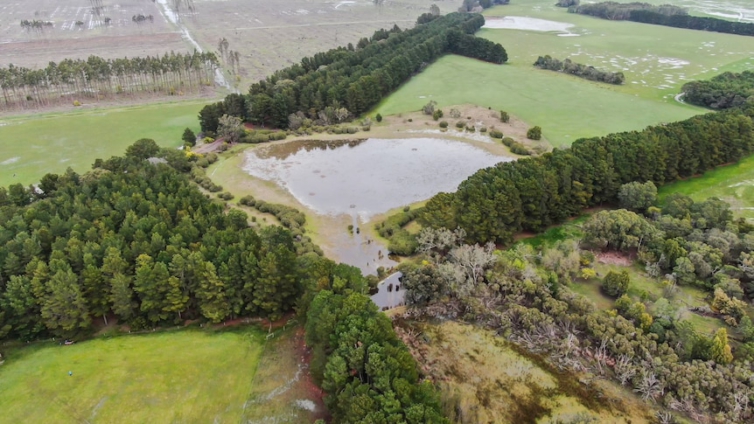
A third of Lanark is covered with built wetlands and several hundred thousand trees planted for stock-shelter, wildlife habitat and forestry.
"I love the word environmentally sustainable," David said.
"They're probably my two favourite words, and we've been that now for at least the last 12 to 14 years."
An environmental jewel
His late father, John, made the wetlands and spent decades planting trees and turning the windswept, near treeless farm he inherited in 1956 into an environmental jewel.
In 1997 when Landline first visited Lanark, John Fenton had spent over half a million dollars on trees.
He admitted his obsession meant farm productivity had suffered.
John's environmental vision was celebrated, but it caused tensions at home.
"I had to lay down the rules a few times and say, 'I'm sorry, but you're not getting any income from your trees apart from beneficial shelter for animals, and if you don't have your pastures right there's no point in doing it'," wife Cicely Fenton said.
David said his father knew the farm needed to be more productive but "he just wouldn't admit it".
A difficult succession
When David inherited Lanark in 2003, he improved pastures and replaced ageing fences, yards, and the shearing shed.
As many rural families know, intergenerational succession can be difficult, and so it was at Lanark, with John hovering and criticising his son.
But it finally passed.
"Not long before he died, he put his hand on my shoulder and said, 'You just keep doing what you're doing. You're doing a great job', which meant a lot," David said.
They might have argued about the trees being the priority, but John taught David a valuable lesson: trees were not the enemy of pasture, with the shelter they provided from wind and sun more than compensating for the space they occupied.
"Twenty-three to twenty-five per cent of trees on your property doesn't affect the amount of stock you can run," David said.
"The ground stays warmer longer, there's less battering from the environment and stock are happier."
John Fenton died two years ago, aged 85.
Next generation ready
Last month Landline visited Lanark for the third time.
Despite a cold, wet and windy winter, lamb percentages were over 150 per cent, and survivability was high due to the farm's many sheltered areas.
David has not needed to sell the forestry lots his father planted to provide a perpetual and alternative income.
His son, Will, runs a crutching and ewe scanning business, which sees him working on many farms.
"I love Lanark. It's so special, and now being older and being able to compare it to other places, there's nothing like it," Will said.
"There's plenty of people trying to do it, but they're 30, 50, 60 years behind."
He hoped to be the farm's next custodian.
"I plan on it being here for my children, their children's children, and my two sisters," Will said.
John and David's work meant there were not any big jobs for the next generation to tackle.
"It's pretty well planted now," Will laughed. "Coco made sure of that."
The only further planting would be harvesting and replanting some of the agroforestry blocks.
An acute 'foresight'
Will and his sister, Georgia Fenton, were too young to have seen the 1997 and 2006 Landline stories about the grandfather they called "Coco".
Georgia said she was "mind blown" after hearing the old stories.
"I've never really actually seen much to do with the farm back then," she said.
Will said the placed looked like it was "falling apart" in the first Landline story.
"If it hadn't been fixed, I don't know if the farm would have survived," he said.
"The fact that he was he was able to have this picture in his mind and go totally against the grain at the time, it's amazing.
"Who has that kind of foresight?"
Preserving the past
John Fenton's ashes were at his two favourite places, Lake Cicely, the wetland named after his wife, and in the oak grove he planted so his great, great, great grandchildren could harvest them too.
David and his children have no appetite to fell the oaks and hoped future Fentons left them standing.
"I'd much rather hear grandchildren and great grandchildren running around underneath them than them hitting the ground," David said.
"The grandchildren will be told the story of what Coco did, and I'm sure they'll get as much enjoyment out of it is we do."
Latest Stories
-
UN housing expert urges Ghana to strengthen Rent Control Department amid housing affordability concerns
7 minutes -
Delta-BCI partnership reaches 166,000 people with breast cancer education
16 minutes -
Power restoration fault suspected in Kumasi Central Market fire
5 hours -
The 7-foot giant of Ngleshie Amanfro: Seven-foot Ghanaian Ephraim Saawa dreams of joining the national basketball team
6 hours -
Government promises support for Kumasi Central Market fire victims
6 hours -
Vibes The Movie: Big Ghun’s Ghanaian film earns five nominations at 2026 REFFA
7 hours -
‘I’m a fulfilled man’—Justice Korbieh on missing out on Supreme Court despite two nominations
7 hours -
MamaCare CEO warns unresolved conflicts among health workers could undermine maternal and neonatal care
7 hours -
Health professionals urged to translate medical knowledge into practice to save mothers
7 hours -
Retired judge Justice Francis Korbieh charges 1,568 new lawyers to uphold integrity
9 hours -
Conflicts among care providers linked to maternal, neonatal deaths – Expert
9 hours -
GIS marks 10th TIME conference, champions improved teaching practices
9 hours -
BRICS Or Balance? What Ghana’s bid really means
9 hours -
Adamus Resources launches breast cancer awareness campaign in Nzema
9 hours -
GPRTU wants full TRAFFITECH-GH implementation to start in 2027
10 hours