


Audio By Carbonatix
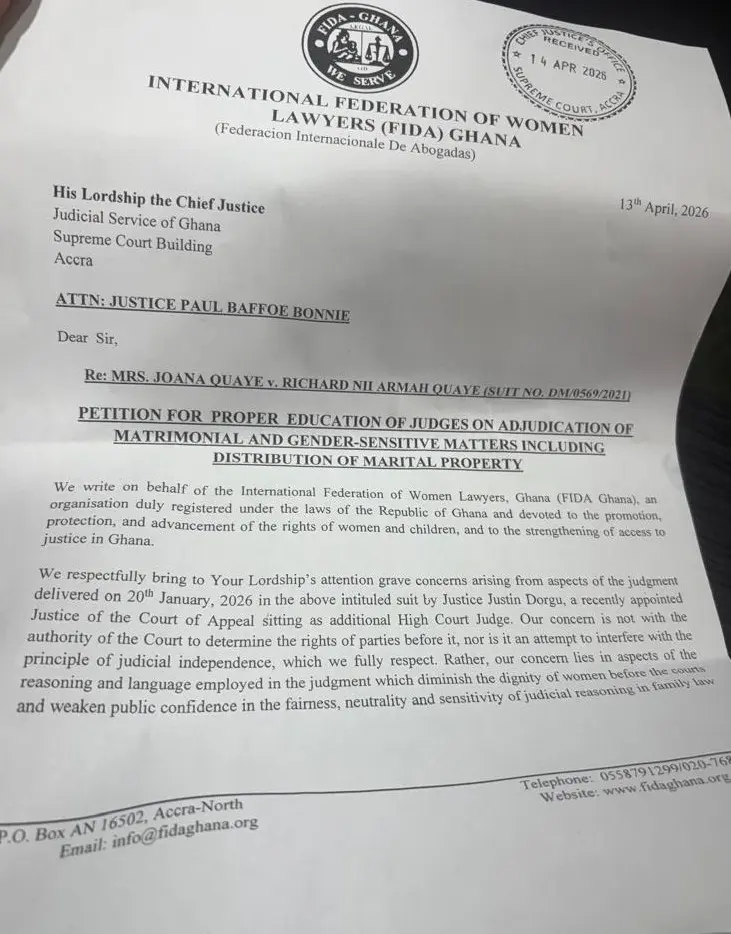
The International Federation of Women Lawyers (FIDA) Ghana has petitioned the Judicial Service of Ghana, calling for urgent retraining of judges following what it describes as a “dangerous” and deeply troubling divorce ruling.
In a letter dated April 13 and addressed to Justice Paul Baffoe-Bonnie, FIDA Ghana raised concerns over the judgment delivered on January 20, 2026, in the case of Mrs Joana Quaye v. Richard Nii Armah Quaye.
The group stressed that its concerns are not about judicial independence but about “aspects of the reasoning and language employed in the judgment which diminish the dignity of women before the courts and weaken public confidence in the fairness, neutrality and sensitivity of judicial reasoning in family law matters, in addition to being a complete departure from recognised principles governing distribution of marital property.”
FIDA emphasised the critical role of family courts, stating, “For many women, the family court is not merely a forum of litigation. It is the place they come to when a marriage has broken down… and when the law becomes their last refuge.”
It added, “It is not enough that justice be done. The reasoning by which justice is expressed must affirm the dignity, equality, and humanity of those who stand before the court.”
The group expressed “complete disapproval” of portions of the judgment, particularly references to the petitioner as “physically… attractive” and “capable of remarrying anytime she felt like,” describing such remarks as “offensive and deeply troubling.”
“Such commentary has no place in the legal analysis,” the petition stated, warning that it suggests “a woman’s entitlement to justice may be weighed against stereotypes about her appearance, desirability, or remarriage prospects.”
FIDA also criticised the judge’s assertion that “marriage is not an investment” and the characterisation of the petitioner’s financial claim as “ridiculous,” cautioning that such language undermines the recognition of women’s non-financial contributions.
“To dismiss or diminish this reality risks sending a message that the invisible labour of women has little legal value,” the group said.
The petition further challenged the reasoning that financial relief should operate “as a way of dissuading these frequent divorces,” stressing that “courts do not exist to deter people from seeking lawful relief when a marriage has broken down beyond reconciliation.”
FIDA warned that such reasoning could have broader consequences. “It creates the impression that family law remedies are being shaped by the moral standards of the judge rather than established legal principles.”
The group also pointed to what it described as a troubling inconsistency in the judgment, noting references to the respondent’s “earning capacity and ‘numerous companies,’” alongside an order of GH¢5,000 monthly maintenance for three minor children.
It argued that the judgment departs from constitutional standards, citing Article 22, which guarantees equitable distribution of marital property and recognises both direct and indirect contributions.
FIDA expressed concern that the ruling ignored recent Supreme Court guidance affirming these principles, describing it as “a worrying ignorance of principles and process for adjudication of matrimonial and gender-sensitive causes.”
The organisation warned of wider societal impact, noting that judicial language shapes public perception. “What is said in courtrooms does not remain in courtrooms. Women and children read these judgments.”
It added that the ruling has already triggered widespread public reaction and anxiety about fairness in the justice system.
FIDA concluded by urging immediate action. It called for “such administrative, educational, or other appropriate measures as may reinforce gender-sensitive adjudication in matrimonial matters,” stressing the need for judicial reasoning to remain grounded in “dignity, fairness, equality, and restraint.”
Latest Stories
-
UPSA uncovers mass results manipulation involving 178 students, over 500 results compromised
21 minutes -
ECG announces planned power outages in parts of Tema from Sept. 29 to October 1
42 minutes -
Sylvester Mensah urges Latenu FM to promote trade, export opportunities in Ga
55 minutes -
Ga language under threat of decline as children shy away from speaking it – Sylvester Mensah
1 hour -
‘Let every Ga child you raise know the Ga language and story’ – Sylvester Mensah
1 hour -
‘We are not deterred’ – Ablakwa responds to backlash over South Africa evacuation
1 hour -
NCA announces major voice and data disruption across Northern Ghana due to fibre cuts
2 hours -
Photos: Housing solutions take centre stage at Day 2 of the 3rd Republic Bank-JoyNews Habitat Fair
2 hours -
Ghana Air Force passes out 293 recruits after six months of intensive training
3 hours -
EOCO vrs Baffour Awuah: EOCO should have secured warrant before arrest attempt at court – Inusah Fuseini
3 hours -
Triple fibre cuts disrupt telecom services across Northern, Oti regions – Sam George
3 hours -
Politicisation could undermine parliamentary probe into cocaine seizures – Dr Osae-Kwapong
3 hours -
EOCO chases MP: Can Section 41 cure lacuna in EOCO Act? – Inusah Fuseini asks
3 hours -
GNFS, GWL inspect fire hydrants in Ministries enclave; 23 found faulty
3 hours -
Gov’t directs release of 50,000 bags of grain to ECOWAS
3 hours