

Audio By Carbonatix
The Fisheries Commission in the Ashanti Region has stepped up efforts to develop future aquaculture professionals by engaging Senior High School students across the region in practical training and sensitisation programmes.
The initiative, implemented under the Ministry of Fisheries and Aquaculture Development, forms part of the “Youth in Aquaculture” programme aimed at promoting aquaculture as a viable career path for young people.
It also aligns with the government’s School Farm Initiative, which encourages the use of idle school lands for practical agriculture to boost food production, improve nutrition and reduce the cost of feeding students under the Free SHS programme.
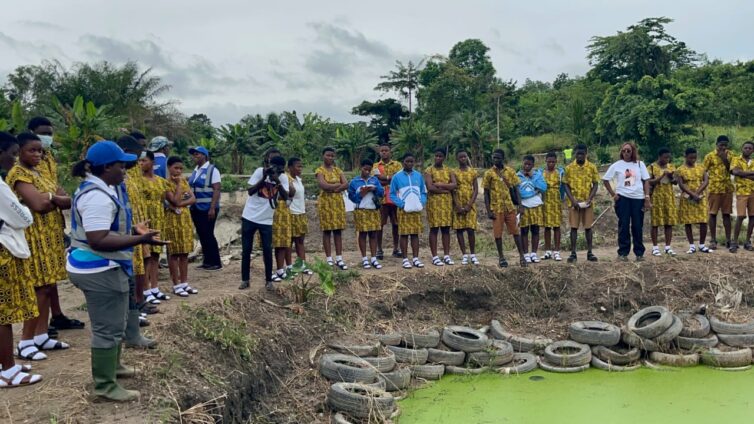
The first phase of the programme was held at Kanta Fish Village in Nkawie Wioso, where agriculture and science students from Toase Senior High School and Nkawie SHS Technical were introduced to practical aquaculture operations.
Technical officers from the Fisheries Commission trained students on fish biosecurity, antimicrobial resistance, responsible use of antimicrobials, value addition in fish processing, and hygiene and storage practices. The sessions combined classroom instruction with hands-on demonstrations in ponds and processing areas.
Ashanti Regional Director of the Fisheries Commission, Abigail Quarshie, said the initiative is aimed at addressing Ghana’s growing fish deficit while creating employment opportunities for young people.
She noted that Ghana remains one of the highest fish-consuming countries in Sub-Saharan Africa, with an estimated per capita consumption of about 25 kilogrammes annually.
However, she explained that the country spends more than 200 million US dollars each year importing over 63,000 metric tonnes of fish to meet local demand.
Ms Quarshie linked the import dependence to declining domestic marine stocks and the limited number of fish farmers operating locally.
“Fish remains the most vital source of animal protein in the Ghanaian diet, with an estimated annual per capita consumption of about 25 kg. To meet this demand, however, Ghana spends over US$200 million annually on fish imports,” she said.
She said the “Youth in Aquaculture” initiative is designed to reduce the national import bill and create direct employment opportunities for students who acquire aquaculture skills after secondary education.
Ms Quarshie also addressed perceptions that agriculture is low-skilled work, stressing that modern aquaculture is science-based and technology-driven.
“There has been a misconception that agriculture does not require intellect, but it is rooted in science,” she said. “That is why we are organising the Youth in Aquaculture programme for senior high school students to show them the inner workings of a modern, technology-driven sector.”
She added that the goal is to equip students with practical skills and entrepreneurial confidence to either join the aquaculture value chain or establish their own enterprises.
Some participating students expressed renewed interest in aquaculture after the training, saying the practical exposure changed their perception of the sector.
“I never thought fish farming could involve science and technology like this,” one Toase SHS student said.
Another Nkawie SHS Technical student noted that the programme challenged misconceptions about agriculture being a low-status field, adding that aquaculture now appears as a science-driven and innovative industry.
The Fisheries Commission says the programme will be expanded to cover all senior high schools in the Ashanti Region in phases, as part of efforts to build a new generation of skilled fish farmers and agribusiness entrepreneurs.
Officials believe the initiative could help reduce Ghana’s dependence on fish imports and contribute to long-term food security and job creation in the agricultural sector.
Latest Stories
-
New Economy will tackle unemployment and restore hope – Ato Forson
8 seconds -
IMMILAC president recounts personal losses as security women lead breast cancer awareness campaign in Wa
8 minutes -
University of Ghana postpones October 12 reopening as GAUA strike persists
22 minutes -
Bahass Foundation launches vocational skills training to support mental health recovery in Wa
54 minutes -
NPP orders parliamentary aspirants and their supporters to suspend campaign activities
1 hour -
Techiman unites against child marriage: Joy Impact Makers Awardee leads charge on International Day of the Girl Child
2 hours -
Ghana Psychological Association calls for greater involvement of people with lived experience in mental health care
3 hours -
Ablakwa says Ghana could evacuate more citizens from South Africa if the situation worsens
3 hours -
Violence against girls must be tackled through individual responsibility – Gender advocate
3 hours -
Ghana’s BRICS bid must be guided by national interest – International Affairs Analyst
4 hours -
Journalists look back on a decade of breast cancer reporting in Ghana
4 hours -
President Mahama ends Resetting Ghana tour of Ahafo Region
6 hours -
African negotiators seek delivery of climate commitments at COP31
6 hours -
BoG develops AI rules for financial sector
6 hours -
‘Big Push’: Government assures contractors of prompt payments
6 hours