

Audio By Carbonatix
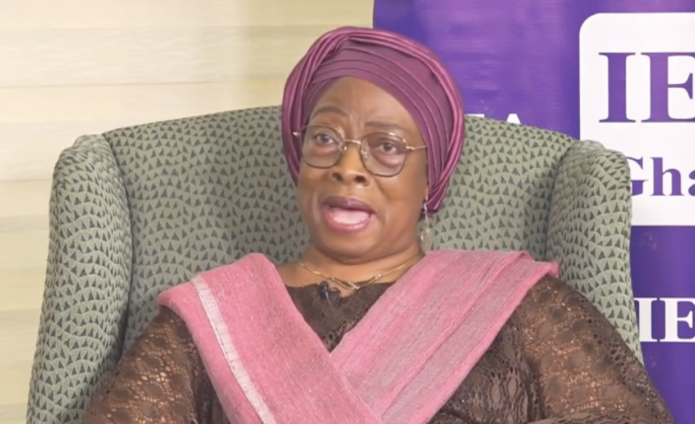
Former Chief Justice Sophia Akuffo has revealed that Ghana once came close to ending the long-standing dominance of Accra in professional legal training.
Speaking on Joy News’ PM Express Business Edition last Thursday, she said concrete steps had been taken to decentralise the system and certify universities across the country to run the full professional law programme.
“Legal education is a whole area, truly,” she began, explaining that reforms were not just discussed but structured and approved.
“There had actually been some recommendations general legal counsel at the general legal council that had been approved even during the time of Justice Acquah as Chief Justice, whereby on a time-bound and a timed basis, that was what was supposed to happen.”
She said the plan was deliberate. It aimed to ensure that by 2020, universities would be certified to run professional legal training beyond Accra.
According to her, groundwork had already begun.
“So we actually did start going around universities which had law schools, we actually started going… working together with the then accreditation board, the national accreditation board, to look at the curriculum and the structure of the faculties of law.”
Standards were clearly defined. “The idea was that certain courses would be taught towards the LLB.”
Facilities were also assessed. “You want to make sure that the library is a worthwhile library.”
Faculty strength mattered. “They have enough number of professors, professors in the strict sense of the word, not the American sense of the word.”
Student numbers were scrutinised. “The student-to-lecturer ratio was not more than one lecturer to 35, and even then, the accreditation board felt that it was too high. It should have been at most 29.”
She admitted that staffing posed challenges. “It was pointed out that the field is kind of sparse with what we need.”
Still, she insisted the focus was quality, not numbers. “The objective is not really how many you’re producing, but still the quality you’re producing.”
She explained that the vision would have allowed students to complete their LLB in one region and their professional bar training in another.
“You could have done that. Maybe you did your LLB at Cape Coast University, and then you chose to do your bar… in some Institute, a certified Institute in Bolga.”
“By the time you finish the professional course, you’re a fully-fledged lawyer.”
She stressed that practical exposure was key.
“It’s not that you have no access to legal practitioners who are going to be imparting practical knowledge to the students.”
Latest Stories
-
Gbande’s arrest directive confirms NPP’s claims of selective justice – Miracles Aboagye
1 minute -
US to announce $150 million for Alaska power lines as Vance campaigns in Senate battleground
2 minutes -
Two CHPS compounds, educational facilities under construction in Keta – MP
4 minutes -
Not every difficult season means you’re in toxic love – Counsellor Adofoli explains
7 minutes -
Badminton: Ghana wins bronze, two silver medals at All Africa U-19 Champs
11 minutes -
Black Star Experience announces national choral music contest to discover new Ghanaian talent
22 minutes -
Melcom serves 1,000 meals to children in selected orphanage homes
23 minutes -
Miracles Aboagye questions Mustapha Gbande’s authority to direct EOCO arrest of Manhyia South MP
24 minutes -
My music is a true reflection of who I am – Nigerian singer Ladé
24 minutes -
Activa International Insurance Ghana reinforces culture of compliance and customer protection
31 minutes -
Mining must prove its impact, not just publicise it — Chamber of Mines
40 minutes -
NDC disqualifies Dzifa Gunu from La Dadekotopon contest
47 minutes -
Togbe Afede XIV opposes proposed 5-year presidential term
51 minutes -
World Vision targets 90 percent universal WASH access in Asunafo North, Asutifi North
1 hour -
I told EOCO to arrest Manhyia South MP – Mustapha Gbande
1 hour