

Audio By Carbonatix
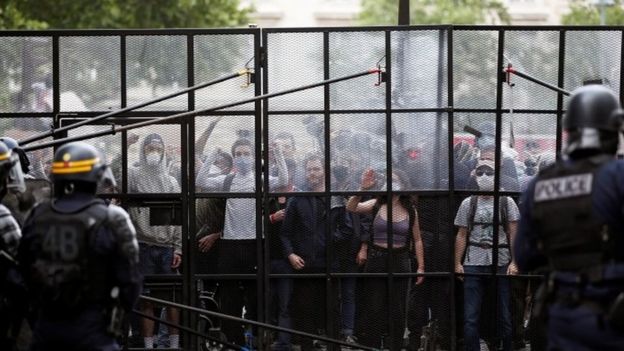
French police have clashed with activists protesting in Paris against racism and alleged police brutality.
Police used tear gas against stone-throwing protesters who tried to hold a march that was banned.
The rally is part is a worldwide movement inspired by America's Black Lives Matter protests.
It was organised under the banner "Justice for Adama", after Adama Traoré, a young black man who died in French police custody in 2016.
What happened in Paris?
About 15,000 anti-racism protesters gathered on the Place de la République in central Paris early on Saturday afternoon.
They chanted slogans such as "No justice, no peace". Some climbed on the the statue of Marianne, the symbol of the French Republic.
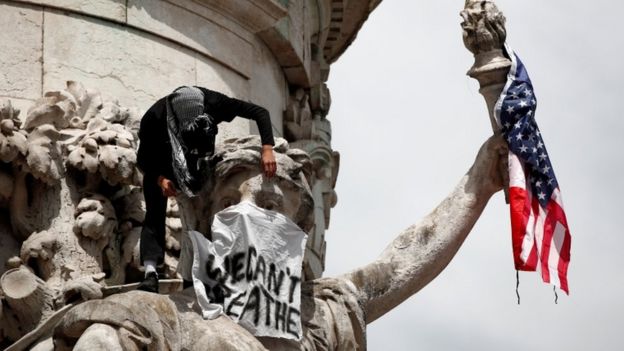
Among the protesters was Assa Traoré, Adama's sister, who called on them to "denounce social, racial, police violence".
"What's happening in the United States is happening in France. Our brothers are dying," she added.
Although the protesters were allowed to gather, they were prevented by police from marching to the Opera area.
The planned onward march had been banned because of the possible threat to local businesses.
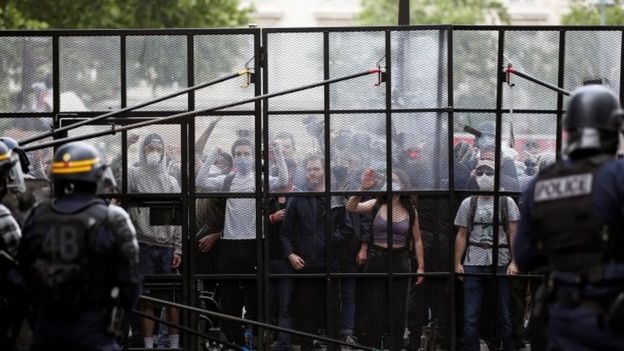
Clashes erupted and tear gas was fired as officers moved against the protesters on the Place de la République.
Le Parisien newspaper says 26 people were questioned by police. By early evening the demonstrators had dispersed.
Smaller protests were held in other French cities, including Lyon and Marseille.
Why are French police in the spotlight?
France's police watchdog says it received almost 1,500 complaints against officers last year - half of them for alleged violence.
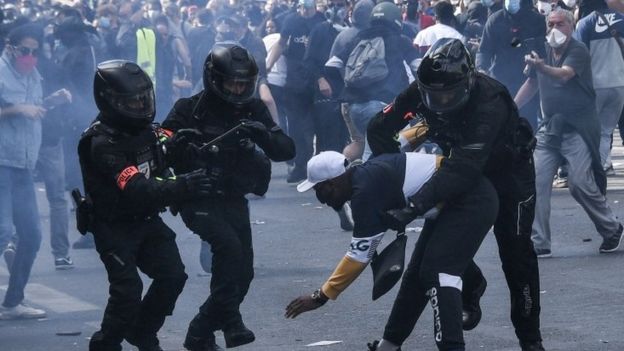
In one recent case, police are accused of seriously wounding a 14-year-old boy when he was detained on suspicion of trying to steal a scooter in Bondy near Paris last month.
On Monday Interior Minister Christophe Castaner announced a ban on the police "chokehold" method for restraining some suspects.
The announcement came after protesters took to the streets accusing French police of using brutality towards minorities.
Mr Castaner vowed that there would be "zero tolerance" of racism in law enforcement and officers strongly suspected of racism would be suspended.
He has faced a backlash from police unions and officers, who denied that racism was rampant within their ranks.
On Friday officers rallied on the Champs-Élysées throwing their handcuffs on the ground.
France is one many countries that has seen a wave of anti-racism marches modelled on the latest Black Lives Matter protests in the US.
They were sparked by the death of George Floyd, an African American man killed on 25 May by a white Minneapolis policeman who knelt on his neck for almost nine minutes.
On Friday US President Donald Trump said the chokehold method should be ended.
Latest Stories
-
Photos: Mahama commissions 85-bed Police Hospital ward, donates two ambulances
8 minutes -
GTEC directs Ghana’s public universities to reopen by October 16 and begin lectures on October 19
10 minutes -
Star Oil donates GH¢1million towards construction of new CID facility
13 minutes -
Court hands Adjetey Sowah, two others lifetime bans after Amputee Football legal dispute
23 minutes -
NDC appoints Julius Kwame Anthony as a Deputy Communications Director
23 minutes -
Ghana repatriates 120 Nigerians rescued from suspected cybercrime centres
28 minutes -
NPP rejects Emelia Agbenyo’s appointment as Deputy EC Chair, demands withdrawal
32 minutes -
EOCO grants Suame MP John Darko enquiry bail in GH¢27m SIC investigation
36 minutes -
NPP cannot question EC appointment after appointing own people to Commission – Kwakye Ofosu
41 minutes -
BoG deepens public trust with regional stakeholder forum in Techiman
51 minutes -
‘We have turned the tide’ – Ato Forson says Ghana is ready to take off
56 minutes -
Police arrest man captured in viral video assaulting wife in Agona Nkwanta
58 minutes -
KATH Mother and Baby Unit construction stalled for 14 months over unpaid contractor arrears
1 hour -
Government wanted to ‘tilt the balance’ with new EC appointments – Kwakye Ofosu
1 hour -
Angry Tema Community 25 residents threaten to sleep at GWL over water shortage
2 hours