

Audio By Carbonatix
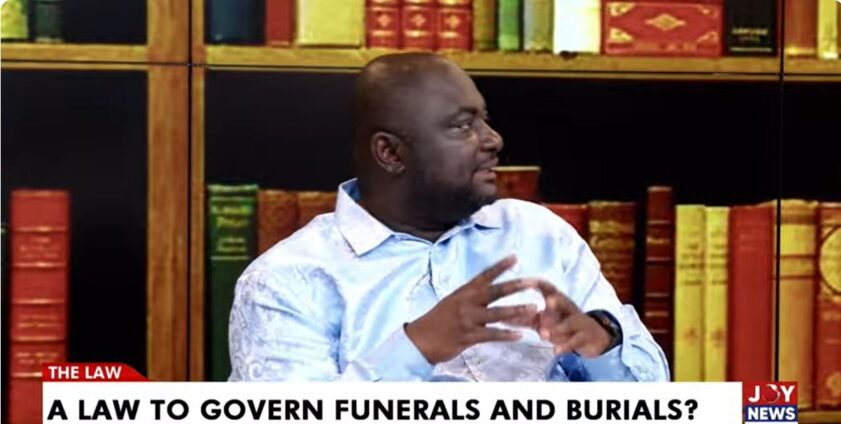
Ghana’s proposed funeral regulation bill is not an attempt to dismantle customary practices but rather a long-overdue effort to bring clarity, dignity, and fairness to how the country manages death and burial rites, Member of Parliament for Mpraeso, Davis Ansah Opoku, has said.
Speaking on JoyNews The Law on Sunday, Mr Ansah poku sought to allay public concerns that the bill could override traditional authority, particularly the role of family heads, known in Akan custom as Abusuapanyin.
“We need to appreciate that this bill has not come to do away with customary laws. It is not about taking over the responsibilities of family heads. Culture remains central to how we conduct funerals in this country.”
Instead, he explained, the legislation is designed to fill a significant gap in Ghana’s legal framework by providing a comprehensive system to regulate funerals, burial arrangements, and related disputes—areas that have long been governed by a mix of customary practices and scattered legal provisions.
According to the proponent of the bill, the absence of a unified law has often led to confusion, protracted family disagreements, and, in some cases, costly litigation when a person dies.
“This bill comes to provide clarity in law and to harmonise the various legal provisions surrounding death and funerals,” he said. “It is ultimately about ensuring the dignity of the dead and peace among the living.”
A key feature of the bill is the recognition of the wishes of the deceased. Under current practice, families—particularly extended family members—can override the stated preferences of a deceased person, opting instead for elaborate funeral arrangements.
Mr Opoku argued that the new law seeks to correct this by giving legal backing to an individual’s final instructions, whether for a modest burial or otherwise.
“Today, a person may clearly state how they want to be buried, but families can still decide to do something entirely different. This bill seeks to ensure that those wishes are respected,” he noted.
The legislation also targets the protection of widows and children, who are often marginalised in funeral decision-making despite bearing significant financial burdens.
“In many cases, children are asked to fund funerals, sometimes at great cost, yet they have no say in how those funerals are organised,” he observed. “That is not proper.”
He added that the bill introduces provisions to grant spouses and children greater decision-making rights, while also addressing the treatment of widows, some of whom are subjected to harmful or inhumane traditional rites.
Beyond family dynamics, the proposed law also seeks to regulate mortuary practices, an area the MP said has seen instances of exploitation and undignified handling of human remains.
“Sometimes we see how bodies are handled in this country, and it is not acceptable. This bill aims to ensure proper standards and accountability,” he stated.
While the legislation does not explicitly ban elaborate funerals or so-called “celebration of life” events, it is expected to promote moderation and order, especially amid growing concerns about the financial and social pressures associated with such ceremonies.
Mr Opoku maintained that the bill strikes a balance between preserving Ghana’s rich cultural heritage and introducing necessary legal safeguards.
“This is not a bill against culture,” he reiterated. “It is about respecting our traditions while ensuring fairness, dignity, and clarity for everyone involved.”
The proposed reforms come at a time when debates around funeral costs, family authority, and the treatment of bereaved spouses continue to gain national attention, with many stakeholders calling for a more structured and humane approach to funeral governance.
According to him, the proponents of the bill seek to introduce the Funeral and Burial Bill in the next session of Parliament.
Latest Stories
-
Trump says he is considering firing US ambassador to Greece
1 hour -
Man City bananas ‘brought fun back’, says Varadi
1 hour -
Meta releases Muse Wonder AI models to challenge Anthropic and OpenAI
2 hours -
Daily Insight for CEOs: The CEO as Chief Decision Maker
2 hours -
Burnham had formal meeting with Man City chair while mayor
2 hours -
Is Ghana producing too many lawyers? What is the best lawyer-to-citizen ratio?
2 hours -
NDC sinking Ghana’s democracy with Emelia Agbenyo’s appointment – Miracles Aboagye
2 hours -
Seedorf back in football as Corinthians head coach
2 hours -
Hincapié and Zubimendi injured in post-match training session
2 hours -
Fridges in French supermarkets hit by cyberattack
2 hours -
Qantas flight grounded after bedbug outbreak
3 hours -
Reality Zone with Vicky Wireko: International Day of the Girl, shaping today’s girl for tomorrow’s future – ZONTA Clubs lead the way
3 hours -
Global health must be led by countries, not designed for them – Mintah Akandoh
4 hours -
Mahama honoured at 2026 World Health Summit in Berlin for global health leadership
4 hours -
Breast cancer is not a death sentence – Besease Kontire Obaapanin, Magmina Foundation lead awareness campaign
4 hours