

Audio By Carbonatix
Twitter has suspended hundreds of accounts for spreading claims about a Washington DC "blackout" which never happened.
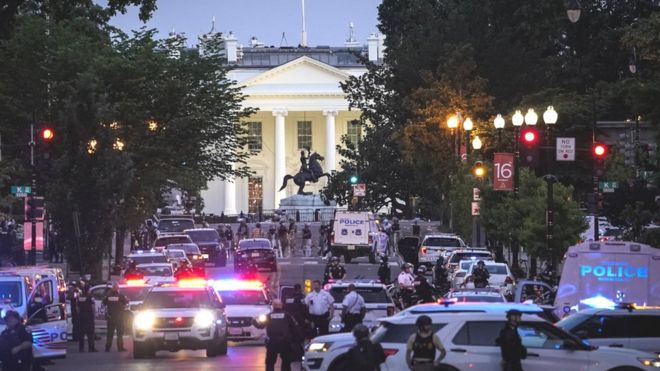
Amid widespread civil unrest in the US, thousands to tweets using the #DCBlackout hashtag claimed that communications had been blocked in the capital to cripple protests.
But there was no evidence of this.
Twitter also said it had banned an account for inciting violence while impersonating a protest group.
The #DCBlackout hashtag trended on Twitter on Monday, with millions of tweets and retweets claiming that internet and phone communications were cut late in the night as the protests continued.
But reporters covering the protests had no such problems, and Twitter collated several of their tweets into a prominent link in Twitter's main website sidebar. An internet monitoring service also said there was no indication of any widespread disruption.
A Twitter spokesperson said the social media site had "suspended hundreds of spammy accounts" that used the #DCBlackout hashtag, citing the company's platform manipulation and spam policies.
Straight from the disinformation playbook
By Shayan Sardarizadeh & Olga Robinson, BBC News
The DC blackout hoax is a classic example of an internet rumour spiralling out of control.
The hashtag first started going viral on Twitter in the early hours of Monday. Panicky messages about a blackout also spread on Facebook, Reddit and later on Instagram too.
Some of the most shared posts were sent by users who were not based in Washington DC or even in the US.
Despite the lack of evidence of a blackout, the hashtag garnered more than 500,000 tweets from 35,000 unique accounts in a matter of hours and became a global trend.
A lot of people are asking me about a possible #dcblackout. I’ve been out near the White House since 4 am and haven’t experienced any outage. My friend and colleague @ABC7HeatherGraf was covering the DC protests last night and was posting multiple updates. pic.twitter.com/ag1cuY3MOD
— Victoria Sanchez (@VictoriaSanchez) June 1, 2020
Concerned residents in and around Washington DC then saw the trend on their social media feeds and began posting about it to find out what was going on.
So by the time Twitter removed it from its "trending topics" list, the claim may have been seen by millions worldwide.
This is a playbook we have seen over and over again.
When a major event is developing, rumours and claims about an emotional topic can go viral without any evidence to support them.
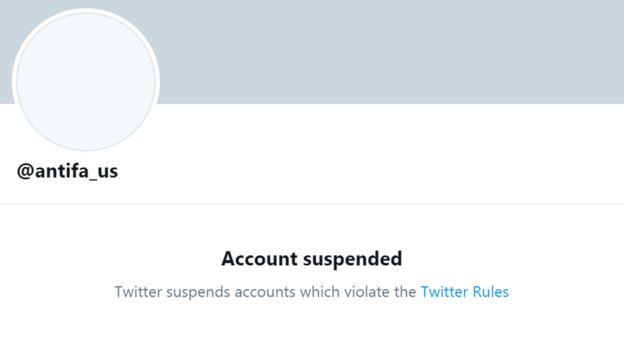
Twitter also suspended another account which claimed to represent the left-wing Antifa group, calling for violence.
But the antifa_us account turned out to be operated by a known white nationalist group operating under an assumed name, Twitter told US media.
Before it was suspended, it tweeted messages including: "Tonight ... we move into the residential areas ... the white hoods ... and we take what's ours".
"Antifa", a contraction of anti-fascist, refers to the loosely-organised far-left protest group that gained fresh prominence in the US after the controversial white supremacist rally in Charlottesville in 2017. Anti-fascists routinely organised counter-demonstrations at far-right events in the months afterwards - sometimes resulting in violent clashes.
The use of the label is controversial because, as the Anti-Defamation League writes, it is sometimes used "to include all counter-protesters, rather than limiting it to those who proactively seek physical confrontations with their perceived fascist adversaries".
Since the outbreak of violent civil unrest, President Trump has blamed Antifa for riots, and declared he would designate it a terrorist group - though it is not not clear he has the power to do so.
A Twitter spokesperson said the company noticed the account after it sent tweets inciting violence, and that it was eventually suspended for violating policies on fake accounts.
Prof Philip Howard from the Oxford Internet Institute said that while Twitter was taking action, conspiracy theories and polarising stories keep returning.
"It is difficult to know how much impact misinformation on any particular topic has. But people do still circulate it," he said.
"The platforms are doing more and more to keep fake news in check. But each platform is different, and a large number of junk news stories come back in new forms, with new links and on new channels, very soon after it gets taken down."
Latest Stories
-
GoldBod must be more accountable to Ghanaians – Haruna Iddrisu
10 minutes -
Affi Agbenyo’s EC appointment is constitutionally appropriate, but politically, people have the right to remind us – Haruna Iddrisu
22 minutes -
Education is critical to Ghana’s future and development – Haruna Iddrisu
41 minutes -
Who’s Emelia Affi Agbenyo, the 43-year-old newly sworn-in Deputy EC Chair?
1 hour -
Haruna Iddrisu calls for limits on annual university accommodation fee increases
2 hours -
Today’s front pages: Tuesday, October 13, 2026
3 hours -
Wealth Over Water: How Galamsey Is Threatening Ghana’s Water Security
3 hours -
LA 2028: Black Queens pumped up for second leg of Mauritius tie
3 hours -
LA 2028: Black Queens hold final training session ahead of second leg against Mauritius
4 hours -
Standards are not Seasonal: What the EC appointments teach both sides
4 hours -
King Mohammed VI urges private sector to create youth jobs and spread benefits of growth
4 hours -
KGL U17 Colts 2026: Greater Accra win title after penalties win over Western Region
4 hours -
UK Investment Roadshow opens in London to advance UK-Ghana growth partnership
4 hours -
Assemblies of God requires pastors to resign before entering partisan politics – Rev. Wengam
5 hours -
Ghana targets 20% annual reduction in maternal deaths – Health Minister
5 hours