

Audio By Carbonatix
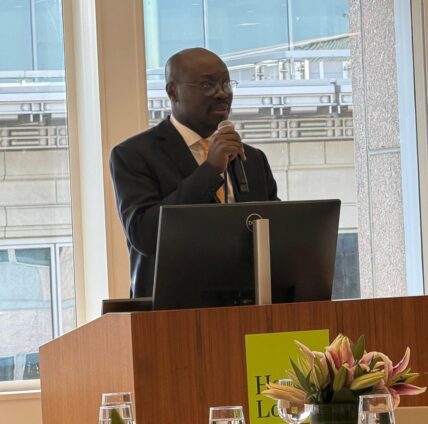
Ghana’s Finance Minister, Dr. Cassiel Ato Forson, has delivered a strong message to international investors, insisting that the country’s economic recovery is real, deliberate, and anchored in deep structural reforms—not short-term fixes.
Addressing investors during engagements on the sidelines of the IMF/World Bank Spring Meetings, Dr. Forson emphasised that the gains recorded in Ghana’s economy are the result of carefully designed policy interventions and legislative reforms.
“These are not cosmetic gains,” he stressed. “They are outcomes of well-thought-through reforms, backed by laws and disciplined implementation.”
The Finance Minister outlined a broad suite of fiscal and structural reforms undertaken to stabilise the economy and restore investor confidence. Central to these efforts has been aggressive waste cutting programme, including a significant reduction in the size of government, with ministers slashed from 123 to 60.
He highlighted the enforcement of a mandatory commitment authorisation regime to strengthen expenditure controls across Ministries, Departments and Agencies (MDAs), alongside amendments to the Public Financial Management (PFM) Act, which introduced new fiscal rules—anchoring a 1.5% primary surplus target and a 45% debt ceiling.
To reinforce fiscal discipline and accountability, government has established key oversight institutions, including an independent Fiscal Council and an Office of Value for Money, aimed at eliminating waste and improving public spending efficiency.
Dr. Forson also pointed to reforms in public funds management, particularly the uncapping of statutory funds to better align spending with national priorities, as well as amendments to the Petroleum Revenue Management Act to prioritise infrastructure investment.
On the revenue side, he noted ongoing reforms in tax administration, including adjustments to the revenue refund system and broader VAT and customs reforms to plug leakages and enhance domestic resource mobilisation.
The mining and petroleum sectors have also seen policy shifts, with royalties restructured and channelled toward large-scale infrastructure financing, while the energy sector has undergone critical reforms, including the operationalisation of a cash waterfall mechanism to improve financial flows and sustainability.
Additional interventions include payroll audits and verification exercises to eliminate inefficiencies, as well as rationalisation of government programmes to reduce duplication and improve targeting. The cocoa sector, through COCOBOD, has also been restructured to enhance operational efficiency, while social protection programmes have been expanded to cushion vulnerable populations.
Beyond fiscal measures, the Minister underscored improvements in Ghana’s macroeconomic fundamentals. Growth has exceeded expectations, driven by strong performance in services and agriculture, while inflation continues to decline steadily, supported by tight monetary policy, fiscal consolidation, and a strengthening cedi.
He further noted that Ghana’s external position has strengthened significantly, underpinned by robust gold and cocoa exports, alongside improved international reserve accumulation, which has exceeded targets under the IMF-supported programme.
“These reforms have translated into tangible market outcomes,” Dr. Forson said, citing a sharp decline in domestic and Eurobond yields, as well as recent sovereign rating upgrades, reflecting renewed investor confidence.
According to him, Ghana’s public debt trajectory has improved markedly, with debt restructuring nearly complete and the country remaining current on its debt service obligations.
One after the other, investors at the meeting expressed strong admiration for Ghana’s reset agenda, commending the depth of reforms and the tangible progress achieved in stabilising the economy and restoring credibility.
Looking ahead, the finance minister assured investors that government remains committed to sustaining the recovery by deepening structural reforms, maintaining fiscal discipline, and prioritising productive investments.
“The gains we achieved in 2025 provide a solid platform for continued recovery and policy predictability,” he said. “Our focus now is to consolidate these gains, strengthen confidence, and build a more resilient and inclusive economy.”
Latest Stories
-
Hawa Koomson pledges experienced and mature leadership of NPP women’s wing
32 minutes -
Young woman found dead at Kasoa Peace Town
1 hour -
Playback: The Law examined lawful arrest in Ghana
1 hour -
Mahama urges African governments to treat healthcare as an investment, not budget cost
2 hours -
Bawumia congratulates John Boadu and new NPP executives, pledges support ahead of 2028
2 hours -
‘No talent should be left out’ – Bawumia pledges inclusive NPP campaign for 2028
2 hours -
Prof. Mike Oquaye recounts how he blocked the Special Prosecutor’s attempt to arrest Bawku Central MP
2 hours -
Make health sovereignty a priority for Africa – Mahama
3 hours -
Dorimon Naa, Wa West DCE lead massive clean-up exercise; threaten sanctions against recalcitrant residents
3 hours -
Photos from Adom FM Y2K Jam
3 hours -
Praye Tiatia steals the show at Adom FM Y2K Jam [Watch]
3 hours -
Boakye Agyarko congratulates John Boadu, pledges support for NPP leadership
3 hours -
Antwi HiMight thrills fans with Antwi ne Antwi hits at Adom FM’s Y2K Jam [Video]
4 hours -
Amb. Edward Boateng congratulates Boadu, Kodua on election wins
4 hours -
John Boadu pledges to rebuild NPP from grassroots and restore ‘winning machinery’
4 hours