

Audio By Carbonatix
The government has begun rehabilitating key irrigation infrastructure across the country as part of efforts to boost food production and secure Ghana’s food supply.
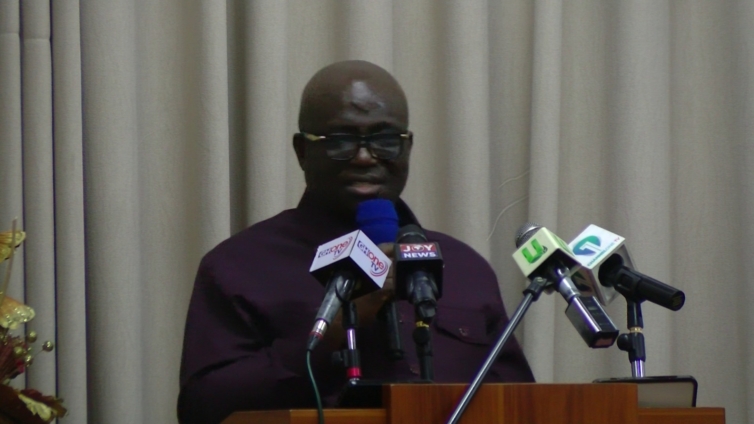
Speaking at a stakeholder engagement workshop at the Council for Scientific and Industrial Research Policy Institute (CSIR-STEPRI) in Accra, Minister for Food and Agriculture, Eric Opoku, said irrigation is central to the government’s strategy under the Feed Ghana Programme to achieve food security and support the 24-hour economy.
“Without irrigation, it will be difficult for Ghana to have food security.
As part of the measures under the Feed Ghana programme to boost food production, ensure food security, and engender economic transformation, we want to provide irrigation to cover a land area of 100 hectares and allocate the land to farmers to produce food all year round to support processing and the 24-hour economy,” Mr. Opoku stated.
He revealed that the government is rehabilitating existing irrigation facilities in areas such as Ashaiman, Aveyime, Wheta, and Via, among others.
The Minister added that new irrigation projects will also commence soon to expand agricultural capacity.
“In fact, in the coming weeks, I will be in the Ashanti Region to cut sod for the commencement of irrigation development in Enumso, Wemu, and several other communities around that enclave,” he announced.
The workshop brought together peasant farmers, civil society groups, policymakers, and community leaders to discuss strategies for safeguarding the nation’s food supply and to adopt the new 10-year Comprehensive Africa Agriculture Development Programme (CAADP) framework, known as the Kampala Declaration, alongside the ECOWAS Agricultural Policy (ECOWAP).
Wepia Addo Awal, President of the Peasant Farmers Association of Ghana, welcomed the government’s plans but emphasised the need for timely delivery and accountability.
“We are very happy with what he has said. The only thing, like I said, is that once we are on the ground, we’ll monitor to see, and we expect to see that on time because the farmers are ready to go into production to support the government to increase food supply in this country,” he said.
He also highlighted the link between agricultural investment and inflation reduction, noting that increased food production is vital for stabilising prices.
“If you look at inflation coming down, the component of food inflation is what is driving the general inflation down.
If the Minister of Finance wants to bring inflation to a single digit, this can only be done with greater investment in agriculture for us to produce more and stabilise food prices,” Mr Awal stressed.
The Feed Ghana Programme is a key government initiative aimed at positioning agriculture as a driver of economic growth, job creation, and food security, ensuring that Ghana becomes more self-sufficient while supporting agro-processing and export potential.
Latest Stories
-
FoSCel foundation calls for end to stigma and stereotyping against people living with sickle cell disease
56 seconds -
Auditor-General to track audit recommendations as GH¢280.5m in surcharges remains unpaid
1 minute -
Walewale MP withdraws ‘rude’ comment on Bagbin’s Parliament recall, apologises
18 minutes -
FoSCel founder urges curriculum reform to strengthen sickle cell education in Ghana
25 minutes -
United States launches America.Gov for public services 5 years after Dr. Bawumia launched Ghana’s version Ghana.Gov
37 minutes -
Cocaine probe: Majority used super majority with Speaker’s support to weaken Parliament – Afenyo-Markin
40 minutes -
UGMC Research Director urges stronger clinical trials to bridge gap between research and patient care
50 minutes -
IEAG calls on FDA to resolve delays in import code issuance
50 minutes -
UGMC research must translate laboratory findings into healthcare solutions – Prof Evelyn Yayra Bonney
1 hour -
Court remands 3 over alleged gold concentrate robbery
1 hour -
Two bodies stuck at St. Anne’s mortuary after refrigeration engines break down
2 hours -
‘We will not let this matter rest’ – Afenyo-Markin after Bagbin rejects narcotics probe
2 hours -
AFCON 2027Q: Ghana suffer 4-2 defeat to Gambia
2 hours -
Your strike could disrupt academic calendar – GES urges teachers to return
2 hours -
Speaker’s ruling has failed integrity test required of Parliament to discharge its duties – Afenyo-Markin
2 hours