

Audio By Carbonatix
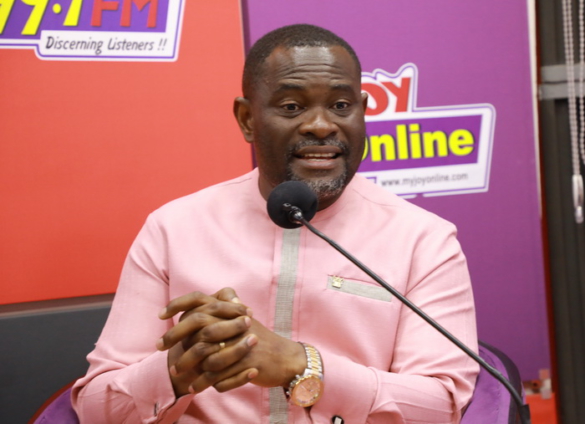
Deputy Finance Minister Dr John Ampontuah Kumah is assuring the public of government’s resort to restore public debt sustainability in order to recover the economy.
He says government intends to undertake structural reforms such as; introducing tax policy reforms, revenue administration changes and public financial management systems.
According to him, sectors which also require optimum attention include the cocoa and energy sectors, stating that the expenditure inefficiency and the issue of lack of consistency in the payment of monies to sustain electricity flow need to be addressed respectively.
“We also want to focus on certain structural deficiencies in the economy. For instance, the cocoa sector; the amount of expenditure inefficiencies in the cocoa sector have to be addressed.
“The energy sector; the Independent Power Producer (IPP) commitment and regular payment you need to do to sustain the electricity to be on – some efficiencies have to be improved,” he said on JoyNews’ Newsfile on Saturday.
He added that should the inefficiencies that have characterised government’s expenditure be addressed, arguments against its flagship programmes would become mute.
Speaking on government’s flagship programme, the minister argued that the flagship programmes are necessarily not the cause of Ghana’s fiscal issues.
He cited that government’s budget for 2023 was about ¢190 billion. Out of this, he said ¢56 billion has been apportioned for debt repayment whereas ¢45 billion is going into compensation and wages.
Another ¢35 billion has been budgeted for statutory payment obligations and about ¢16 billion for goods and services.
According to him, budgetary allocation for government’s Free S.H.S policy for 2023 was just ¢2.9 billion, an amount to educate “1.3 million of the population,” adding that there is nothing wrong with that.
Dr Kumah, therefore, speculated that people arguing that the government’s flagship programmes are incurring fiscal challenges are just being sentimental. He expressed that contrary to the perceptions, debt obligations have been responsible for the fiscal challenges. This, he said informed the government’s pursuit of an International Monetary Fund (IMF) programme.
Latest Stories
-
President Mahama ends Resetting Ghana tour of Ahafo Region
2 hours -
African negotiators seek delivery of climate commitments at COP31
2 hours -
BoG develops AI rules for financial sector
2 hours -
‘Big Push’: Government assures contractors of prompt payments
2 hours -
Court fines miner for breaking into gold buying shop
2 hours -
Tarkwa court jails labourer for three years over GH¢123,000 theft
3 hours -
GAEC must retain nuclear scientists for Ghana’s nuclear ambitions – Minister
3 hours -
Man reportedly mistaken for game and shot by hunter dead in forest
3 hours -
19-year-old mason jailed 15 years for defiling seven-year-old pupil
3 hours -
Ghana’s banking sector assets rise 20.47% to GH¢500.2bn – BoG Governor
3 hours -
22 injured as Sprinter bus overturns at Sege after tyre burst
4 hours -
UN housing expert urges Ghana to strengthen Rent Control Department amid housing affordability concerns
4 hours -
Delta-BCI partnership reaches 166,000 people with breast cancer education
4 hours -
Power restoration fault suspected in Kumasi Central Market fire
9 hours -
The 7-foot giant of Ngleshie Amanfro: Seven-foot Ghanaian Ephraim Saawa dreams of joining the national basketball team
10 hours