


Audio By Carbonatix
How much rest do we think we need, who is getting the most, and what are the most restful activities? The results of the world's largest survey on rest indicate that to feel truly rested, a lot of us want to be alone.
Last November an online survey called The Rest Test was launched to investigate what rest means to different people, how they like to rest and whether there is a link between rest and well-being. The results are now in and the analysis has begun.
Rest sounds easy to define, but turns out to be far from straightforward. Does it refer to a rested mind or a rested body? Actually, it depends. For some, the mind can't rest unless the body is at rest. For others it is the opposite. It is the tiring out of the body through vigorous exercise that allows the mind to rest - 16% of people said they find exercise restful.
Altogether, 18,000 people from 134 countries made time to take part in what was quite a lengthy survey devised by Hubbub - an international group of academics, artists, poets, and mental health experts - showing perhaps what a pressing issue rest is in the modern world.
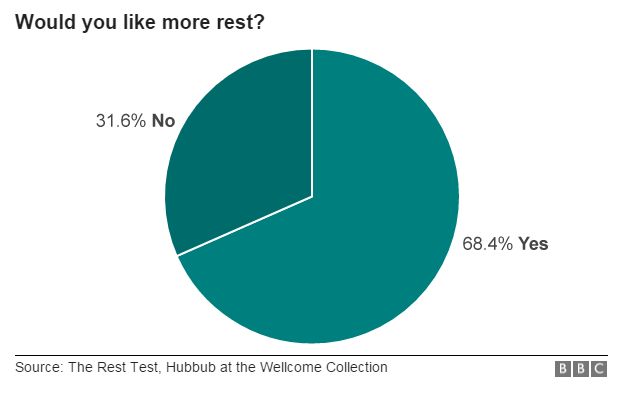
Just over two-thirds of respondents said they would like more rest. Almost a third thought they needed more rest than the average person, while 10% thought they needed less than average.
One question asked people how much they had rested the previous day, leaving them free to define rest in any way they wanted to. The average was three hours and six minutes.
Another gave people a long list of activities, asking them to rank the three most restful - and the results were unexpected.
Reading came out as the clear winner, followed by being in the natural environment, being on your own, listening to music and doing nothing in particular.
What is striking is that all these are activities often done alone.
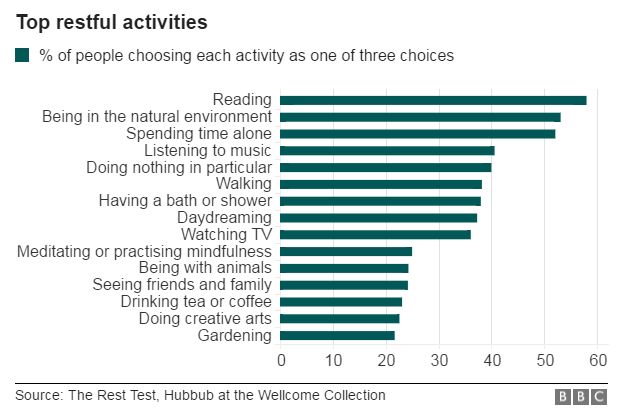
Could it be that what we really want, in order to rest, is respite from other people?
Seeing friends and family, chatting or drinking socially all come much lower down the list. This doesn't mean that the respondents don't like socialising, but that they don't consider it to be particularly restful.
Interestingly, this applies both in the case of extroverts - sometimes defined as people who gain energy from being around others - and introverts, who find other people draining. Extroverts do place chatting and socialising a little higher up the chart, but still they are beaten by solitary activities.
We need to remember, of course, that choosing to be alone is very different from enforced loneliness.
The Rest Test
 Image copyrightTHINKSTOCK
- The Rest Test is a collaboration between BBC Radio 4 and the Wellcome Collection's researchers in residence, Hubbub
- Hubbub is an international collective led by Durham University, comprising scientists, artists, poets, humanities researchers, mental health experts and social scientists - among them the BBC's Claudia Hammond, presenter of All in the Mind
- Some 18,000 people from 134 countries took the survey - they were self-selecting, not randomly chosen
- The biggest survey of rest before this was a fraction of the size, based on data from little more than 1,000 people.
The reason people want to be alone might be explained by the answers people gave when they were asked what is going on in their minds while they do different activities.
"People said that when they were on their own mostly they were focused on how they were feeling, so on their body or their emotions," says Ben Alderson-Day, a psychologist from the University of Durham, who co-wrote the survey.
The idea that when people are alone they are mentally talking to themselves is only partly true, it seems.
"People said they were only talking to themselves in their head 30% of the time," says Alderson-Day.
"There is a hint that when you're on your own, as well as switching off from other people, you get the chance to switch off from your own inner monologue as well."
But just because we're on our own doing nothing, that doesn't mean the brain is resting. Neuroscientists used to think that the brain was less active whenever we stopped concentrating on a task, but late in the 20th Century studies using brain scanners threw up some curious findings and they realised they had got it wrong.
When we are at rest, supposedly doing nothing, our minds have a tendency to wander and our brains are in fact busier when we're not concentrating on a task, than when we are.
These days it's common to hear the complaint that rest is hard to find. So what if we don't have enough time to do these restful activities? Does it matter?
Possibly.
Latest Stories
-
Four family members burnt to death in fire at Apemanim Number Two
7 minutes -
Comfort Jehu-Appiah
17 minutes -
Afoko can help rebuild NPP and bring back disgruntled members – Political Scientist
23 minutes -
Too early to say if Iran involved in Dubai-Tel Aviv flight attack, Israeli PM says
34 minutes -
Ghana’s trade surplus shrinks by 70% to US$1.3bn in quarter 2, 2026 – GSS
37 minutes -
KMA orders traders and garage operators to vacate Abrepo ahead of Suame Interchange works
37 minutes -
Ankrah’s removal should not end accountability over World Cup visa controversy – Ekow Assafuah
39 minutes -
You have 24 hours to vacate – AMA Mayor warns squatters after Avenor fire outbreak
41 minutes -
Western Region teacher unions reaffirm strike over unpaid allowances and promotion concerns
44 minutes -
Prof. Emmanuel Sarpong replaces Yaw Ampofo Ankrah as National Sports Authority boss
48 minutes -
Agric Committee in Parliament calls on Finance Minister to fund timely completion of Farmers Service Centres
50 minutes -
GABET raises concerns over teacher training and resources for new SHS curriculum
52 minutes -
Daily Insight for CEOs series
1 hour -
Government moves to make public institutions buy from Ghanaian farmers
1 hour -
Diesel price to remain below GH¢20 per litre in October after government intervention – NPA
1 hour