

Audio By Carbonatix
A shift to a digitalized economy combined with enabling sound government policies can improve economic efficiency in all sectors.
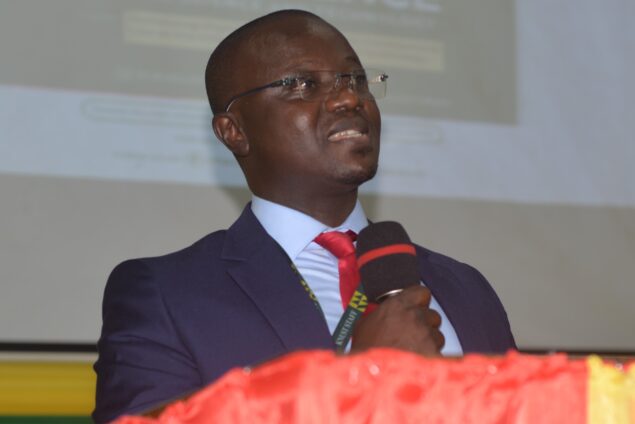
That is according to the Dean of the Faculty of Law of the Kwame Nkrumah University of Science and Technology, Dr. Ernest Owusu-Dapaa.
He was speaking at the maiden edition of an KNUST Faculty of Law International Conference on Law, Science and Technology.
The conference is under the theme: “Harnessing Digitalization for Economic Development: Law at the intersection of science and technology."
The conference attracted renowned academics and legal experts in the field of law, science and technology and other intersecting disciplines.
Participants discussed key challenges that require a targeted and nuanced understanding of the cross-cutting nature of digital transformation and its policy dynamics in Ghana and Africa.
Dr. Ernest Owusu-Dapaa said the initiative is in line with the faculty’s aim to make their activities available for national benefit.
“As a learning community, we have a duty to undertake research to generate knowledge and disseminate the same to support sustainable industrial and socio-economic development.
“Through this conference, we will build, reinforce and scale up innovative solutions to improving the legal channels that can be adopted in response to potential challenges that will emerge from our digitalization drive,” he said.
Vice-Chancellor of KNUST, Prof. Rita Akosua Dickson emphasized the university’s commitment to improving the digital space.
“We will continue to research and develop applications, software and programmes to help drive the digitalization agenda. Not only in the justice delivery system but for the common use of the ordinary Ghanaian,” she said this in a speech read on her behalf by the Pro Vice-Chancellor, Prof. Ellis Owusu-Dapaa.
A computer engineer, Prof. Kwame Osei Boateng called for policies to realize the gains in digitization.
“We have to ensure a sufficient level of internet infrastructure development and digital education and also to reduce the digital divide.
“This brings policy makers face to face with challenges of harnessing the maximum benefits of digitalization,” he noted.
The conference is divided into 6 cardinal themes aimed at providing insights into the interface of the law, its boundaries with science and technology.
These include; Technology and the Court, Technology and Medical Law Issues, Rights to Privacy and Technology, Emerging Technology and the Law, Digitalization Law and Ethics and Technology Commerce and Banking.
Dr. Owusu-Dapaa revealed that all accepted and presented papers at the conference will feature in the maiden edition of the International African Journal of Law, Science and Technology.
Latest Stories
-
Fitch Solutions maintains its policy rate forecast of 14% by December 2026
3 minutes -
Diaspora Nasara Caucus congratulates Mohammed Ali Suraj, new NPP executives
2 hours -
Dr Antwi-Boasiako’s cybersecurity book showcased at UN crime prevention congress
2 hours -
We will empower the grassroots and protect every vote – NPP’s 1st Vice Chair Kojo Bamba
2 hours -
I do not see myself as better than anyone – NPP’s 1st Vice Chair Kojo Bamba
2 hours -
Police blur the line between invitations and arrests – Reindorf Twumasi Ankrah
3 hours -
Turning invitations into arrests is making citizens reluctant to assist police – Twumasi Ankrah
4 hours -
The Traffitech-GH SMS spot-fine system: The good, the sad, and the funny – Bright Simons writes
4 hours -
Hawa Koomson pledges experienced and mature leadership of NPP women’s wing
5 hours -
Young woman found dead at Kasoa Peace Town
5 hours -
Playback: The Law examined lawful arrest in Ghana
6 hours -
Mahama urges African governments to treat healthcare as an investment, not budget cost
6 hours -
Bawumia congratulates John Boadu and new NPP executives, pledges support ahead of 2028
6 hours -
Aksa Energy delegation pays courtesy call on GRA Commissioner-General
6 hours -
‘No talent should be left out’ – Bawumia pledges inclusive NPP campaign for 2028
6 hours