

Audio By Carbonatix
Students in tertiary institutions worry face to face teaching is gradually becoming a drawback in accessing higher education.
Socio-economic background and geographical location have excluded some groups from learning in institutions offering exclusive in-person classes.
This is slowing down the progress of education.
In-person teaching and learning has been the traditional way of learning for decades.
However, as the student population increases in all tertiary institutions, lecturers and teaching assistants find it hard managing class sizes.
On the other hand, students disregard unfavorable weather conditions to attend lectures or submit assignments.
Both parties describe this as tedious and worrisome. Benedict Afriyie, is a student at the Kwame Nkrumah University of Science and Technology.
“In class, I am unable to hear the lecturer. Usually, the lecturers do not use microphones. Sometimes, the class is so huge you will not find a sitting place. There are times we walk all the way from our hostels to submit assignments,” he revealed.
Tertiary institutions struggle with space for lessons. Emmanuella Gidi, a student lives farther from the university.
She reveals some of her colleagues have missed examinations and class hours due to change of venues for lectures.
“I live at Boadi and come to Kotei for lectures daily. It is quite a distance. I wake up early and rush is. Getting a shuttle from Boadi to campus is a struggle. My colleagues and I missed lectures a few times,” she said.
Frank Boateng Agyemang, a student, is intimidated speaking in front of a class of over 200 students
This has limited his interaction and opportunity for valuable feedback.
“Questions are asked and you will see the supposed brilliant students answering fiercely. This makes us question our intelligence,” he revealed.
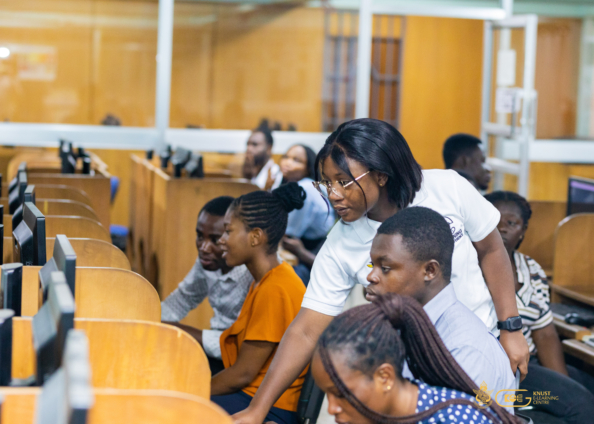
The E-Learning Centre of the Kwame Nkrumah University of Science and Technology seeks to open up education to more people by offering online learning courses
The Centre is tutoring Teaching Assistants in the university on the usage of online platforms for teaching and learning.
“They are going to offer teaching assistance to students who may be familiar with online platforms. This means they must always be a step ahead,” said Professor Eric Appau Asante, Director of KNUST E-Learning Centre.

Latest Stories
-
World Bank maintains Ghana’s growth rate forecast at 4.8% in 2026
58 minutes -
Cedi was worst African currency in quarter 2, 2026 – World Bank
1 hour -
AI gains can lift three times as many people out of poverty in Ghana – World Bank
2 hours -
Police arrest suspect over jewellery theft during fire outbreak
4 hours -
EOCO returns Hanan’s £6,700, GH¢2,750 and devices after defence challenge
4 hours -
Opplift Youth Entrepreneurs Summit 2026 equips entrepreneurs with skills, mentorship and support
4 hours -
Rival clubs want range of punishments for Man City
5 hours -
Tear gas in Paris and Marseille as school protests grow across France
5 hours -
Kane inspires England to win over Czech Republic in UEFA Nations League
5 hours -
Finland orders halt to work on two Google data centres
5 hours -
Substitute Merino scores twice as Spain win in Croatia
5 hours -
Ronaldo wants Portugal ‘punishment’ but not retiring
5 hours -
White House defends Trump comment to let Iran ‘take out’ LA and San Diego
5 hours -
Asos confirms hackers sent ‘unauthorised’ notification to app users
6 hours -
US televangelist Jim Bakker, disgraced from sex scandal and fraud, dies at 86
6 hours