

Audio By Carbonatix
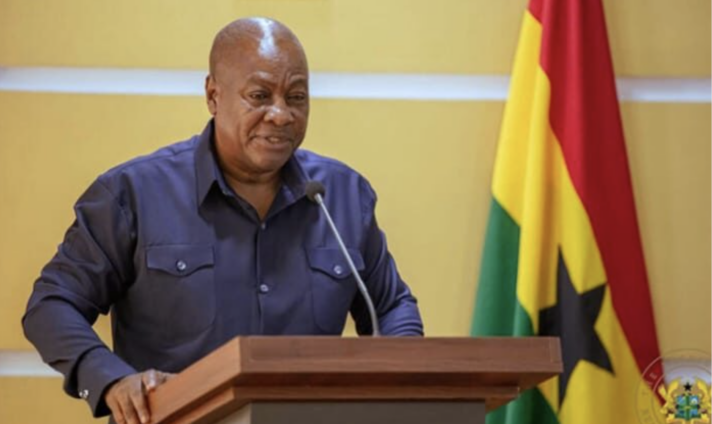
President John Dramani Mahama has urged Ghanaians to adopt a more disciplined and forward-looking approach to national development, warning against what he described as a “vulture-like” attitude of short-term memory and cyclical neglect of responsibility.
Addressing the recent flooding situation in parts of Accra, Mr Mahama said it was time for citizens to abandon complacency in the face of recurring environmental challenges, stressing that collective action was required to prevent the annual destruction caused by heavy rains.
He drew a metaphor of a vulture often associated in popular narrative with inconsistency and forgetfulness, suggesting a pattern where people lament disaster during rainy seasons but gradually return to normal habits without sustaining preventive measures when conditions improve.
"We have to do some soul searching. I think the government must be firm in doing what it has to do in order that we stop the perennial flood issues. We shouldn't be like the vulture, who says it will repair his roofs when the rains stop, when the rains stop, he forgets about it until the next rains come, and it promises again to repair the roofs. This time, we have to really work and repair it," he said while speaking upon his arrival at the Accra International Airport from the UK and Belarus.
According to him, this behavioural cycle undermines long-term planning and weakens efforts to build resilience in rapidly urbanising areas.
He noted that public opposition to the demolition of structures at Ramsar and protected waterway sites had, in many cases, complicated attempts by authorities to enforce planning regulations aimed at reducing flood risk.
"When the Greater Accra Regional Minister and her team went out and demolished houses built in the wetlands, people say the government is inhuman. But it is also partially the fault of those who sold those lands and also the fault of our assemblies and officers who grant the permits," he said.
He further expressed concern over widespread encroachment on waterways in Accra, linking such practices directly to the severity of recent floods.
"We build everywhere. This is a concrete jungle. In many places, in many countries, there are green spaces that soak up the water. In Accra, there is nowhere; the only place left is the children's park and the Achimota forest, and even that one is in danger of being bequeathed to successors and made part of people's wills."
"We need to address this issue of flooding," he added.
Latest Stories
-
The 7-foot giant of Ngleshie Amanfro: Seven-foot Ghanaian Ephraim Saawa dreams of joining the national basketball team
31 minutes -
Government promises support for Kumasi Central Market fire victims
37 minutes -
Vibes The Movie: Big Ghun’s Ghanaian film earns five nominations at 2026 REFFA
1 hour -
MamaCare CEO warns unresolved conflicts among health workers could undermine maternal and neonatal care
2 hours -
Health professionals urged to translate medical knowledge into practice to save mothers
2 hours -
Conflicts among care providers linked to maternal, neonatal deaths – Expert
3 hours -
GIS marks 10th TIME conference, champions improved teaching practices
3 hours -
BRICS Or Balance? What Ghana’s bid really means
4 hours -
GPRTU wants full TRAFFITECH-GH implementation to start in 2027
4 hours -
Mahama announces plans to import electric wheelchairs for PWDs
4 hours -
KGL U17 Colts 2026: Western beat Prempeh Elite Academy to set up final final with Greater Accra Region
4 hours -
Late Solanke strike salvages 10-man Spurs draw at Man United
5 hours -
Gender Ministry to monitor welfare of Nana Akua Addo’s children amid domestic violence case
5 hours -
Benedict Okyere Yeboah: Ghana’s football problem goes beyond sacking a coach
5 hours -
GPL 2026/27: Darkwah Wiafe’s winner sees All Blacks beat Kotoko
5 hours