

Audio By Carbonatix
"Water no get enemy."
If you're West African, chances are you didn't read those words. You sang them, recalling Fela Kuti’s classic. But long before Fela, Water no get enemy was already a proverb, and the older I get, the more I realise that it was never really about Water at all. It was about humility.
I have thought about that proverb repeatedly this rainy season, as I’ve been asked the same question again and again. “Why didn’t Kantamanto flood this year?” Kantamanto, in the heart of Accra, is one of the world’s largest secondhand clothing markets where up to 30,000 traders, retailers, upcyclers and more work symbiotically and move through tightly packed lanes, many of which, during periods of heavy downpour, have historically turned to standing water in minutes. Stock is damaged, trade is halted. But this year was different. Not due to luck, but because of months of arduous work that most of the city wasn’t even aware of.
As a bioengineer, I probably should have spent more time obsessing over DNA or proteins, but I found myself repeatedly distracted by water. A molecule made of just two hydrogen atoms and one oxygen atom that expands when it freezes, making ice float instead of sink. It absorbs enormous amounts of heat, quietly regulating the Earth's climate. It dissolves, transports and transforms almost everything it touches and yet has an extraordinary habit of making life possible. The more I studied it, the more I understood the proverb.
Water doesn't negotiate. It doesn't care how much money we spent paving a road or how confident we are in our engineering. It simply follows gravity, moving according to laws that long predate cities by millennia. Every rainy season in Accra, we're reminded of this. Toni Morrison once wrote that "all water has a perfect memory and is forever trying to get back to where it was." That line describes June in Accra better than any planning document could.
We often describe Accra as a city vulnerable to flooding, but perhaps a more accurate analysis is that Accra is a vast coastal wetland that we have spent more than a century asking to behave like a European city. Long before roads crisscrossed the city, this landscape was a network of lagoons, marshes and floodplains that absorbed rainfall and carried it gently towards the Gulf of Guinea. Colonial planners treated that wetland as empty land waiting to be reclaimed, believing that rivers could be confined and that concrete represented progress. Independence changed who governed Accra, but not always the assumptions underpinning how it should grow.
Water, meanwhile, continued consulting a much older map, returning every rainy season to the places we paved over and reminding us that landscapes have longer memories than cities do.
So Kantamanto did not flood this year. For the first time in over two decades. Not because we somehow outsmarted the water, but because we spent months making it a little easier for Water to do what it has always wanted to do. Because impactful flood prevention cannot simply begin when the clouds gather.
Over the past several years, I've had the privilege of being part of the team building The Or Foundation's Community Ecological Care Network (CECN) alongside retailers, waste workers, scientists and community leaders across Accra. Together, we've come to see ecological care not as charity or volunteerism but as an essential part of how a city functions.
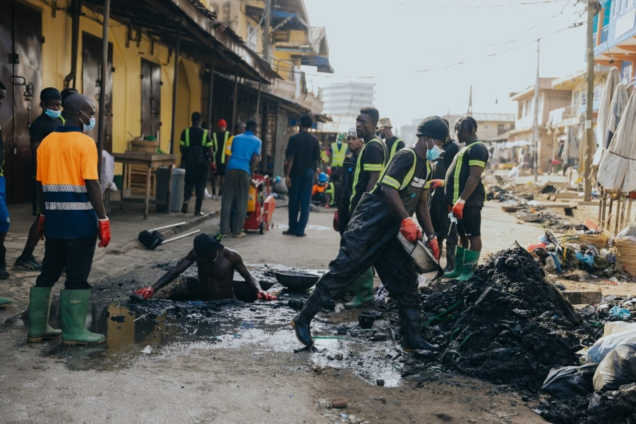
Ahead of this year's rainy season, that meant working with the Accra Metropolitan Assembly and the market leadership to clear the canal into which much of Kantamanto's drainage eventually empties, excavating an informal dumpsite that had gradually narrowed the Water's path by removing over 100 truck loads of waste and preparing the system before the rains arrived. It meant deploying more than 150 members of our Tide Turners and June 4 Task Force cooperatives into the underground Okai Kwei storm drain to remove years of accumulated silt, plastics and textile waste from a drain that had reportedly never been desilted since it was constructed in the 1980s. It meant recovering the waste that has ended up at the beach by removing an average of 30 tons every Tuesday and monitoring a 7km stretch of coastline every week to track progress and locate hotspots. It means maintaining plastic interceptors that prevent floating waste from travelling further downstream, diverting textiles before they could become blockages and working day after day to keep drainage pathways open rather than waiting for them to fail.
And alongside these cleanup and remediation efforts, the Kanta Keepers cooperative cleans Kantamanto every evening, diverting textile waste from entering the drainage network or being disposed of through open burning. Some of the collected waste makes its way to our Material Transformation & Technology Lab (MTTL) where our team recycles this waste into new materials and products using innovative home-grown recycling methods.
At the same time, community ambassadors monitor flood-prone areas, document blocked drains and report emerging issues, while citizen scientists collect environmental data that help identify recurring patterns and guide interventions across the watershed. Together, through consistent daily activities, we have built the kind of environmental memory that cannot be captured in a single satellite image or one-off assessment.
None of these interventions are particularly glamorous – most happen on ordinary Wednesdays and rarely make the evening news. But taken together they reveal something that is too often overlooked: infrastructure is only as resilient as the social systems that care for it. A drain that nobody maintains quickly stops functioning as infrastructure, and rather can become a dangerous and destructive problem. A flood map is only useful if someone notices when the landscape changes. Engineering matters, but so does stewardship.
At The Or Foundation, our mission is to catalyze a Justice-led Circular Textiles Economy by embracing Community Ecological Care. Perhaps community ecological care is best understood not as a substitute for public infrastructure but as the living system that allows public infrastructure to do what it was designed to do.
This year's rains offered a glimpse of what that partnership can look like. Our community ambassadors reported no flooding within Kantamanto's market, not because the rain was less intense or because climate change took a day off, but because months of consistent maintenance, textile diversion, ecological restoration and collaboration had improved the market's ability to move water through a landscape that has always known where Water wants to go.
It has been encouraging to see renewed public investment in flood prevention and urban sanitation across Accra. As our government continues this important work, I hope we also broaden our understanding of who holds expertise. Communities are not simply there to participate after strategic decisions have already been made. Years of ecological stewardship, environmental monitoring and lived experience have produced knowledge that can help shape those decisions from the beginning in order to turn strategy into sustained change. The future of climate adaptation will depend not only on better infrastructure, but on better partnerships between engineers and retailers, scientists and waste workers, local government and local knowledge.
Water no get enemy. Fela may have known something we are only now beginning to rediscover - the goal was never to conquer water. It was to build cities humble enough to live with it.
*******
The writer, Katia Osei, is the Head of Environmental Justice at The Or Foundation
Latest Stories
-
Ghana Psychological Association calls for greater involvement of people with lived experience in mental health care
1 hour -
Ablakwa says Ghana could evacuate more citizens from South Africa if the situation worsens
2 hours -
Violence against girls must be tackled through individual responsibility – Gender advocate
2 hours -
Ghana’s BRICS bid must be guided by national interest – International Affairs Analyst
2 hours -
Journalists look back on a decade of breast cancer reporting in Ghana
2 hours -
President Mahama ends Resetting Ghana tour of Ahafo Region
4 hours -
African negotiators seek delivery of climate commitments at COP31
4 hours -
BoG develops AI rules for financial sector
4 hours -
‘Big Push’: Government assures contractors of prompt payments
4 hours -
Court fines miner for breaking into gold buying shop
5 hours -
Tarkwa court jails labourer for three years over GH¢123,000 theft
6 hours -
GAEC must retain nuclear scientists for Ghana’s nuclear ambitions – Minister
6 hours -
Man reportedly mistaken for game and shot by hunter dead in forest
6 hours -
19-year-old mason jailed 15 years for defiling seven-year-old pupil
6 hours -
Ghana’s banking sector assets rise 20.47% to GH¢500.2bn – BoG Governor
6 hours